Service Activity Updates at Olin!

Red Cross Blood Drive: Organized by Michael Resnick
On Friday, October 16th the Red Cross will be on campus from 11:00am to 5:00pm to collect blood donations!
To volunteer at the registration desk and snack table, which needs about 10 people, or to donate blood please see Michael’s email for the sign-up sheet and more information.

Big Brother Big Sister College Campus Program: Olin and Babson College
Two Oliners are participating as a Big!
The Bigs have been assigned will travel to their Little’s community for their first meeting in the third week of October!

E-Disco:
Adam and Doyung have spent the summer working on renovating the E-Disco/SERV stockroom to create a better space to support collaboration and ideation for their events and activities in the community.
The E-Disco team spent the summer restructuring the program. More experienced E-Disco member will mentor new members in designing a course, connecting with interesting schools, and teaching their course.
E-Disco members will do weekly or bi-weekly activities, such as Bottle Rockets and Storybook Engineering throughout the Fall.

Jimmy Fund Walk: Olin College Group organized by Sally Phelps
On Sunday, Sept. 27th, 8 members of the Olin community walked 13 miles (2nd half of the Boston Marathon) in honor of Michael Moody, Olin’s former VP of Academic Affairs, as well as other friends and family members who have fought, or are currently fighting cancer!
You can still help the team by donating up until October 19th! Please contact Sally Phelps for the team page.

Hub on Wheels: Organized by Human-Powered Vehicle
On Sunday, September 20th, eight Oliners (and two alum!) volunteered at the Hub on Wheels bike ride in Boston, some helping at registration and others riding as bike marshals.

Peer Advocates: Team of Twelve Students; Led by Ellie Funkhouser and Jessica Diller
The Peer Advocates team has been busy getting trained and planning community outreach and education and seminar events within Olin and with outside advocate organizations like BARCC, REACH, and Babson and Wellesley peer advocate programs

“Universal Access” Adaptive Biking Program: Led by Mary Martin as part of Sara Hendren’s Assistive Adaptive Work
Sara and Mary are proposing a new adaptive biking program in Cambridge on Memorial Drive next summer has been proposed to make the current weekly “Riverbend Park”—which closes all four lanes on Sundays from 12-6 in the summer—more accessible to people with disabilities who want to use adaptive biking gear and other “universal” wheeled mobility.
The future volunteer program will connect people who couldn’t ride bikes on their own with volunteers who can assist, creating both a fun activity for the people involved and raising awareness about accessibility. The work involves creating a volunteer training and schedule, working with accessibility experts and the park district, getting donated or funded bikes of all kinds arranged, etc.
Talk to Mary Martin or Sara Hendren if you would like to learn more about the proposal and development of the program

The Food Recovery Network: Led by Mackenzie Frackleton with GROW
Partnering with the Food Recovery Network to donate uneaten, prepared food from the dining hall to the Salvation Army to combat both wasted food and hunger
Currently scheduling the first date for donation!

Reusable Travel Mugs in the DH: Led by Ruby Spring, Celina Berkins, Anisha Nakagawa and Aaron Greiner with GROW
Waiting on the final purchasing permission to get reusable cups in the DH to reduce the number of disposable cups used
Will be looking for volunteers to help collect mugs from bins in the dorms and AC in the Fall

SERV can make transportation more accessible for people doing service activities off-campus! Please contact us for more information on transportation methods and support if you are interested.

Do you participate in service-related activity within or outside of Olin? If so and you would like your work to be included in Service Updates in future Frankly Speaking issues, please email Kelly Brennan & Michael Searing.
Community, Not Class

Can you subtract by four? Could you switch out a single word from your daily discourse? Then you, my friend, are capable of making a language shift that will both change Olin’s culture and better reflect who we are. I’m talking about “Community Identification.”
What is this change? Easy. Stop identifying by graduating year, and instead identify by the year you started being a part of the Olin community. For example, instead of saying that the current first-years are the “Class of 2019,” we would say that they’re “Community 2015.”
Why would we want to do this? Firstly, it breaks the barriers between students and alumni in a way that reflects our Olin community. Graduating class identification separates students and alumni in a very simple way: current students have a date in the future, and alumni have a date in the past. The latter implies that alumni have left Olin completely. But just because somebody has graduated doesn’t imply that they are no longer a part of our family; once an Oliner, always an Oliner. Under Community Identification, were recognize how long alumni have been a part of our larger community.
Second, community identification egitimizes alternative student experiences, such as LOAs and withdrawals. For example, I took a semester off, and no longer will graduate in 2016. Although I will technically receive a degree in 2017, I will stop attending Olin next December. To say that I’m a part of the class of 2017 is socially wrong, but to say I am a part of the class of 2016 is just factually incorrect. Most LOAers resolve this by calling themselves “Class of X.5,” but that separates them from their entering community in a weird way. No longer will delayed graduation cause such a class identify crisis. I’m simply a part of the Community of 2012, and when I graduate doesn’t matter nearly as much as that fact.
Thirdly (and I’m sure some people will find this contentious), it can recognize faculty and staff as Oliners. These people, employees of the college, are also part of our community. Students and faculty/staff who enter Olin in the same year have some shared experience, and that should be recognized in our language.
(Some people have pointed out to me that the linguistic difference between faculty and students is useful. I agree! I’m not proposing that we do away with the faculty/staff/student (or even alumni!) community names, just that we adopt them as a part of the larger Olin community. One could identify as “Staff, community 2010” or “Faculty, community 2006.” Or, in the case of students who work here later, they could say “Alumni and Staff, communities 2008 and 2014, it’s complicated.”)
You may wonder what community identification does to traditional class names, like Senior, Sophomore, etc. I’m not saying that we should necessarily do away with these names altogether, but we could, in time, use community identification to replace them. So when people ask you ” what year are you?” you could simply respond with “Community 2013” instead of “a Junior” and people would know how long you’ve been here (which is way more useful that knowing how much longer you have). The terms would probably co-exist, in practice.
This isn’t a perfect proposal. But it’s totally better than Class Identification. It’s unifying language: it recognizes all of us as Oliners. And although it may be awkward at first, switching our language as a community would speak a lot about what Olin is. We’re not just a college, we’re a collection of people that grow every year and interact in new ways all the time.
So let’s stop measuring by endings (that are honestly pretty arbitrary) and instead by beginnings. Try it for a month, see how you like it. Give me feedback on what it’s like for you to use it, and we can modify this approach to fit us more as a community. This can be a living, growing effort, just like Olin itself.
/Thanks to Greg Marra and Marco Morales, who introduced this idea to me last year at SLACfest./

Let’s talk about race and ethnicity

LA’s South Bay will always be my stomping ground. The predictable sunniness is more than heartwarming, and I have a soft spot for the grittiness of urban living. But, my favorite is the amount of cultural cross-pollination that naturally results from being one of the most ethnically and socioeconomically diverse counties in America.

But as much as I love Olin and as much as I have grown here, I can’t help but think that last piece is what’s missing.

I don’t have an overwhelmingly huge problem with Olin’s racial diversity deficit. Administration is making an effort. This past August, Provost Vin Manno signed a White House/American Society of Engineering Education pledge committing to increasing campus diversity and inclusiveness. Admissions Dean Emily Roper-Doten is working on, to quote her recent email, “creating an admissions process that is equitable and supports students of all backgrounds, especially those from low-income families or those traditionally underrepresented in college.”

No. What I find more troubling is the reluctance to learn from those fundamentally different from ourselves – outside of a small group of friends. We have no problem sharing the whacky, off-the-wall we do inside and outside class. I’m always impressed! But, I want to get to know my peers as whole people, not just as engineers-in-training.

Changing the school’s numbers on paper means nothing if we students don’t know how to identify and embrace each others’ uniqueness. I’m talking about here and now, not the fuzzy, distant future when administration’s plans have been defined and executed. We Oliners value harmony, and naturally so. It’s a tiny community. By refraining from recognizing differences and sticking to safe topics, we reduce the risk of offending our friends, neighbors, peers.

The result is a clean, neutral space. But where is the vibrancy in that?

If we fail to acknowledge the impact that any axis of diversity – ethnicity, gender, socioeconomic status, religion, whatever – has on a person’s background and experiences, we are invalidating chunks of identity. If we avoid our peers’ differences instead of embracing them, then we are silencing what makes each individual unique. If I want to be a thoughtful human being, let alone an effective designer and engineer, I can’t afford to ignore the dimensionalities of a person. I can’t even abstain, because every conversation I abstain from means that I am losing knowledge and insight.

I don’t have any formula or magic bullet. But I believe that if we can discard our discomfort, we can navigate this space together.

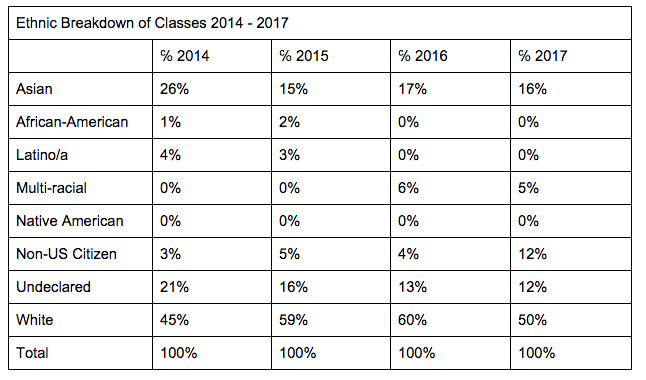
Ethnic Breakdown of Classes 2014 – 2017
EthnicTable

For anyone that’s curious, this is what the student body looked like when I was a freshman. Data from former Dean of Admissions Charlie Nolan, compiled Summer 2014. His breakdowns are percentages, which I understand might not be the best representation of a tiny student population. Quoting Charlie: “1) These are self-reported data as indicated on the Common App. 2) The Common App added “multiracial” for ℅ 2016. 3) There are likely more underrepresented students who are more than one race or ethnicity or, who list themselves as multi-racial or don’t declare a race or ethnicity.”

Practicing Engineering

Engineering is a profession.
It is not simply an occupation, something that ‘occupies’ us. For some engineers, it’s not a career (an occupation of significant length), or a vocation (an occupation that one feels strongly suited to do). But for all engineers, it is a profession, an occupation that requires a mix of technical and practical knowledge. A professional is the intersection between a tradesperson and an expert: someone with a particular set of skills and the knowledgebase to inform use of those skills.
A lot of occupations are professions. Being a car mechanic is a profession. Teaching is a profession. ‘Consulting’ is usually a profession. Practicing medicine or law is certainly a profession. And, as I said earlier, engineering is a profession. Why does this classification matter?
Academia does not (generally speaking) prepare people for professions.
Suppose one becomes a Master of Arts in literature. Does this degree necessarily mean that they are an author? What about somebody with a PhD in physics? Does that piece of paper make them a physicist? How about somebody with a BA in business? Are they a businessperson?
Contrast these degrees to the degrees of doctors or lawyers. An MD or JD is fundamentally different than a PhD. The former are professional degrees, and the latter is an academic degree. The difference is simply that academic degrees certify that the holder has completed a school and learned a certain amount of knowledge, but that professional degrees certify that the holder is capable of practicing the profession, and has the requisite knowledge to do it.
The fact that engineers receive academic degrees and then become practicing engineers seems, on the surface, as fine as letting people with BA’s in business run businesses. It is, as many current engineers will tell you, fine. “Most of the skills you need you’ll learn on-the-job,” they say. They’re right. But the reason that engineers receive academic degrees, I hypothesize, is because of a key historical assumption about engineers that cannot be made about doctors or lawyers: Engineers already have engineering experience by the time they attend school.
Engineers of the past were tinkerers, carpenters, and artisans. Formal training doesn’t matter nearly as much as experience when you’re making things. But as humanity needed more and more complex things to be made, we began schooling the makers so that they would have a good knowledgebase to build the things of the future. People went to engineering school because they were already good at engineering, and it was a way to enhance their knowledge. Their experience contextualized their knowledge.
Education for doctors began in the opposite way: the human body has always been complex. In order to be good at healing people, one must understand how the body works, and intuition covers almost none of it. Even experience in healing people doesn’t make someone an expert; medicine advanced very slowly for thousands of years. But along the way, the formal training improved, and so did medicine. For doctors, knowledge contextualizes experience. You probably don’t know any doctors who went to medical school because ‘they were good at healing people.’ Doctors can only get useful experience once they’ve attended some school.
This brings me to my major point: the assumption identified above is wrong. It could have been true at some point, but today, many people attend engineering school with no experience in engineering. Math and science are thrown at them under the promise of ‘being useful’, rather than because they make easier what has already been done. That this assumption is wrong is a key reason for the Olin education being the way it is. We do projects to give us experience and knowledge simultaneously. It’s literally the definition of “do-learn,” as opposed to “learn-do,” the way that engineering had been taught for so long.
Maybe a takeaway from this is that engineering is not an academic subject, any more than medicine or pottery are subjects. There are certainly academic subjects that are important to engineers, like statics, or materials science, or semiconductor physics. But engineering is more a skillset that requires the use of these subjects. Engineering is more like research than physics, or information-gathering than history; it’s a lot broader, and a lot harder to teach. So stop saying that you ‘study engineering.’ You’re practicing being an engineer.
Most of this article was inspired by a conversation I had over the summer with some faculty. Especially influential were Ben Linder and Rebecca Christianson. Thanks also to Wikipedia: https://en.wikipedia.org/wiki/First_professional_degree.

REVO Updates

REVO will represent Olin College for the first time at Formula SAE Electric and Formula Hybrid in 2016. Formula SAE is a student engineering and racing competition. Teams design, build, and test a prototype based on a stringent rule set.
Formula Hybrid specifically emphasizes innovation and efficiency in a high-performance application and thus only hybrid and electric vehicles are sanctioned to compete.

Zero Motorcycles has generously donated two Z-Force brushless DC motors and Sevcon Gen 4 motor controllers. We plan to run each motor at 30 kW (100V/300A), for a power to weight ratio of 6.25 pounds per horsepower, just shy of a Ferrari 458!

Adit Dhanushkodi, John Sakamoto, and Lisa Hachmann are designing the battery pack, which contains 6.7 kWh of Nissan lithium battery modules. The pack must withstand a 40g deceleration crash while isolating the high voltage powering our vehicle. Two relays activate the powertrain after going through a rigorous series of system checks. Adit and John are senior mechanical engineering majors and Lisa is a sophomore electrical engineering major. Contact us if you are interested in learning more about the design.

We have partnered with General Motors engineers to advise the team. We meet with GM engineers regularly to discuss our designs and receive critical feedback. As alumni of Formula Hybrid, they also advise us on project management and execution.

Subscribe to these monthly newsletters : revo-contact@lists.olin.edu.

We’re Here to Help :)

Dear First Years,

Welcome to Olin! We’re so excited to have you join our community, and we look forward to meeting you all over the next few weeks. But before you all get busy with problem sets and projects, we’d like to introduce ourselves. We are CORe.

What is CORe, you ask? CORe stands for the Council of Olin Representatives – a fully elected council which represents the student body to the administration of the College. CORe is comprised of 13 dedicated students who have volunteered to help improve life at Olin. We are the “movers and shakers” – the changers – the people who get things done. We examine issues facing the student body and do whatever we can to make our classmates’ dreams a reality.

Unlike any other group on campus, CORe has the authority to make recommendations to the administration on behalf of the student body. We appoint student volunteers to faculty and operational committees, like the Dining Task Force or the Curriculum Innovation Committee, where the administration has requested student representation. We also have a budget which we can use to improve student life, fund student initiatives, and make capital improvements to spaces around campus. Most people think of us as the student government at Olin (although the “Student Government” is actually a separate larger organization of which CORe is a part – feel free to reach out to us if you want to learn more!).

CORe is structured a little differently from most student governments. We have 3 executives who organize our activities and serve as primary points of contact, 5 specialized representatives who each represent the student body to different departments in the administration, and 5 class representatives who represent the interests of each class. Now, 5 may seem like an odd number, but there is a method to our madness. The specialized representative positions are open to students from any graduating class, and most of the elections occur in the spring before the first years have arrived on campus, so to compensate for first years being unable to run for those positions, they have an extra class representative.

Now that you understand how CORe is organized, here are the members of CORe for the 2015-2016 school year. (First years, the election for your representatives will be happening soon – stay tuned!) Let us know if you have any questions about CORe, if you need help reaching out to the administration, or if you have a cool new idea you want to share. We work for you, and we’re here to help!

President
Ian Hill
Vice President for Communications
Kevin Crispie
Vice President for Finance
Logan Sweet
Representative to Operations
Mariko Thorbecke
Representative to Marketing and Communications and Development, Family, and Alumni Relations
Manik Sethi
Representative to Admissions and the Office of Student Affairs and Resources
Ellie Funkhouser
Representative for Curriculum and Faculty
Jamie Gorson
Representative for Intercollegiate Affairs
Maggie Jakus
Senior Class Representative
Lauren Froschauer
Junior Class Representative
Subhash Gubba
Sophomore Class Representative
Not yet elected
First Year Class Representative
Not yet elected
First Year Class Representative
Not yet elected

<3 CORe

The Eminent Eighteen

Fellow Oliners,

The Student Government Restructuring last spring strove to make CORe more transparent and improve our communication with the administration. This fall, we’re hoping to give Oliners a better understanding of how the administration operates, so in this edition of Frankly Speaking, we’re going to pull back the curtain on the Board of Trustees.

Have you ever wondered who President Miller reports to? You guessed it – the Board of Trustees. The Board of Trustees is the highest governing body at Olin College and is comprised of eighteen dedicated individuals who care deeply about Olin’s mission. Two of the eighteen trustees are Olin alumni who are elected and rotate out every few years. Two other trustees, namely Mr. William Norden and Mr. Lawrence Milas, were trustees of the Olin Foundation before it dissolved to create Olin College. The trustees’ backgrounds range from being investment managers to lawyers to experts in STEM fields.

The Board meets three to four times a year where they address the most important business of the College – once in February, May, August (as needed), and October. In order for the Board to function effectively, the trustees established seven committees to handle various aspects of the College’s operation. Faculty, staff, and (in certain committees) students are often present during meetings of these committees to give presentations and keep the Board informed, but only the trustees actually vote. Five committees handle particularly confidential issues and do not have any student representation present at their meetings.

The Executive Committee works closely with the President throughout the year and will act for the full Board on certain time-sensitive matters that may come up between Board meetings.
Unlike what you might think, the Governance Committee doesn’t actually govern the college but rather considers how the Board itself should be governed. Trustees on this committee discuss the By-Laws of the Board and the candidacy of possible new trustees.
The Audit Committee oversees financial audits of the College and makes sure that we are keeping ourselves honest. This Committee also has oversight of all risk management activities at the College.
In cooperation with the Development Department of the college’s administration, the Development Committee works to identify and cultivate major donors to the College.
The Investment Committee manages how Olin invests the endowment.

However, student representatives sit in on meetings of the two committees which handle issues most relevant to students.

The Finance and Facilities Committee reviews and approves the budget for each fiscal year and performs financial monitoring for the College. They approve new faculty and staff positions and discuss our long term financial sustainability. Directly impacting students, they review Olin’s tuition and fees as well as current, future, and long term facilities projects. This committee also considers the viability of returning the full tuition scholarship. Logan Sweet, CORe Vice President for Finance, serves as our student representative on this committee.
The Academic Affairs and Student Life Committee approves faculty promotions and appointments and spends much of their meetings receiving updates and discussing academic life issues including faculty activities, admission, post-graduate planning, and student life. At their most recent meeting in May, the trustees expressed their excitement that Emily Roper-Doten re-joined Olin in May as our new Dean of Admissions. On a related approval and promotion note, they also awarded Emeritus status to founding Provost, David Kerns, and founding VP for Innovation and Research, Sherra Kerns. They follow new curricular innovation closely and were excited to see new sponsors for the SCOPE program –particularly Indico, Limbs International, and SpaceX. The committee’s concerns lately largely center around strengthening Olin’s faculty and considering the expectations for external arrangements between Olin and its partners. Ian Hill, CORe President, serves as our student representative on this committee.

We hope this article sheds some light onto the operations of the Board of Trustees. If you have any questions please feel free to reach out.

Respectfully yours,
Ian Hill and Logan Sweet
CORe President and Vice President for Finance

Coder In, PM Out

Ah, springtime! The melting of snow! The chirping of birds! The wonderful return of warmer weather and longer days! However, spring harbors a monstrous beast which seeks to disrupt the life I’ve meticulously built at Olin. Ultimately, it shall succeed. No, it’s not room draw this time;* it’s something even more terrifying: graduation.

That’s right, graduation’s just around the corner, and I’m happy to say that I’m well prepared for the transition. Most importantly, I have a wonderful job lined up at athenahealth as a Product Manager. Hmm, but that’s strange. I’m majoring in E:C, so why am I taking a job as a PM?
The number of Olin engineers who choose to become PMs after graduation is fascinating. We hear all the time about Microsoft’s status as the #1 employer of Oliners, most of which are PMs. Others choose to become PMs at companies such as athenahealth or Facebook. I’ve heard many jokes regarding Oliners becoming PMs and “leaving behind their engineering skills.” I’m sure that at some point, even I have thought along those lines. So what happened? What changed? At what point did I transform from a programmer to a PM? The answer lies within my Olin journey.
But really it starts before that. I’m extremely fortunate to have been coding since 4th grade. Through an enrichment program, I spent several hours a week learning Scheme. By 9th grade, I had finished the program’s curriculum, thus making me what I believed to be a fairly proficient coder. Unfortunately, my high school had no programming classes, although that didn’t stop me from taking AP Computer Science on my own.
From the outset of my time at Olin, I saw myself as an E:C. ModSim provided a fun opportunity to reinvigorate my rusty coding muscles, making me excited for what was to come. The next semester, I naturally rushed to be in SoftDes.

Unfortunately, SoftDes wasn’t quite the class it is now. Stuck on a roughly 10-person project with an uninspiring visiting professor, I quickly realized I wasn’t the coder that I thought I was. In fact, I was easily in the lower half of the team skill-wise. The top half would quickly breeze through writing difficult code, while I could barely comprehend what to do. It was discouraging to realize that my previous skills didn’t allow me to keep up, but what made me even more disappointed was my lack of desire to. I felt so behind that I didn’t even think it was possible for me to catch up. I recognize now that what I lacked was the “hacker spirit” that drove the others to spend countless hours coding. I just couldn’t do it. I’m not saying that I wasn’t willing to put in hard work, but it was clear that I simply didn’t have that drive.

I’ve taken many more E:C classes since, and in many I’ve noticed the same things. For instance, in Mobile Prototyping, I had no desire to put in the 25-hour weekends that my teammates relished. In my heart, I convinced myself that I just wasn’t a coder. It wasn’t meant for me. Sure, I was pretty good at it, and sure, I loved a lot of my classes and learned a ton in almost all of them. I didn’t regret being an E:C, but just looking around at my friends and fellow E:C’s, I knew I wasn’t like them. I didn’t have their hacker spirit.

My beliefs were cemented by my two developer internships as a rising sophomore and rising junior. One summer, I worked for a large consulting company doing application development, and the other I worked at a startup doing website development. What both had in common was a rather boring and unsatisfying daily work life. It’s not that I didn’t enjoy coding. I just didn’t enjoy coding every day for eight hours in a row with little else. It clearly wasn’t the career for me.

And then I took UOCD. To this day, UOCD is my favorite Olin class and easily the most influential. Acting as team leader, every day I used skills that I did not even know I had. Presentation, organization, and design were all things I had done before, but never together like this. It was a challenging experience in many regards, but in the end, I understood that these were skills I could really use. And that’s when it clicked – I could be a Product Manager.

Despite this revelation, the next semester I applied to numerous development internships, none of which came through. I began to feel that I didn’t fit into a “true” programming job. But then, one last opportunity appeared. Strangely, it was an interview for PM internship at athenahealth, even though I hadn’t applied for one. As it turns out, my recruiter saw my resume and submitted it as a PM candidate based on my experience in UOCD. That was probably one of the luckiest things to ever happen to me.

The interview was extremely successful, with my UOCD experiences proving invaluable, and I got the internship. As for the internship itself? Overall, it was a fantastic experience. Sure, I may not have used all of the technical skills I’ve gained at Olin, but I did use all of the design, presentation, and organizational skills that Olin helped foster. It was very satisfying, and it made me realize that I could still own and shape a product without coding it. And most importantly, it was both challenging and fun. At the end, I was offered a full-time position, which I gladly accepted.

And now, almost a year later, I’m about to start work. In just one month, I will be a PM. And although it’s not what I expected to be when I started Olin, I truly thank Olin for enabling me to discover skills I didn’t know I had and helping me find where I think I belong in the world. As I’ve learned, your college experience and passions don’t always lead where you expect them to. Discover the skills you have and enjoy using. Use them and do cool things, even if it’s not what you originally set out to do. And the next time you hear that an Oliner is graduating “only to go off and be a PM,” understand that Olin does a lot more than just teach engineering. It gives us the skills we need for the future. And I don’t think that wanting to use those skills is very strange at all.

*Reference to April 2014 article

We Could Be Great

Every year at Olin, a group of 80 people sign a document that is hung by the Wooden Waterfall. And every year at Olin there is at least one Town Hall to talk about what’s on that piece of paper. And, inevitably, every year at Olin what is written is used as a means to address concerns or wrongs that occur on campus – and very seldom used to point out what is right.

Can a list of five values really capture what we want this community to be, and should they be used to frame or limit what can be talked about on campus? Some argue that yes, we absolutely need an Honor Code. It gives us a common language to talk about our community, it can reflect perhaps not who we are now but who we want to be, and it sets an expectation – as a member of Olin College, I will be great. But ‘greatness’ has such a wide variety of meanings to the students at Olin. If my definition of greatness doesn’t align with the Honor Code’s, am I wrong?

There is no safe venue for students to actively choose not to sign the Honor Code. There is no reaffirming ceremony, the Town Hall vote has slipped into symbolism, and when the question of whether or not the Honor Code should be kept comes up there are still those of us that laugh when the few votes of dissent trickle in. Why are you laughing?

Often, the alternative to the Honor Code is cited to be a rule-based system. A list of conduct, rather than a to-your-interpretation set of values. I propose a thought experiment: what if the values were replaced with….nothing? What would happen if suddenly there were no more values, but the Honor Board Hearing Panel Process was still in place? Perhaps campus would erupt in chaos… I tend to believe that things would likely continue the way they were.

From the Honor Board’s perspective, having the values is a neat and tidy way of handling cases and administering a report procedure. But there have been times in history where a report doesn’t necessarily fit into a tidy value – its more messy than that, just as real life always is. By having a listed set of values, perhaps we are limiting what we see as ‘honor-board-able’ actions thus leading to this perpetual state of minimal mediation through the procedure process.

Simply signing a piece of paper does not hold us accountable to ‘follow the Honor Code,’ though it is supposed to lend an air of promise to try to ‘be great.’ Voting to keep the Honor Code at every Town Hall doesn’t necessarily make us reflect on why we feel that way. Simply instituting an Honor Code does not fix or regulate our campus climate, but perhaps that isn’t the point of the Honor Code. Perhaps the focus on using it as a governing, behavior-controlling document isn’t how we should be thinking about it. Rather, perhaps it is a platform for discussing our campus climate. To reflect on personal values, on personal definitions of ‘greatness.’ To share with our community what makes us ‘great.’

The Honor Code is not the end-all be-all. We have the power to change, shape it, demolish it, ignore it, live it. What is the right thing to do?