A Review of The Wild Robot

Disclaimer: Spoilers ahead.

The Wild Robot is perhaps the most transformative movie I have ever watched. I was talking to my good friend, Al Gore, and he told me something very interesting: “Family isn’t an obligation, but instead a choice.” I think that the 2000 election changed him. Afterwards, he never smiled and he never wept; he simply stood. He no longer thought that the people of America were his family. He no longer championed the climate for which he had fought so hard to protect or the people of the country that betrayed him.

Much like a hanging chad, his life was perpetually suspended in limbo, an uneasy balance between the death of his soul and the very alive body which so indignantly propelled him through time. I tell you about Al not to paint a tragedy but to make a point. I spent years trying to pull him out of that slump and I couldn’t do it. It took something bigger, it took someone better; we needed The Wild Robot.

The Wild Robot starts with a simple premise: what if a robot was taken out of its environment? 2000 pounds of steel and wiring is dumped in the forest in the form of Roz, and immediately the entire woodland community hates her. This cleverly references the reaction of Glen Falls, Vermont when I dumped 2000 pounds of steel and wiring there. The Wild Robot gears you up in the first couple minutes for a heartwarming story about living in a community, examining your biases, and environmentalism above all. That is not what this movie is about.

The Wild Robot delivers a series of sucker punches. The first of which is that unlike WALL-E and The Terminator, there is no sci-fi eco-fable happening; this is a movie about the struggles of parenting. Perhaps this is only shocking if you haven’t seen the trailer. When Al and I walked into the theater that Saturday afternoon, we certainly had not. It’s jarring, but it isn’t bad. You’re going to spend the next 2 hours watching a robot raise a goose. You watch Roz and the goosling grow to form a family. By the end, the payoff of Brightbill leaving the nest is earned (in a way that Bush’s presidency certainly was not).

A lesser movie would end here – not The Wild Robot. In the last half hour, The Wild Robot has no less than 3 movie-ending emotional payoffs. Al’s reaction was something to see. The first payoff hits when Brightbill migrates south, leaving Roz behind. Looking right for but a moment, I see a single tear roll down Mr. Gore’s face, the first hint of emotion he’s betrayed since November 7th, 24 years ago. 

And before you can recover… BAM!! Payoff number 2: every carnivore and herbivore in the forest has been stuffed together into a little room and they’re all attacking each other. Roz, perhaps powering down for good, makes a speech with the last morsel of energy she can muster from her fuel cells. The fighting stops, the animals lay quiet, and Al Gore texts his children for the first time in 14 years. He’s smiling – he’s actually smiling! Roz has succeeded not only in stopping the conflict in the forest but also the conflict in our beloved 45th Vice President’s heart.

BAM!! Not even 5 minutes later, they do it again. At this point I must admit that I lied earlier; this is an eco-fable after all. The Rozzum corporation attacks the forest and nearly burns it to the ground. Fighting back, the community of animals bands together against this ALeGOREy for consumerism, rampant exploitant of the environment through industrial processes, and unenlightened technocentrism. It is then that Roz says the line: “I am a Wild Robot”.

Upon hearing this, Al, who was now bouncing with excitement in his seat, simply died. The EMTs who arrived on the scene could not help as they were too transfixed by Dreamwork’s newest release in IMAX 3D. I am told that his carotid artery burst, the tragic downside of his heart growing three sizes that day.

I tried to weep but could not. Al had lived more in those twenty minutes than I had seen him live in twenty years. This is how he would want to be remembered. He would want you to know what he’d seen. He would want you to know, even if only for a moment, that he was alive.

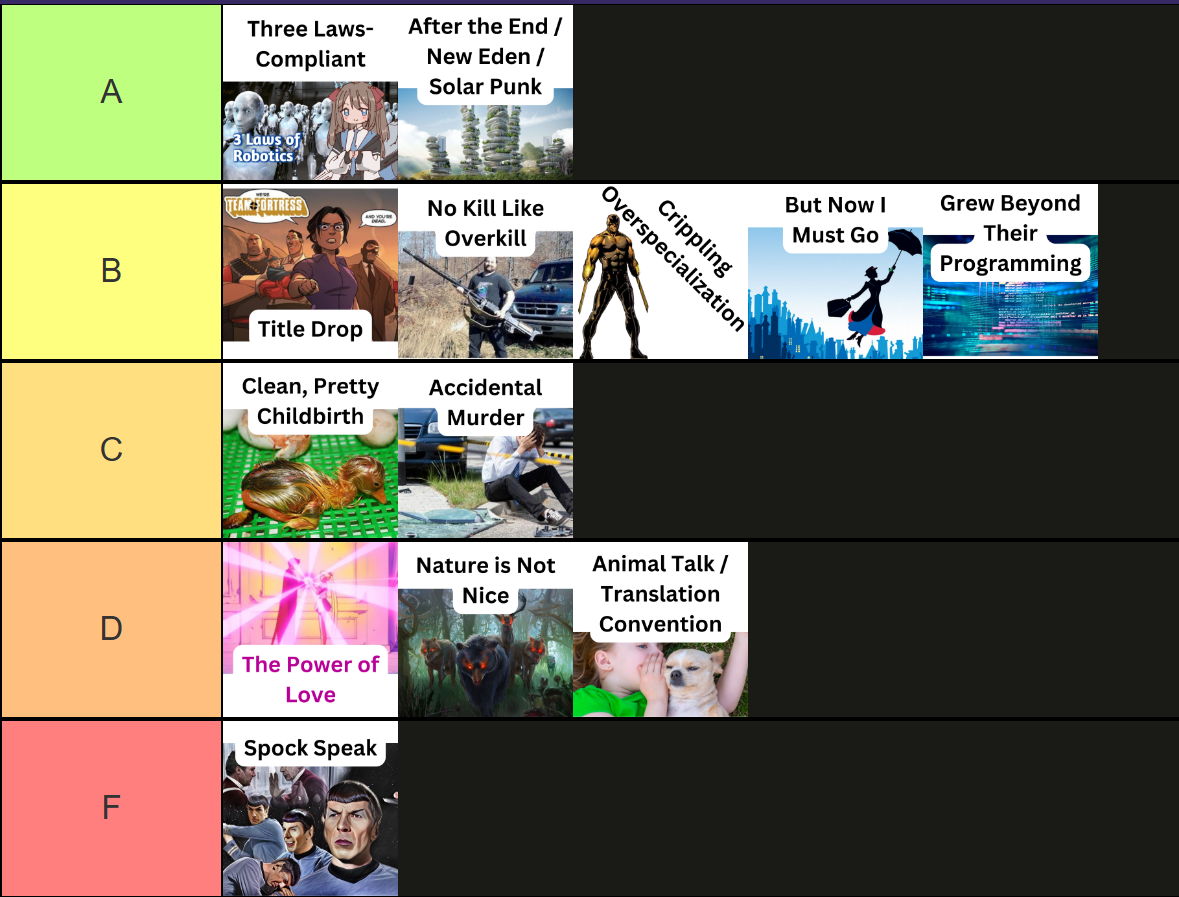
Tropes in The Wild Robot Ranked By My Personal Opinion

A-Tier: Despite my personal opinion, I can’t help but adore these tropes; they made this movie so much more than I expected it to be.

B-Tier: I’m not usually a fan of these tropes in most movies, but their inclusion in this one was to its benefit.

  • Title Drop – Usually cringe-worthy; in this instance, however, the title drop was the funniest part of the movie.
  • Grew Beyond Their Programming – Ok, I’m a bit sappy.
  • Crippling Overspecialization – Has unparalleled ability to learn and extensive databanks but teaches a goose to do the front crawl like a human person.
  • No Kill Like Overkill – From tube arms to railguns real quick.
  • But Now I Must Go – A very realistic decision to surrender and return; no power source:  no robot.

C-Tier: I’m neutral toward these tropes.

D-Tier: I usually like these tropes, but this movie did not do them well and suffers for it.

  • Nature is Not Nice – Had more realistic prey/predator relationships at the beginning, but they backed out of it halfway through.
  • The Power of Love – Where is the love physically kept??? It’s a robot?
  • Animal Talk / Translation Convention – We could’ve had more variety in how the animals sounded; there is no difference in grammar despite a broad range of species.

F-Tier: I might appreciate these tropes in other media, but they are so poorly executed in this movie that it does the whole film a massive disservice.

  • Spock Speak – They attempt this convention at first, but it is so quickly discarded that it only serves as a mild distraction at best and a nuisance at worst.

Ways to Meet Eachother

Recently, I’ve heard people complaining about different groups of people on campus not being reachable. I realized my experience has been quite different. I am the student who emails admin invitations to the dining hall and introduces herself to as many dining hall staff as she can. Here are some ideas so that you can start your own conversations.

To Meet Dining Hall and Facilities Staff

  • Say hi to them in the hallways and introduce yourself! 
  • When they help you out on campus, thank them and go from there!

To Meet Students

  • Sit with them in the dining hall. Really just sit down if there is an empty seat next to them and introduce yourself. Oliners like to talk!
  • Email them! Even if it is a stranger.
  • Email our CORe representatives! There are elected members who run events, meet with admin, and much more. Feel free to reach out to Kenneth Xiong… he’s happy to talk CORe or about parking spots in Boston…
  • Reach out to a fellow student who you want to get to know better! You know you have that person; send them a random text or email about meeting up!

To Meet the President’s Cabinet (if you are wondering who they are, try a google search)

  • Email them! 
  • Sit down with them in the dining hall. Al Sacco and various members of the cabinet have lunch in the dining hall on Thursdays from 12-1. They are there to meet everyone!
  • Show up to their office. If the door is open, go in and say hi!

To Meet Staff and Faculty

  • Email them! Most of them have informational pages on the Olin website. See what they do and reach out about it.
  • Sit with them in the dining hall, schedule a meeting with them, or go to events that they advertise!
  • Ask them about their research or what they studied in college!

To Meet Babson Police

  • Say hi to the officers when they do their rounds through campus. They like to hear about our projects!

To Meet President Barabino and the Board of Trustees

These might all feel awkward at first and that’s okay. To help, I have added a few tips below:

  • People want to talk with other people! That means you!
  • Some conversation starts: Favorite hobby? Favorite sports team? If you could only eat one meal for the rest of your life what would it be? 
  • To send an email: Start with “Hi my name is ___!” and maybe follow that up with something like “I do XYZ at Olin. I would like to learn about XYZ things you do. Could we find a time to meet this week?” 
  • My favorite thing to do when I meet up with someone: Get some ice cream! Suggestions of places: Trim for soft serve, Olin dining hall when we have it, Truleys in Wellesley.

I challenge you to do one of these things listed above and meet someone new this month! I am looking forward to meeting more of you! 

My Gilman-Sponsored Study Abroad Experience

Disclaimer: This article is my required follow-up project for my Gilman Scholarship. More details below.

I spent my 6th semester at Olin, Spring 2024, studying abroad in Stockholm, Sweden under DIS Study Abroad. My participation was sponsored by the U.S. State Department’s Gilman Scholarship.

What is the Gilman Scholarship? According to their website, “The U.S. Department of State’s Benjamin A. Gilman International Scholarship Program enables students of limited financial means to study or intern abroad, providing them with skills critical to our national security and economic prosperity.” Applying for a Gilman Scholarship is probably a good financial decision and isn’t an endorsement of U.S. foreign policy. You are eligible to apply if you’re a Pell Grant recipient.

My decision to study in Sweden was not well-planned. I applied to DIS Abroad because I had heard good things. DIS has two programs: Denmark, Copenhagen and Stockholm, Sweden. I indicated preferences for one program in Stockholm and one in Copenhagen so that the admissions committee would decide for me. In the end, I was assigned Stockholm, likely because they are trying to develop a new program.

I will not recommend nor discourage Stockholm as a study abroad location, but I will endorse the DIS Abroad organization. I felt very supported navigating all the logistical difficulties of studying abroad. All classes are led by DIS Abroad (as opposed to a local university), and they have a modest diversity of offerings. I used my study abroad to get my AHS concentration done – “Scandinavian studies.” My classes: history of the Vikings, transgender culture in Scandinavia, Scandinavian crime fiction, and Scandinavian fashion.

One of your classes is your “core class” – mine was Vikings – and you’ll travel with your class twice during the semester, all-expenses-paid. The first trip is shorter, maybe 4 days. My class went to Uppsala, a city not far north of Stockholm to look at Viking stuff. Later, we went to Oslo, Norway and Reykjavik, Iceland to look at… more Viking stuff. We were also treated to some dope Indian food in Oslo, which I’ve heard is the best place for Indian food.

As far as personal growth, I became very good at cooking rice and beans. That’s all I ate for two meals a day for over two months. This was also a good financial decision if that’s your thing. Overall, studying abroad will probably have a neutral impact on my future. I suppose it was nice to have classmates that are more uniformly distributed across humanly traits than Oliners are for a semester. Besides that, Stockholm in the winter is very cold and dark, so beware.

As for the Gilman Scholarship, there are plenty of resources at Olin that can help with your application: myself, writing tutors, and Courtney Beach. I’m glad to chat if you have questions or want to get a sense of your personal fit.

Olin Mad Libs

My Olin Mad Libs Adventure: Swimming in the LPB

It was finally happening! After __(number)__ months of planning, we were ready to throw our beach day palooza in the LPB! We had all the best decorations prepared. A  ___(noun)___ to set the mood, ___(noun)___s to bring the hype, and 7 ___(noun)___s to top it off. Everyone came in their ___(adjective)___est  ___(noun)___, and stood waiting by the poolside. Dave Barret says to never  ___(verb)___ in the LPB pool because it’s for his robot  ___(noun)___, but  ___(name an Oliner)___says it’s fine, and they’re basically as ___(adjective)___ as Dave. So we took off our  ___(noun)___, and took a dive. “ __(exclamation)__!” each Oliner would yell as they hit the pool floor. Everyone was having a  ___(noun)___, but then we realized the floaties on the water were  ___(verb)___ing. We realized it’s because of all the  ___(noun)___ in the water, which would lead to horrible  __(medical condition)__, but that was the risk we were willing to  ___(verb)___ after we passed the LPB training. After  __(number)__minutes of  ___(verb)___ing around, we all left the pool. Every last one of us had turned into  ___(noun)___, and we were all covered in  ___(noun)___es.  ___(Name an Oliner)___was in a particularly  ___(adjective)___situation, because now they were growing a new  ___(body part)___. We were about to  ___(verb)___ it off with a  ___(noun)___, but just then, speak of the  ___(noun)___, Dave Barret, the  ___(noun)___ himself,  ___(verb)___ed open the door. We all ___(verb)___ed, and hid in the  ___(noun)___ until he left. Dave, suspicious, looked around, admired the decorations, and once he was confident no one was there, grabbed a  ___(noun)___, and hopped in the pool. We escaped by the skin of our  ___(noun)___, and we vowed never to  ___(verb)___ in the LPB pool ever again!

Drunk Horoscopes

♈ Aries: March 21–April 19

  • Horoscope? More like whore of scope?! More like whore…O-scope?!!! Return them please?!!!!!!!! MY WHORES?!

♉ Taurus: April 20–May 20

  • Taurus? More like. Clitaurus. Wait, where’d it go?! The asteroid made them go extinct.

♊ Gemini: May 21–June 21

  • Have you shown up to DesNat recently? Kate has probably been more than you have.

♋ Cancer: June 22–July 22

  • They’re inverting the dogs! They’re transposing the cats! That’s Kamambla’s eigenvector!

♌ Leo: July 23–August 22

  • Is Charmander bicurious? Only in theory, not in practice.

♍ Virgo: August 23–September 22

  • Did he tell you to come? No, he did that all by himself.

♎ Libra: September 23–October 23

  • Wait! I think we have that song on Rock Band. Wait! I think we broke the drums on Rock Band. MaaAaAaAAAaaAaps.

♏ Scorpio: October 24–November 21

  • I’ve fucking had it with Frankly Speaking! Posting shit all over the Dining Hall… I could have used that paper to wipe my ass.

♐ Sagittarius: November 22–December 21

  • Team bonding? No no no, team bondage. What’s our PIE budget?

♑ Capricorn: December 22–January 19

  • Feeling overwhelmed? Have you considered quitting FWOP? Quitting Formula? Quitting CORe? Quitting the first year?

♒ Aquarius: January 20–February 18

  • Just so you know, it’s your fault I’m leaving. -Aurelia

♓ Pisces: February 19–March 20

  • Go white boy go! Hot To Go?! H-O-T-T-O-G-O! You can take me hot to go.

I have fucking had it with this college’s leadership.

I came to this school because I wanted to make an impact on society through my future engineering career. I thought that this was a community of people that cared about doing good in the world. And don’t get me wrong, I’ve met lots of people like that here. But Olin College’s leadership, like Gilda, Al, and Donna, the people who seem to be calling all the real shots, aren’t those people.

I’m going to be honest, my time here has been stressful. Courses, clubs, halfhearted attempts to socialize with the little energy I have left, and caring about this college and about a planet that’s burning in front of our eyes is mentally and emotionally draining. But it might be bearable if this place felt like a place where I could actually make a difference. I’m frustrated and tired by screaming into the void, trying to communicate what we want and getting ignored every single time. All those meetings, trying to bring up my concerns, taking notes, ignoring the many problematic ways that Al interacts with or describes people who aren’t white cisgender men… only to have our concerns completely ignored. Why do they even pretend to care about what we have to say anymore?

Sometimes, to find a bit of escape and entertainment, I imagine Gilda, Al, Donna, and the board huddled together in smoke-filled back rooms, spinning a roulette wheel where each number is some aspect of student life or the campus community’s well-being that they want to get rid of. I picture them grinning, rubbing their hands together as they count the thousands of dollars they’ll save with this “inevitable” cost-saving measure.

I know they’re not like this in real life; they aren’t monsters purposely trying to make life horrible for all 350 (soon to be 600) of us. But they are out of touch with the community. They don’t value our time, our well-being, our culture, or people who have been here long enough to understand Olin – anything that isn’t dollars, really. And they don’t live by our values. They don’t respect us, aren’t open to new ideas, and they don’t act with integrity or have our best interests in mind.

In some ways, I can understand the way they got to this place. Maybe they came with some grand ideas of how to change this place for the better, and found out that real change is hard. But in the face of that reality, rather than listening to us and understanding what we needed beyond “financial sustainability”, they decided to put their own interests, their jobs, their public image, and their own ways of doing things (read: from much bigger and more traditional schools) before all of that. Olin is a college that prides itself on training its students to do good in the world and make “engineering for everyone”, but it’s led by leaders who aren’t good role models of those things, and who don’t understand or live out our values.

Let me start by highlighting some of the many out-of-touch things that our leadership has said. You can find these quotes from Gilda’s “Key Speeches, Writings + Appearances” page.

“We will continue to value equity, inclusion, and diversity, and we will continue to be a strong and vital institution if we live by these values.” It doesn’t take much time to learn to pronounce people’s names correctly, or to learn and use their pronouns. Why can’t our leadership even invest that little effort to live by these values, while calling on us to be “inclusive” by packing us into increasingly cramped living spaces or bringing Babson students into our dorms?

“The students, faculty and community partners in Technology, Accessibility, and Design who work together to design a technology that enhances accessibility for users with disabilities.” So our students and faculty are doing amazing work in accessibility, while our facilities staff (which leadership could easily hire more of if they just cut a high-paid, “crucial” admin position) are stretched so thin that half of our automatic doors don’t work and people regularly get trapped in elevators. Got it.

“Joy is a choice, and making the choice to approach even stressful experiences from an attitude of joy is an investment in our well-being.” Oh right, choosing joy is what I was missing from my well-being. That’s all I need to ignore the fact that the world is on fire, that a literal fascist is running for president for the third time, that you slashed our scholarship by over 60% while continuing to raise our tuition far beyond inflation, or that you housed Babson students in our dorms after we repeatedly told you no.

“We will continue to strive to provide a safe environment that supports freedom of inquiry, protects diversity, and fosters a sense of health and well-being among all Oliners…” Right, that’s why we have things like the protest policy, smaller suite lounges, tons of triples, and heavy restrictions on our ability to email the class.

“…I know many of you, particularly our students, will be moved by this decision and will be driven to advocate for change. I urge you to do so peacefully and with respect for all viewpoints, because even amid upheaval, respect for others must remain a core value of both our campus community, and our national one.” Then why do you keep putting restrictions on our peaceful advocacy for change? Because you “respect us?” Or does “respect for others” only mean “students respect the administration?”

“As we move forward towards realizing our vision of College as a Living Lab, we are springing to action in inspiring new ways, coalescing around execution in service of our vision and society.” Can anyone on the leadership team explain what College as a Living Lab means or what it actually looks like? Does “coalescing around execution” mean “the leadership ignores the committees, decides whatever it wants and then forces the rest of the community to do its bidding?” What even is the vision, beyond revenue at the cost of all well-being?

And now, let me go through the Honor Code values, as defined on the college website, and talk about how leadership has repeatedly failed to live up to these values.

“Integrity: I will represent myself accurately and completely in my work, my words, and my actions in academic and in non-academic affairs.” I’ve heard leadership constantly misquote us, only getting input from their favorite few students or cherry-picking quotes from us and then representing it as “the students’ opinion” to support any point they want to make. But of course, they never want to put anything in writing themselves. Maybe they’re afraid of being misquoted.

“Respect for Others: I will be patient with and understanding of fellow community members, and considerate of their inherent dignity and personal property. I will care for community resources and facilities so others may effectively use them.” I’ve already talked about how leadership doesn’t listen to our input, doesn’t respect trans and nonbinary identities, and doesn’t care for our college facilities. There’s just no money for these things, but they’re very important, sure. I’m especially sad that they don’t respect our faculty and staff, who work hard and care for our well-being despite being short-staffed. So much so that we are currently experiencing a great resignation of the people who run the day-to-day of this place. How can our leadership possibly say they respect others and live with themselves?

“Passion for the Welfare of Olin College: I will be a steward for the welfare of Olin College through a spirit of cooperation, concern for others, and responsibility for the reputation of Olin College.” After reading all of this, do you really think that our leadership cares about anything except the financials of this college? The community is a big reason I came here, and it’s built on the work of the students, faculty, and staff before me who understood Olin well and collaboratively designed systems that work. They’ve destroyed so much of that community, taking away suite walls, packing us into dorm rooms like sardines, cutting off our ability to email the student body, and suppressing a lot of open honest discussion.

“Openness to Change: I will be receptive to change, supportive of innovation, and willing to take risks for the benefit of the community.” Leadership has constantly ignored our ideas, failed to work with us on anything except their own ideas, and they’ve consistently tried to make us “more like other colleges,” showing that they aren’t interested in taking any real risks for the benefit of the community. Instead, they want to fall back on boring ideas from their time at schools that were much bigger than Olin will ever be.

“Do Something: I will strive to be an active advocate for the well-being of my community. I will seek to understand, and then act on, issues I perceive around me that are specific to both Olin and beyond. I will engage in open, self-reflective discussion with my peers and support them in their efforts to do the same.” Honestly, this article is getting long enough as it is, but I think it’s clear that college leadership doesn’t listen to us and doesn’t act with our best interests in mind. Any changes they make aren’t solving issues that we actually have with Olin, and the only discussion they have is just for show so they can say that they talked about their ideas with us before implementing them.

I’ll end by saying that I don’t think all hope is lost. Like I said, our leadership aren’t monsters, but they’ve been heading in the wrong direction for a long time, and they aren’t listening to us. So to students, faculty, staff, and the board: we need to do something. I hope that you’ll stand with me in saying that we won’t let our leadership continue to destroy this place for a few more dollars. If they’re not willing to change their ways, or if all they’ll commit to are empty promises like “holding a community forum to discuss our thoughts,” or showing up to serve cupcakes as a PR stunt, then frankly, they need to step down and we need to have leadership that actually cares about the spirit and welfare of this college. But if they’re willing to commit to real change, like empowering elected groups of students, faculty, and staff with real decision-making power, then maybe there’s still hope.

If any of this resonated with you, I encourage you to support this effort and share your own stories about why you’re concerned about our leadership. You can fill out the form here:  https://forms.gle/YTcy7Pd6ZvKXbEuYA
Green Space: Choosing The Rails

Green Space is a column dedicated to sustainability-related writing, initially written from 2012-2014 and revived in 2023.

Olin has been home to plenty of brilliant engineers working on novel green technologies, but I believe we can’t just engineer ourselves a sustainable future without significant changes to how we live our lives. Many luxuries we have become accustomed to are only possible because of exploitative, extractionist, environmentally unfriendly practices, from cheap industrial meat to 2-day shipping to fast fashion. To build a truly sustainable future, we need to be willing to adapt our consumption habits.

One significant aspect of our lives where overconsumption has become the norm is air travel. Cheap fares incentivize us to jet off to Europe for a conference or the Caribbean for spring break. If we are to live a sustainable future, we must consider traveling with intention. Embracing slow travel by utilizing green transportation, practicing mindful consumption, and engaging with local businesses, peoples, and cultures will allow us to create a future of travel that is environmentally and socially sustainable.

I spent the Spring 2024 semester in Copenhagen, Denmark, taking courses in sustainable cities and transportation. My classmates hopped on flights to a different European capital each weekend, but I wanted an alternate way to experience the continent. My reputation as a train-lover precedes me at Olin, so it shouldn’t come as a surprise that dedicated my breaks to exploring Europe by train. Throughout the semester, I covered about 7000 miles by train, from the far northern reaches of Norway, Sweden, and Finland to the Mediterranean in both Barcelona and Venice. The allure of these trips was largely in the trains themselves and in the pure joy of watching beautiful landscapes pass by the window. On my trip to Norway, I took 11 trains, 6 buses, and a boat. I followed my curiosity wherever it wandered. I saw and experienced so much along the way that I never would have if I had just flown north and booked a hotel. By taking the train, I emitted just 3% of the carbon dioxide I would have otherwise, spent about the same amount of money, and was able to engage with and gain an appreciation for the countries through which I traveled.

My travel abroad was pretty extreme because I wanted to experience as many trains as possible, but the true strength of slow travel comes when you design your travel around destinations that are a more reasonable distance away. My core course while abroad, Sustainable Development in Northern Europe, traveled by train to Stockholm for our study tour week, which took about 6 hours. I am confident that my class learned just as much on our trip as the other section of this course that flew to Spain. We had an amazing week, without so much as stepping foot on a plane.

How can you put this into practice in your life? Olin students and faculty engage in all kinds of exciting research work, so it is common for members of our community to travel to conferences. This kind of travel is incredibly valuable to the academic experience, an opinion likely shared by families who donate to send students to networking conferences and Olin administrators who sign off on grants to send delegations to present research. However, directly-financed air travel accounted for 7.18% of Olin’s total emissions in 2021.

Not all conferences are created equal, and sometimes there are few options for relevant conferences. However, we must consider location if the goal is to reduce the carbon emissions caused by academic travel. Choosing a conference with a medium-distance flight rather than a long-haul flight significantly reduces the impact of attending. My Olin research group attended the 2023 OCEANS conference, two of which are hosted each year. In 2023, the conferences were hosted in Biloxi, Mississippi and Limerick, Ireland. Our group of 3 student researchers attended the Limerick conference. If we had flown to Mississippi from Boston, we would have generated almost exactly half of the emissions that we generated by flying to Ireland. Looking back, I realize that I could have had effectively the same conference experience with half the same carbon impact. Even better, we could have sought out a closer conference that we could attend without flying.

Now, you’ve chosen a conference closer to home, great! The easiest way to further reduce the impact is to substitute ground transport instead of a flight. For conferences in cities with rail service, the barrier becomes the cost or convenience of booking a train. Let’s take the 2024 Society of Women Engineers conference, to be hosted in Chicago, as an example. One option is to attend the local conferences, but let’s focus on the national conference for the sake of this article. Most Oliners wouldn’t consider anything besides air travel to attend this conference, but please entertain me for a moment. Amtrak runs a once-daily service between Boston and Chicago, known as the Lake Shore Limited. The train stops at Framingham Station and terminates at Chicago Union Station, making it a convenient end-to-end journey. I will admit that the train isn’t particularly quick, departing Framingham at 1:30pm and arriving in Chicago at 10:15am the next day (a travel time of 21:45). However, Amtrak offers both seats and sleeper cabins for this journey, albeit at a premium compared to airfare. Choosing to fly this route instead of taking the Lake Shore Limited emits at least 6 times as much carbon dioxide. 

What is the role of Olin administration and others who fund this conference travel? What if we were willing to subsidize students and faculty who prioritize sustainable transportation when traveling to conferences? Incentivizing rail travel by making up the cost gap is an opportunity for the college to make good on our sustainability ambitions.

By choosing conferences closer to home and choosing to minimize the flights necessary to reach them, we can become more mindful consumers and reduce the carbon emissions associated with our academic and professional careers. This is not a call to never attend distant conferences, but merely an encouragement to consider the impacts of your travel as you make these decisions.

You can apply these same principles to your leisure travel. I fell in love with long-distance train travel during my semester abroad, but there are many other ways to embrace slow travel as you explore our amazing world. Instead of jetting across the world for spring break, consider hopping on a train to Montreal, the Adirondacks of upstate New York, picturesque coastal Maine, historical Philadelphia, or any number of other destinations. I guarantee that a train journey to any of these places, especially with a group of Oliners, will forge lasting memories. You may even fall in love with train travel as I have.

Next time you are planning to travel for leisure, academics, or work, I hope you consider slow travel and experience for yourself why to choose the rails.

“Chairs” In Museums

I’m going to lose it. Look at this:

Chairs, in museums, caged behind ropes and standing lines, displayed as pieces of art. Among the petty things I care about, this perhaps makes me the most angry. If you don’t care about this yet, and you will, then bear with me as I scream this question from the rafters: why do they keep putting stuff I can’t sit on in museums? I’m disgusted.

The crux of the issue is simple. You cannot display a chair in a museum because the second you do, it stops being a chair. A chair is an object defined by action. If you cannot sit, it cannot be a chair. If the chair is durable and wide, that is part of the chair. If it is uncomfortable, that is part of the chair. And if the chair breaks after just one person sits in it, then that is part of the chair as well. When a chair is divorced from the context of its being, when you remove the mechanism that demands its existence – it stops being a chair and becomes a crude and confusing piece of abstract visual art. If a museum “displayed” a painting that you could only perceive by listening to the artist throw tomatoes at it from behind a curtain would you call it a painting? It would certainly be interesting; it would probably even be art, but would it be a painting? I don’t think so. Any designer who has had the pleasure of sitting down on something in their lives (as I imagine the vast majority have) should understand this: a seat should never be put behind bars. Function is a part of form and designing a piece of seating for a museum fundamentally denies its purpose.

It isn’t hard to fix the problem either. Most chairs are not particularly hard to build, even those that use premium materials can be adequately replicated (albeit at a lesser quality) with imitation leathers and silks. Modern furniture with particular design value often falls into this category. If it is a historical piece then it’s even easier, wood is more readily available than ever before and we certainly didn’t lose the technology to make dovetails. In these cases, a newer representation of a historical artifact would actually add to the exhibit. I promise you the Vikings did not sit in the crusty, splintered relic laid out in the exhibit, at least not in the state it is presented. “Where would we put it?” – In the exhibit, people already need seating for accessibility reasons, if your museum doesn’t have seats already then you have much bigger problems. Make a second chair. It is only through laziness that we have been forced to understand touch as a visual medium.

I have already stated my case enough to make the word chair lose all meaning. You might agree with me and you might even care, I hope you do. You might only care a little bit; I want you to care a lot. If you’re still on the fence then maybe gaining a greater appreciation for the beauty and complexity of seating could help. I think the crux of the issue here lies in the difficulty of actually designing a chair. 

If you’ve gone through your entire life, somehow managing to never feel uncomfortable in a chair, then I envy you, but have you ever tried to design a chair? Have you ever even tried to build one? It is impossible to do right. Sure, if you design in a world composed solely of 5’10”, able-bodied men, you might be able to nail down a solution. But unless you are designing crash test dummies or stocking grocery shelves, those kinds of assumptions just don’t fly in the real world. It is so incredibly difficult. People do not come in standard heights or widths, they are not all able to sit down or stand back up, and the “irregular” things that can be true of some people’s spines would shock you. What if a child or elderly person needs to sit? This is all before taking into account the environment of the object or the context of its use. The human body is beautiful, complicated, and infuriating. Designing a chair means making a fundamental piece of human architecture public; to analyze such a thing you must take into account the whole disturbed majesty of the human experience. You cannot do this solely with your eyes. You must sit in the chair. 

Here is a photo that I took at the Museum of Islamic Science in Istanbul. It is a row of imitation Wassily chairs just sitting in the lobby. This is a chair that could be in a museum but to enjoy it here is free. 

If you are an artist about to send your cool new chair to a museum or a historian setting up an antique bench for display, maybe just put in the effort to make a second one.

Who Are the PAs?

You might have noticed that the signs in the bathroom stalls have been updated with a LOT of new names.

The PAs, or the Peer Advocates for Sexual Respect, are happy to announce that we have nearly doubled our size this semester! We are a diverse group of people who are committed to being a support network for any students struggling with sexual misconduct. 

For some brief history, the PAs began as an AHS Capstone in 2014. The motivation to start the PAs stemmed from a climate survey* and a Frankly Speaking article from 2013 that stressed that sexual assault happens at Olin and affects the same percentage of students as other colleges around the country.

The PA program ensures that people feel safe and respected at Olin. As a completely independent, student-led group, we aim to be a resource and response to the evolving situation of sexual respect at Olin.

We recognize that it can be tough to approach anyone with personal and sensitive issues, so we hope to connect with the community and break social barriers when it comes to topics like consent, sexual health, and relationships as a whole. Be on the lookout for PA Jeopardy, “It Happens Here”, and PA Wellness events!

So to finally answer the burning question, here are the PAs. Please come talk to us!

  • Please see the PDF version of this article in your email or take a look in any Olin bathroom for the list of contacts!

* Refer to this Princeton Article for what a climate survey is: https://academicinclusion.princeton.edu/get-started/consider-climate-survey