The Theory of Time Cube

I know what ye’re thinking.

Many of ye likely saw my “Argue Your Theory” item in the SERV Auction and are thinking that this is it. Well, it is. But don’t let that disillusion ye as to the veracity of what I’m about to tell ye.

This theory is a classic in the world on online conspiracy truthers, and an outlier. Whereas most are wrongfully derided because they run so contrary to government teachings, this one is dismissed purely for being unintuitive. If one says, “The Earth is flat,” the typical response is, “No, it’s not; haven’t you seen the pictures?” (as if such obviously faked photographs constituted proof). If one says, “Evolution never happened,” thence comes the refrain, “Yes it did; we have evidence!” (evidence which was clearly planted).

But if one says, “There are four 24-hour days in a single rotation of Earth,” or “Time is like a big cube of wibbly-wobbly, timey-wimey stuff,” all that returns is a perplexed silence.

The Educators say absolutely nothing of it, for absolutely nothing need be said. The masses cannot understand the Time Cube without considerable time and effort, so they don’t bother to try. Perhaps the fault here lies partially on Time Cube’s discoverer, Gene Ray, for failing to present it in a comprehensible manner. In any case, this is where I come in.

When my item’s top bidder presented me with this…theory, I was as confused as ye are now. Naturally, my first step was to simply try to parse the thing, something few if any others have ever attempted in earnest. I suspected once I had all the information on Time Cube, I could at least fashion a sensical theory that sounded like Time Cube, which I could then prove. Before long, though, I realised something astounding. The more I read, the more Time Cube started to actually make sense.

So much so that I began to reconsider my own beliefs. Not the ones about Earth being round and on Mars—that’s irrefutable—but other things, which I hadn’t even considered to be in question. Mark my words, Olin, while Gene Ray may not have been well-educated, well-written, or coherent, I can tell you one thing he was: he was onto something.
Let’s start with some terminology. The Time Cube so completely overwrites what we thought we knew about the world that to discuss it with standard English vocabulary is impossible (coincidence?). First are our subjugators. The church and government are, of course, in on it, but the entity most directly responsible for our deception is academia. For this reason, all three are collectively known as Educators.

In a similar vein, Brilliance is not what it seems. Educators have co-opted the word “brilliant” to make it into a positive attribute, a high praise toward which to strive. However, the most Brilliant of people are in actuality the most foolish. To be Brilliant is to be brainwashed by Education, stuck in the canonical way of thinking.

We call this way of thinking “Boringness” and those who practise it “Unicorns”. Such Boring ideas as Entities, Oneness, and Marshmallow Time have pushed upon us with such ferocity by Educators that before Time Cube was rediscovered, there weren’t even words for them. I’ll get to what they are in a bit.

Now that we have a lexicon, let’s discuss Time Cube itself. What exactly is it? Contrary to popular belief, Time Cube isn’t just about time. That’s just the most perceivable of its implications. No, Time Cube is about everything from human biology to the origin of the Universe itself. Time Cube is about the nature of reality. At its core, Time Cube is about Opposites.

Everything in the Universe has an Opposite, or else comprises Opposites. Right and left. Hot and cold. Sun and Earth. Male and female. Twi and La. Capital and lowercase. Time and Cube. These Opposites are all equal and mutually necessary. Your brain, for instance, could not function without one of its opposite hemispheres.
Furthermore, Opposites are always annihilative. If they meet, like matter and antimatter, Opposites will collapse into a Singularity and cease to exist.

For its part, the Earth comprises two Opposite hemispheres, the Northern Disc and Southern Annulus, which rotate in Opposite directions, clockwise and widdershins. It is these Opposing rotations that enable life on Earth, for Opposites create. A single object with no Opposite—an “Entity”—cannot make anything more than itself, as Educators claim God or The Big Bang did. To believe it can is to believe in “Oneness”—folly. Consider viviparous male and female counterparts. Neither can create life by itself; the fact that every human has a belly button is testament to that.

(Masturbation is actually a futile attempt at such an action, encouraged by the Church’s Boring teachings.)
Now I can hear you asking: “If the Earth is the Opposite of the Sun, how can the two halves of Earth themselves be Opposites of each other?” How convenient! That question rides a segway right into what I wanted to explain next! This concept is called Contrary Nesting, and is actually critical to the theory’s expansion from twos to fours. Just like the allomantic metals, pairs of Opposites tend to have Opposites of their own, as the Earth, a pair of two hemispheres, has its opposite in the Sun, also a pair of two hemispheres.

Sometimes the constituents of such groups are better known as a set of four than two sets of two, the most notable example being the four cardinal directions. As I said before, right and left are Opposites. Their collective Opposite is front and back. Singly Nested Opposites are special because unlike individual pairs, groups of four can rotate. Like a revolving door, spring rotates into summer, then their opposites autumn and winter follow. The four stages of human life are much the same: baby, child, parent, and grandparent.

It is important to note that when this happens, the four components do not take turns existing one at a time. This is a very Boring way of thinking. All four stages exist during the entire rotation. A child becoming a parent does not end childhood, as at the same instant, thousands of babies around the world become children. All four corners are necessary and eternal. Only Brilliant Unicorns would follow only one corner at a time each revolution.

And perhaps now, you can start to see the Time Cube. Right, front, left, and back. The four vertical edges of the Contrarily Nested Time Cube surrounding the Earth. The Time Cube is not a physical object but rather a mathematical construction that spins with the Earth and drives the flow of energy to and on its surface. If the Earth were an Entity, then each rotation of it would be just that: one rotation. So says “Marshmallow Time”, the popular Oneist one-day-per-day theory.

Because Earth has four corners, though, one must see that each turn of the Earth is really four rotations: one for each of the vertical edges of the Cube. Each of these rotations lasts 24 hours and happens simultaneously, adding up to 96 usable hours every time the Earth turns.

Many who misunderstand this theory claim that it merely describes time zones, that there’s nothing special about the number four, and that we could just as easily make an icositetragonal prism and call it 24 days per rotation. Do not be mislead. The four vertical edges of the Time Cube are not purely hypothetical, but real paired Entities that rotate about each other, create energy with each other, and would annihilate if they collided with each other. There are exactly four, and any attempt to define more would overcount the rotations of these sole orthogonal corners.
You can see how much this diverges from the Boring physics with which we were Educated, which explains why Educators try so hard to silence it. They can’t disprove Time Cube—they know they can’t—so they simply run and hide and stifle any honest debate. Have you ever heard an Educator even mention Time Cube in a serious discussion? That alone should be proof enough that this is real.

That’s not to say that that’s the only evidence we have. It abounds all around us, and can be easily found if you set aside your Brilliance and take the time to look.

For one thing, there’s the sheer coincidence present in the fact that the number of legs on most animals, the number of fundamental forces, the number of dimensions (counting time), the number of seasons of Korra, and the number of lights there are (not to mention countless other natural quantities) are all exactly the same.

For another, there’s the fact that the Cube is practically visible on a map, if you know where to look. Many know of the government-constructed vessel for one of the four horses of the apocalypse that resides in front of the Denver International Airport. Some also know of its sister vessel, in Barcelona’s El Prat Airport. But did ye know that Barcelona and Denver are offset in longitude by exactly 90 degrees? What could inspire such a powerful rectilinear alignment of apocalyptic foci other than the edges of the Time Cube itself? Thanks to the Time Cube, we now know that the other two horses will probably emerge from underneath the other two corners, likely from the Hastings Aerodrome in New Zealand (of which there are suspiciously no photographs whatsoever on the Internet) and from this construction site in the Taklamakan Desert that I found on Google Maps.

Still, though, some demand more “solid” evidence. Well,
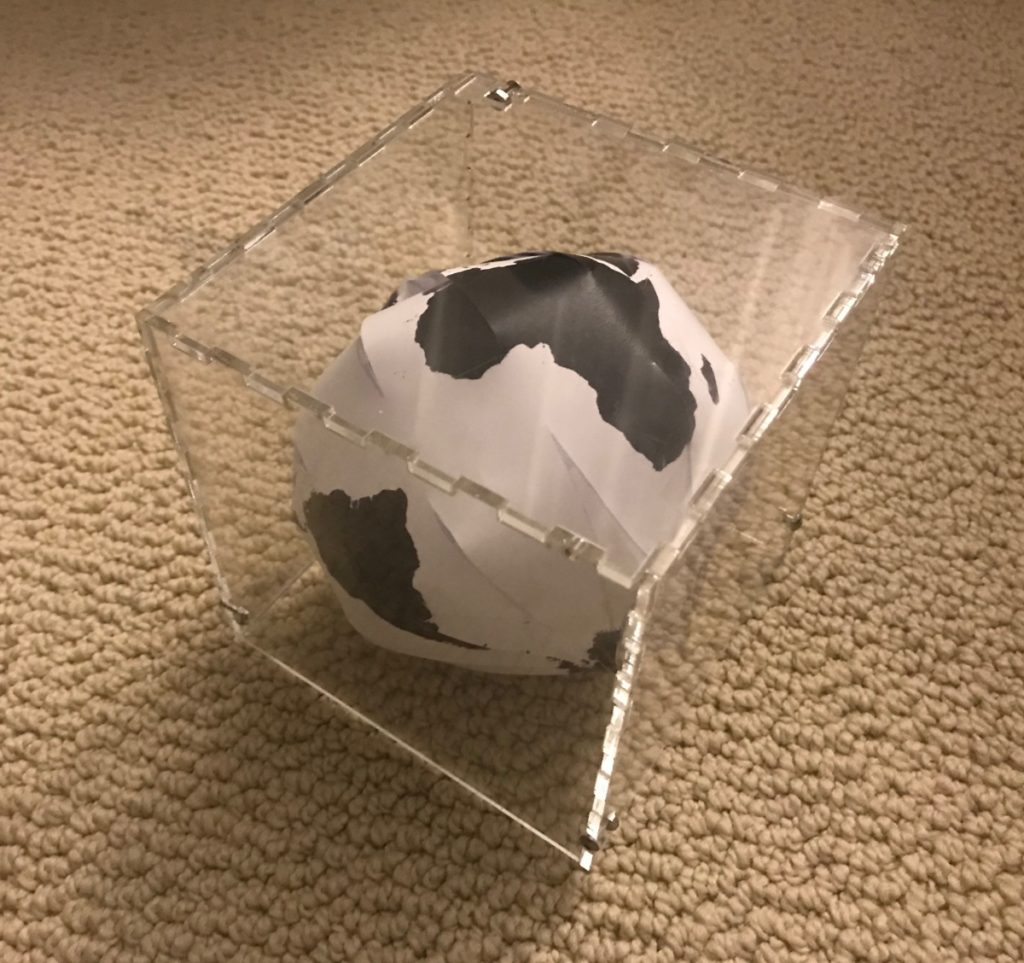
there’s yer evidence right there. Read it and weep, Unicorns.

In conclusion, the Time Cube is an oft-misunderstood incontrovertible fact that the government is trying to hide from us. Clearly they’re afraid of what we’ll do once we find a way to harness all four days per day worth of productivity. Alas, us Cubers have been obstructed by all the Brilliant Oneists and haven’t yet figured out how to do that, but don’t ye worry. We plan to have it down by Expo. Hopefully a little before so we can use Time Cube to finish all the projects we put off trying to harness Time Cube.
This Dream Made Me Mad

You can still faintly recall the event that shifted your world from one of peace and comfort to one of war, famine, and fear. It was 11 years ago – you were a mere child of 10 summers. But though it was long ago, you will never forget.

The young queen had just given birth to a baby boy. He was called Golden, a name that represented all the prosperity and good fortune the kingdom had enjoyed those past years. The king and queen were overjoyed.

Then, three weeks after his birth, the infant vanished. It was thought that he was stolen away by the fae – an assumption that prompted the grieving king to declare war on the fair folk. Furious at the king’s actions, the fae struck back with equal ferocity, decisively marking the end of a peaceful era.

Your life has been difficult and frustrating ever since. At age 15, you took up work as hired muscle. Now, at 21, you are completing the job that has taken the last three years of your life.

You discovered that disorganized, clustered attacks in the north are somehow linked to the elves, families responding to the sudden disappearances of their children. It took you far too long, but you finally traced the missing elf children back to a specific boggart in the northeastern marshes. Initially, the pixie clans seemed the obvious culprits, but there were no changeling children left behind, and elves are rarely the victims of such crimes.
You spent weeks planning your next move. Catching a boggart is tricky. But with patience, there’s nothing you can’t do.

Somehow, it all goes wrong.

Through careful observation, you learned the boggart’s daily schedule. But as you approach silently, you hear someone stumbling through the marshes. A young boy tumbles past, water splashing, grasses rustling around him. The boggart looks up and sees you. There’s a moment where you stare at each other – somehow, there’s recognition in the creature’s eyes. Then it is gone, and you are alone with the boy.

You curse softly. The boggart will be wary now. You won’t be able to try again for a long time.

Finally, you turn to look at the boy. He’s young, still a child. He watches you with wide, expectant eyes.

“What’s your name?” you ask.

He simply stares at you; the silence stretches uncomfortably.

“Alright,” you say. “Maybe you don’t speak Common.” You repeat your question in several other languages, to no avail.

You turn to walk away, but are stopped by a gentle tug on your sleeve.

“You… want to come with me?” you guess. The boy nods.

“So you do understand Common,” you mutter under your breath. But you prepare a mule for the boy and ready your own mount.

The child accompanies you on your journey back to the kingdom. He never complains, or even speaks at all. You take to calling him Silence because in your one-sided conversations with him, it feels strange to grow attached to an unnamed boy.

At last, after a few weeks of blessedly uneventful travel, you find yourself kneeling before the king.
“Your Majesty,” you begin.

But the king’s eyes are not focused on you, but on the young boy who has been shadowing you for so long. Silence stands, unkneeling, before the king. His face is upturned, his expression more peaceful than you have ever seen it.
The king rises from his throne. His face is unreadable; you cannot quite pinpoint the emotion behind his eyes. Anger at Silence’s gesture of insubordination? Or something else?

“I do not care,” the King says tremulously, “for you have brought me something much more valuable: My lost son. My Golden.” He rushes forward and embraces the boy.

“Ohhhh,” you say, standing there stupidly as the touching reunion unfolds. “Silence is Golden.” And then you facepalm into the next century.

Overheard at Olin

“I’m sorry, all. It’s been a long week. I’m not usually this edgy about broccoli and cauliflower.”

[brandishing a P100] “Consider it gently mixed.”

“Be careful. Peach is a gateway cobbler!”

“I want a servant. But not like…a love slave.”

“I have to completely reframe how I work. … I will start by changing my socks.”

“Anyone can be anything, and also racist.”

“Git pull me a sandwich.”

“If I count as animal, a rock should count as an animal… mrow.”

“You need to erase some looks from your face before you can be considered a genuine person.”

[with a look of pure joy and maniacal-ness on his face] “Alright, it might be cocaine…. according to the FTIR machine.”

“Not to be dramatic, but if someone made me eat sushi with a fork, I think I would die.”

“If you want to hack my password, that would be great, but only if you’ll answer my email for me.”

“People don’t only have sex on business days!”

“I’ve been scrambling harder than eggs.”

“There’s nothing more French than lung cancer.”

“What kind of grading system expects you to do ALL the homework?!”

“I am the Magikarp of people.”

“You had me at Yargle.”

[about a truck with its hazards on] “I guess it’s not directional, all his lights are cautious.”

“Hair is such a crutch.”

“I have no idea how paperclips work.”

[pointing at plant] “Now we’re in love.”

“This is a spicy meatball right here.”

“Now I have to party, I guess.”

“Shear is the poor, abused child of the family. After dealing with bending, torsion, and axial stress, I don’t want to take care of this kid anymore. I just want it to sit on the couch and do nothing.”

Horoscopes by Drunk Editors

Taurus (Apr. 20 – May 20): Tired of lying in the sunshine staying home to watch the rain. You are young and life is long and there is time to kill today. And then one day you find ten years have got behind you. No one told you when to run, you missed the starting gun.

Gemini (May 21 – Jun. 20): Hey you, Whitehouse. Ha, ha, charade you are. You house proud town
mouse. Ha, ha, charade you are. You’re trying to keep our feelings off the street. You’re nearly a real treat. All tight lips and cold feet. And do you feel abused? You got to stem the evil tide. And keep it all on the inside.

Cancer (Jun. 21 – Jul. 22): There is no pain you are receding. A distant ship’s smoke on the horizon. You are the only coming through in waves. Your lips move but I can’t hear what you’re saying

Leo (Jul. 23 – Aug. 22): Come in here, dear boy, have a cigar. You’re gonna go far. You’re gonna fly
high. You’re never gonna die. You’re gonna make it if you try. They’re gonna love you.

Virgo (Aug. 23 – Sep. 22): I am just a new boy, stranger in this town. Where are all the good times? Who’s gonna show
this stranger around? Libra (Sep. 23 – Oct. 22): Hey you out there on your own, sitting naked by the phone. Would you touch me? Hey you with you ear against the wall Waiting for someone to
call out. Would you touch me? Hey you, would you help me to carry the stone? Open your heart, I’m coming home

Scorpio (Oct. 23 – Nov. 21): Down, down. Down, down. The star is screaming. Beneath the lies. Lie, lie. Tschay, tschay, tschay. Careful…Careful…Careful with that axe, Eugene. The stars are screaming loud. Tsch. Tsch. Tsch.

Sagittarius (Nov. 22 – Dec. 21): For millions of years mankind lived just like the animals. Then something happened which unleashed the power of our imagination: we learned to talk.

Capricorn (Dec. 22 – Jan. 19): And if the dam breaks open many years too soon. And if there is no room upon the hill. And if your head explodes with dark forebodings too, I’ll see you on the dark side of the moon

Aquarius (Jan. 20 – Feb. 18): Pisces (Feb. 19 – Mar. 20): IF YOU DON’T HAVE YER MEAT, YOU CANT’ HAVE ANY PUDDING.

Aries (Mar. 21 – Apr. 19): We don’t need no education. We don’t need no thought control. No dark sarcasm in the classroom.

Horoscopes by Drunk Editors

Taurus (Apr. 20 – May 20): Move forward one pawn or your pawn may change places with any pawn of an opponent.

Gemini (May 21 – Jun. 20): Three dice are rolled on the Able-Bodied Welfare Recipient Promenade to determine the number of blocks advanced each turn.

Cancer (Jun. 21 – Jul. 22): When one player’s stock of colored plastic trains gets down to only 0,1 or 2 trains left at the end of his turn, each player, including that player, gets one final turn. The game then ends and players calculate their final scores.

Leo (Jul. 23 – Aug. 22): There’s a delicious chocolate cake in the kitchen which is just impossible to resist. Luckily Dad is asleep and the kids are about to try creeping past to get a piece. But they really have to be careful, there are so many obstacles along the way and any one of them could WAKE DAD!

Virgo (Aug. 23 – Sep. 22): Bonus, receive $300 when you land on this space. Not from me, what do you think this is, a bank?

Libra (Sep. 23 – Oct. 22): At the beginning of each players’ turn they draw one candy card. That card may contain a single color block, two color blocks, or a picture of a place on the board. The color blocks allow you to move forward to that corresponding color. If two color blocks are drawn, then you move forward to the second matching color.

Scorpio (Oct. 23 – Nov. 21): Watch out for Gemini. They’re thinking about changing places with your pawn. What an asshole.

Sagittarius (Nov. 22 – Dec. 21): You must move one pawn forward 7 squares or split the move between any two pawns.

Capricorn (Dec. 22 – Jan. 19): Bonus, receive $250 from Virgo when you land on this space.

Aquarius (Jan. 20 – Feb. 18): You are curious to learn more about Bigfoot and hope to befriend him, but he is threatened by your presence. Will you escape as he kicks the boulder in your path or will you have to start again?

Pisces (Feb. 19 – Mar. 20): The object of the game is to WIN. Even a straight hairdresser could understand that. On the surface that means driving your opponents into bankruptcy, leaving you as the ultimate Gay Realtor.

Aries (Mar. 21 – Apr. 19): You must move one pawn backward 4 squares.

Letter to All First Years

I’m just going to get some thoughts down here for my views on Pass/No Record at Olin and the student body’s perception of Pass/No Record. Pass/No record is a wonderful thing that Olin does to help with what can be a difficult transition from high school to college.

For a lot of people, myself included, their first year at college means their first year being away from home, from people they love, from environments they’ve become accustomed to, and really the start of a new part of their lives. That’s where it helps to have something like Pass/No Record. It takes away some focus from your academic performance and gives you the opportunity to get yourself situated.

Sadly, I don’t think this is the common perception of Pass/No Record at Olin. It seems as though we, as a student body, treat Pass/No Record as a time to slack off and not try our hardest to apply ourselves to what we’re learning. Something that feels very special about a lot of classes at Olin is that you get out of them what you put into them.

You have so much agency with what you choose to focus on in your classes that no two people will come out of the same class having gained the same things from it. This is easy to take for granted when it feels like you’re not learning what you think you’re “supposed to be learning” from a class, but the reality is that you can learn what you want to learn from a class. At least, you have a better chance to than you would with a narrower curriculum.

Let me explain. Over the summer, I had the awesome opportunity to work at Harvey Mudd and go through the course materials of a class there called “CS 35.” This class is the closest equivalent Harvey Mudd has to Software Design here at Olin.

Both classes are designed to teach computation as a tool with exposure to an assortment of powerful Python libraries. The point is to give the students an opportunity to do some stunning things with the power of programming.

However, when you look beyond the goals of the classes, and really pay attention to their structures, you begin seeing the discrepancies. Before I go on, I want to explicitly say that by no means do I think either class is better than the other. Both do a wonderful job of achieving their goal, but they go about it very differently.

Software Design gives students a ton of freedom to go where they want with Python and to develop creative solutions to the challenges it throws at students. The underlying core of Software Design is its open ended projects.

You start with a relatively simple, well-scaffolded project to get you comfortable with string manipulation. All of the high level code architecture is there. You just have to turn the ideas into computer code. The next project is also well scaffolded, this time with an emphasis on recursion. Again, the high level code architecture is there; you just have to turn ideas into computer code. How you do this is up to you.

Then we get to the part of Software Design that gets really interesting. You’re introduced to lots of different libraries in Python: web scrapers, data visualizers, game development, sentiment analyzers, the list goes on!

Then you’re told to go ahead and create projects that utilize these libraries. Software Design is truly an open-ended, project-based class, ending with a final project where you can go nuts with a team of people and develop your software skills in whatever the heck you want.

With this example, it’s fairly easy to see how two people could go through Software Design and get very different things out of the experience. I learned how to utilize object oriented software principles to make a simple game, whereas some of classmates learned how to visualize massive amounts of data. These are two very different outcomes from the same project, and projects are the backbone of this class.

Now let’s take a look at CS 35. CS 35 has students go through a series of problem sets that expose them to different Python libraries and challenges them to do some really cool things with those Python libraries. Students learn how to use Python for image processing, machine learning, file management, web interfacing, and so on.

It’s an awesome class, but it’s structured very differently than Software Design. Students in CS 35 come out of it with a shared experience, and shared knowledge. Everyone going through CS 35 will learn about image processing, machine learning, and so on. Students going through Software Design will have very different experiences depending on where they choose to invest their time. This makes Software Design a strong example of Olin’s self directed learning model.

With all this, the question remains: How does this relate to Pass/No Record? Pass/No Record is the epitome of self directed learning. You’re not doing it for the grade; you’re doing it for your own learning. No one is going to be there to evaluate and hold you accountable for the effort you put into your first semester classes.

It’s up to you to begin taking control of how you spend your time, to start figuring out how you best learn, to get what you want to get out of your classes, and to get what you want to get out of your education.

If you want to get better at sketching and communicating ideas visually, really pour your heart into practicing sketching in Design Nature. If you want to learn more niche programming skills, take what you learned in ModSim about parameters, functions, and arguments, and go work on a project in the Robo Lab. Start searching for the opportunities to work on what you want to work on.

Of course, figuring out what you’re going to want to work on can be really challenging. A lot of Oliners advise that you try everything all at once and see what sticks. It’s Pass/No Record after all, so why not go ahead and take the risk of overcommitment? Well, from my perspective, you shouldn’t because overcommitment is overcommitment.

You could try this approach and spread yourself thin over Baja, OARS, the Robo Lab, Ultimate, and all of your coursework, but there’s no way you’ll get what you want to get out of any one of those things.

Everyone on this earth has exactly 24 hours in a single day, no more and no less. The more things you’re doing, the less time you can allocate to any one thing. The less time you can allocate to any one thing, the lower the chance you can actually get what you want to out of any one thing. Also, the higher the chance that your personal health is going to take the hit for your overcommitments. Your sleep is important, dammit!

To remedy all of what I’ve said, I want to leave you with a piece of advice that I welcome you to follow or not follow as you see fit. Take advantage of Pass/No Record as a time to get yourself situated, to figure out how to balance your coursework, your extracurriculars, and your own personal health.

Don’t fall into the trap of seeing Pass/No Record as an opportunity to slack off and do whatever you want. Use it as an opportunity to prepare yourself for the rest of your time at Olin. Set up good habits now so that when you’re thrown into the more intense classes like QEA, MechProto, or SoftDes, you’re ready for it.

Everardo Gonzalez, your friendly neighborhood ModSim NINJA

One Last Note:
As a ModSim NINJA, I get to work with ya’ll and get some glimpses into your lives and how awesome you all are. There’s so much positivity and awesome questions! Keep that up! Asking questions when I’m lost and keeping a positive attitude in the face of some really intense challenges is probably the reason I’ve survived QEA thus far. Keep those positive attitudes and inquiring minds. Just make sure you’re taking care of yourself and not falling into the overcommitment no-sleep tired-all-the-time trap. It’s not a fun place to be, and yes, I’m speaking from experience.

Perspectives on Olin from The Netherlands

Exchange students on campus add cultural diversity and new perspectives to the Olin Community. This fall, Olin welcomed seven exchange students from The Netherlands, France and Belgium. The following questions and answers provide an image of how these students feel about their opportunity to study at Olin. Thank you, Florian and Jai, for your thoughtful responses and your insights on the novel educational experience of Olin, valued cultural traditions you left behind in the Netherlands, and much more.
1. Tell us a bit about how you found Olin and why you wanted to study here?
Jai: My home institution of University College Twente in the Netherlands has an academic model similar to that of Olin. I wanted to use the semester abroad opportunity offered by my college to not only further develop my engineering skills and knowledge but also explore educational frameworks best suited to preparing me for the complexity of global engineering challenges. After talking to professors and advisors at my college about Olin, I was convinced that it was the best fit for me.
Florian: Olin College of Engineering is not only one of the most prestigious engineering schools in the United States of America. Olin also has an educational model that is most likely to teach you the skills you expect to learn when you go to college.
Can you tell us about your academic experience at Olin so far?
Jai: I had high expectations of the academic rigor at Olin. While I had expected many similarities in the collaborative, project-based learning approach of Olin and Twente, I was pleasantly surprised by the efficacy of learning even highly technical subjects through exploration rather than traditional instruction. I enjoy the freedom to determine my own learning path, so I find my courses challenging and stimulating. The instructors are very approachable, and they provide the needed academic support so that I feel confident in myself in exploring a subject.
Florian: So far, I have really been enjoying my courses. Of course, given that the University I attended in the Netherlands was largely modeled after Olin College’s educational strategy, the way education works at Olin was not exactly new to me; however, at the University of Twente I really missed the competitive aspect of work. At Olin competition is not about beating each other, but it is about continually improving your work and yourself. Because there is some sort of numerical reflection of your performance, liberal though this may be, I feel that Olin does a better job of maintaining the drive to improve than the UT.
2. Can you tell us about life outside the classroom?
Jai: Olin has a very warm and friendly community. I find it amazing that you can strike a conversation with anybody, be it sitting in the dining hall, walking to the residence halls, or out playing on the fields. It is a pleasure being part of such a closely-knit community. I’m also planning on exploring the beautiful countryside and national parks in the New England area on weekends and breaks this semester with other Oliners.
Florian: Life outside the classroom is a bit different from what I expected. For instance, at Olin everyone can be who they are and, even though we are all peculiar in our own ways, everyone is accepted and welcomed into the community. I definitely think this is fueled by the size of Olin. The college at the UT I went to is about half the size of Olin, and I think in this sense the community is too small to maintain a truly open and accepting environment.
3. Do you think studying in the US will ultimately help you achieve what you want to do professionally?
Jai: The US is an undisputed world leader in higher education. Colleges and universities are not only well connected with industry and its needs but also driving a lot of the innovation in science and engineering in the US. Olin and this small region of Massachusetts with its many prestigious universities has many opportunities to connect with exciting ideas and projects in research and industry. With my novel engineering education at Olin, I am certain I will be better equipped to tackle complex real-world challenges and build my career in the challenging field of materials engineering and Nanotechnology.
Florian: Currently I am looking to explore the relatively novel field of combining urban engineering with health sciences to optimize living standards in cities across the globe. Relatively open learning environments such as the one offered at Olin enable me to learn the skills and gain the technical knowledge I need to achieve this. My ambition is to apply for a mid-size to large architectural firm in the United States as a consultant urban planner after completing grad school. I firmly believe that US firms are uniquely well-positioned to make the global changes that I would like to contribute to. US firms are more or less universally looked up to around the globe, and I believe we could harness this respect to make real, lasting impact.
4. What do you miss most about Dutch culture (or your own home country culture if it’s not the Netherlands) now that you’ve been here for over a month?
Jai: Although, I was born and raised in India, studying for the past 2 years in the Netherlands has endeared the country and its culture to me, and I’m proud to represent it here at Olin. Although Olin’s culture of openness reminds me a lot of Dutch culture, I miss the almost brutal honesty of my foster home country. The Dutch are very expressive of their feelings and receptive of criticism. Instead of souring interpersonal relations, this honesty brings people closer and fosters ‘gezelligheid’. This Dutch word lacks an English translation but signifies a state a little beyond cozy, quaint and fun.
Florian: I am one of the Europeans who firmly believe in the unity of Europe. As a result, I consider myself more of a European citizen rather than specifically relating to any country in particular. The greatest difference between American and European culture I have noticed is the European tendency to take everything with a grain of salt. In Europe, people often take each other at face value.
5. Students who study abroad often talk about a turning point as they assimilate and find their way in a new country. For some, it’s about feeling comfortable speaking a new language. For others, it’s feeling immersed in the culture of their host country and enjoying their new home. Can you think of one moment that this was true for you at Olin?
Jai: I was surprised by how easy it was to connect with people at Olin and make friends. I think a more significant aspect of settling in at Olin was identifying with the mission of the college. I think the strong sense of community stems from a common belief in Olin’s model of education and the values it embodies. These values go beyond just the Honor Code and are reflected in simple things like the trust Oliners place in each other to the more abstract, enterprising ethos of the college. I’m still exploring what it means to be an Oliner, but since Olin’s core values resonate with my own, I feel like I belong here.
Florian: When I came to the United States, the biggest challenge was being confronted with the concept of “being offended”. Compared to other countries I’ve lived in, American culture tends to be about respect and acceptance; a virtue that manifests in very different ways in most other cultures I have experienced. In the beginning I was ridiculing it because it seemed like Americans were so sensitive. Now that I understand it better, it actually makes me appreciate American culture more than I already did. I think this understanding of an open culture will make my life in the United States even better than I expected; I hope this aspect of American culture will make sure that everyone in this country can be accepted and appreciated the way they are.
6. Is there something about Dutch culture or language that you would like to share with your Olin classmates?
Jai: The most important word for me in the Dutch language is ‘gezellig’ (pronounced heh-SELL-ick). As I mentioned in a previous response, it doesn’t translate well to English, but a ‘gezellig’ experience most closely signifies a fun, quaint, and cozy experience. I look forward to a gezellig time at Olin.
Florian: The Netherlands is one of the most internationally welcoming countries in Europe. Most of the education is offered in English, the official language of Amsterdam is English and most companies are also really open to employing workers from abroad for their international experience or new perspectives. If you are looking for a way to move to Europe in a country where multiple languages are considered working languages, the Netherlands is definitely your go-to place.
7. Would you encourage Olin students to spend a semester at the University of Twente or to visit you in the Netherlands?
Jai: I would most certainly encourage Olin students to spend a semester at University College Twente (the Honors College of the University of Twente). The educational model is similar to Olin’s. The semester is based on a multidisciplinary project on a real-world challenge. Students choose technical engineering as well as non-technical courses like psychology, economics or product design from across the university to customize their academic profile and contribute to the project by leveraging their unique skill set. Even if you’re not interested in a semester abroad program, the Netherlands is a beautiful country to visit. There’s a rich culture of design, enterprise, and innovation in the Netherlands beyond the tourist traps of Amsterdam. All Oliners are welcome to get in touch with me for any recommendations or questions about the University of Twente or the Netherlands in general, and I’ll be glad to help them in any way I can.
Florian: International experience is always a good to part of your curriculum. The University of Twente also offers good engineering programs to broaden the minds. Especially with the fully English education offered in the Netherlands, international students would have a great experience studying there for a semester. As for visiting me, I have no concrete plans of moving to the Netherlands any time soon. After my semester at Olin, I’ll be going to Singapore for a graduation project much like SCOPE, and I’m hoping to go to grad school in Trondheim, Norway. I also have multiple applications open with American engineering firms, so I’d probably end up getting a job in Boston, New York or Montreal. If Olin students would like to visit me in Singapore, Norway or Canada, they all know they are more than welcome to.

Funetik Inglish

Thu hardist part uv lurnyng Inglish iz lurnyng tue spel, but it duznt haf tue by. Wut if Inglish wuz speld funetikly? Moest uv thyz wurdz mey look streynj, but theynks tue thu dizien uv this nue kunvenshin, meny uv thyz spelyngz ar egzaktly or nyrly thu seym az ther standurd kownturparts, wiel uthurz ar alredy in yues az nonstandurd spelyngz umung yung pypul.
Rydyng this mey by hard for yue, but ask eny chield or hispanufoen and they wil tel yue: this form iz signifikintly yzy’ur tue lurn. If yue kan sey a wurd, yue kan spel it, and if yue kan spel a wurd, yue kan sey it (with thu noetubul eksepshin uv “th”, wich miet by voyst az in “this” or voyslis az in “thin”). It apliez tue neymz tue, soe thu eyj-old dubeyt butwyn “Gedis” and “Gedyz” wood fienuly by rizolvd dependyng on how Jon chuziz tue riet it. Morovur, “Q” and “X” ar wurthlis pysiz uv garbij and ar not yuezd in Funetik Inglish, kutyng thu numbur uv leturs lurnurz nyd memuriez down tue tweny-tue.
Now ie kan hyr yue thynkyng: “Wut ubowt thu etimolujyz? Thu konjoogashinz? Woent it by hardur tue lurn tue riet if kidz doent noe wen tue ad u ‘-s’, ‘-z’, or ‘-iz’? Or uf they kant sy thu ryleyshinship butwyn ‘telefoen’, ‘fonugram’ and ‘funolugy’?” Um, noe. And hue kerz enywey? The kunjunkshinz ar yzy; kidz kan due thoez verbuly withowt thynkyng, soe tychyng them in skuel iz ryly a weyst uv tiem enywey. Az for the etimolujyz, lyngwists liek Noe’u Webstur and Otoe Yesbursin tend tue furget how yueslis they ar. Noe’yng how tue riet iz moer importint than noe’yng frum wens wurdz keym.
Thu oenly ryl downsied tue this iz murjurz, liek how sum pypul sey “kot” and “kot” difrintly, but uthurz doent. In thoez keysiz, ie er on thu sied uv fyuewur distynkshinz—wy Umerikinz get ulong just fien withowt difrenshi’eytyng “kot” and “kot”, soe British pypul shood by eybul tue due soe in rietyng az wel. In eny keys, betur tue meyk wun gruep rite difrent sowndz thu seym than tue meyk unuthur gruep memoriez sielent letur spelyngz.
Ther ar sichue’eyshinz wer spelyngz haf tue dievurj, wich iz wen difrint pypul prunowns thu seym wurd difrintly. For egzampul, “plan” if yor Umerikin vz. “plon” if yor rong. Spelyng standurdizashin iz u posibility, at lyst much mor soe than prununsiashin standurdizashin, but ie woent komprumiez on thu prinsipul that no spelyng nyd by memorizd. Thus, Funetik Inglish wil simply kary thu jrobak that sum wurdz ar speld difrintly bie difrint pypul, but oenly soe far az they ar sed difrintly.
Soe ther yue hav it. Mie prupoesul to meyk Inglish just u litul bit mor sensikul: Funetik Inglish. Wuns eynglufoenz urownd thu wurld sy thu lojik in mie argyuement, iem shoor theyl ygurly meyk thu chranzishin. Look forwurd tue sy’yng thyz spelyngz in thu nekst edishin uv Mery’um-Webstur.
Thats it. Wow, look at that. Undur fiev hundrid wurdz! This iz ryly speshul for—weyt, noe! Deyng it. Nevurmiend.

Promise of Ra: Chapter 1

Oscar walks through the cracked streets. He turns the wrong corner and finds himself at a dead end.

Two teenagers come up from behind, blocking his path. Their jeans are tattered and their guns clearly visible.

One walks forward. She wears an oversized army shirt and a dangerous expression, but more unsettling, her eyes are two different colors, one grey and the other an unsettling yellow.

“What you doing here, pretty boy?” she taunts. Oscar straightens and looks her in the eye.

“I have as much right to be here as you do,” he returns, perhaps unwisely. The girl laughs and shakes her head.

“See, I don’t think so,” she responds. “I think you’re on our turf, and if you don’t get off, you’re gonna end up on the wrong side of my Colt.”

“Your turf?” Oscar asks incredulously. The girl shakes her head.

“You’re out of your depth, boy.”

“I don’t think I’m the only one.” In response, the girl stops with her hand on her hip. The look on her face, if possible, becomes more dangerous.

“And why’s that?” she asks.

“You don’t have what it takes to shoot me,” Oscar challenges. She laughs drily.

“We’re not gonna kill you, trust fund baby. I, for one, always go for the feet, and Anubis here always loves a good kneecapping.” The boy behind her grins and cocks his pistol. “So get.”

Oscar doesn’t move. The girl pulls him down by the collar.

“Look,” she snarls, “I don’t walk your streets. I don’t crash your high society balls.” When she says this, a flicker of recognition passes across Oscar’s face.

“That’s not true,” he retorts. Her expression darkens. She pushes him back and cocks her gun in one motion, pointing it at his chest.

“I’ve never crashed one of those stupid parties,” she snaps, her voice tight with controlled anger.

Oscar, showing real fear for the first time, holds up his hand.

“Relax,” he responds frantically, “I’m just here to visit my grandmother.”

Surprise then skepticism pass over the girl’s faces. She looks back at the boy who shrugs. She shrugs back and drops the pistol.

“You better not be playing us, Red Riding Hood,” she threatens. She and the boy part to let Oscar pass. He starts to walk through them but stops near the girl.

“You’re playing a dangerous game,” he warns.

She steps closer and, though shorter, seems to tower over him.

“I’m not the only one, and the difference is, I know how to play mine, and I always win. Remember the name Horus, and pray to whatever pathetic god you keep that you never hear it again.”

Oscar, once again reminded of the real danger of the situation, walks away
without responding. Horus bangs her fist against the alley wall in frustration.

“He recognized me,” she snaps. Anubis shrugs.

“Maybe, maybe not,” he responds. “He seems like a guy who likes talking out of his ass.”

“Even so,” Horus says, “I need to be careful. They already think I’m not worth their champagne towers.”

“Champagne towers?” Anubis snorts.

“Yup,” Horus confirms. “Always gets knocked over by some drunk two hours in.” When their laughter dies, Horus suddenly sighs. “I have to get back. There’s another hell fest tonight. It’s not a medal ceremony without a champagne tower, right?”