Who Are the PAs?

The PAs, or the Peer Advocates for Sexual Respect, aim to have a diverse set of student volunteers who are committed to being a support network for other students struggling with sexual misconduct, having a healthy relationship, or for students who are concerned for others. 

For some brief history, the PAs began as an AHS Capstone in 2014. Motivation to start the PAs stemmed the climate survey and Frankly Speaking article from 2013 that confirmed that sexual assault does happen at Olin and affects the same percentage of students as other colleges around the country.

The PA program is here to advocate for and work towards making Olin a place where people feel safe and respected. As a completely independent, student-led group, we aim to be a resource and response to the evolving situation of sexual respect at Olin.

We also recognize that it can be very tough to approach anyone with personal and sensitive issues so we hope to connect with the community and break the social barriers when it comes to topics like consent, sexual health, and relationships as a whole. Be on the lookout for PA Jeopardy, “It Happens Here”, and PA Wellness events, and community wide Trainings!

Thank you, Olin

My time at Olin has been overshadowed by conflict with my parents. At first, it was manageable. I could ignore them. I could fake and tolerate them during the infrequent calls. But with each month, things got worse. A new demand. A new threat. A new ultimatum. As they pushed harder, I grew increasingly distant from them. Eventually, the only thing keeping me in their orbit was money—money to pay for Olin. I finally broke this summer when they pulled that string and used the money as a weapon against me. I felt the floor rip from beneath me. I lost hope in reconciliation when I sent a letter explaining my needs, and their only response was, “You have a severe anxiety condition.” This semester, they became more erratic and more delusional. When my mental health struggles took on physical manifestations, I knew I could not sustain this relationship any longer. Having fully lost hope, I finally estranged myself from my parents. No more communication. No more returning home. No more money.

With no other way to pay for the full cost of attendance, I turned to Olin financial aid. With a letter from my therapist and a 5,000-word document detailing my parents’ emotional abuse and my resultant mental health struggles, I was hopeful things would turn out all right. Unfortunately, I was wrong. Three weeks ago, I was denied my FAFSA Dependency Override request by Olin’s Financial Aid Administrator. In a conversation with said administrator, they recommended that I learn to cope or try communicating with my parents, despite my written and verbal explanations as to why this was not feasible for my mental health. (Please read into FAFSA Unusual Circumstances and FAFSA Professional Judgement—you’ll find there is no way to appeal.) To put the nail in the coffin, I was told earlier that becoming self-supporting was insufficient to justify a new Dependency Override decision for later semesters. Thus, because I cannot bear to take on $150,000 of debt, I find myself unable to afford the remainder of my Olin education. I have been in a scramble to get a job, a car, and housing, and Engineering for Everyone feels so far away.

As I have been preparing for my departure from Olin, I have come to appreciate all the great things about this community that I will soon miss. I’ll miss playing Blood on the Clocktower and Coup on weekends. I’ll miss being Olin’s leading Egyptian War (Egyptian Rat Slap, ERS) player. I’ll miss all the good times playing table tennis. I’ll miss the pool room. Soccer. The wild conversations and napkin drawings in the dining hall. Causing a spectacle with a fork and knife. Being that crazy Californian still in shorts and flip-flops. Spectating Spoon Assassins. Volunteering at Candidates’ Weekend. 30-Second Videos. All the emails. The acronyms. The drama. Joking about Olin infrastructure while living in it. Collectively suffering with Olin courses. Being in the shop. Fixing up the Baja car in the LPB. Welding. Walking through the O at night. The busy weekends and late nights working on projects. I’ll miss having a shoulder to lean on. I’ll miss this community. Being surrounded by so many genuinely good people has truly changed me for the better. To those I have worked with, hung out with, suffered with, had crazy conversations with, I’m so grateful to have known you. I’ll never forget my time here at Olin and this community which has served me so well. From the bottom of my heart, thank you for being with me.

All the best,

Austin “live free or die” Strahm

So, I Transferred to UMass

In fall 2021, I entered Olin College of Engineering as a member of the class of 2025. I studied there for six semesters, and was miserable for all of them. However, this article is not a rant about why Olin was a poor fit for me and why I left; that would be irrelevant and unhealthy for me to recount. No, it’s about my experiences transferring out of it. Many people I talked to while attending (both inside and outside of Olin) believed it wouldn’t be worth leaving because Olin’s unconventional curriculum wouldn’t transfer well, and college credits don’t come without a large financial and time investment. My response: look up “sunk cost fallacy”.

There are plenty of valid academic and non-academic reasons to transfer colleges. This is also not about that; you know you best. If you want to transfer, you are valid :)

I originally wrote this article back in May, working minimum wage during a gap year. I now attend UMass Amherst, survived midterms, am out of the closet (at UMass, family pending), have a great group of friends, and am probably happier than I have ever been since I can remember.

That’s what this article is for, to let people know it is possible. If this article was published during my first or second year at Olin, I would have started the transfer application process immediately.

Transfer Credit

You will lose some time, but nowhere near as much as I originally thought.

I mainly applied to engineering programs in Massachusetts, and can only share the experience about the schools that accepted me. You receive a credit evaluation after acceptance; most schools send an evaluation in a timely fashion, other schools are Northeastern University…

Some things to keep in mind about transfer credits:

  • Some schools have a minimum credit requirement to accept a course: “Insufficient credit earned, must be 3 credits or more”. This is a problem since many Olin courses show up as two two-credit courses on your transcript.
  • Some schools accept the majority of your courses, but don’t map them to specific major requirements. You will have to put in time with your advisor, and some schools make it easier than others; unfortunately, meeting with an advisor is often behind your deposit. At larger schools, credits may have to be evaluated by different departments, which becomes a pain.
  • Download all of your syllabi from Canvas; they will ask for them. If you take a gap year like I did, your olin.edu email will be disabled, and anything behind Microsoft Single Sign On will lock you out. Then you end up awkwardly emailing all your professors and learning that external emails find their way to their junk boxes… shout out to Brad, Carrie, and Steve for responding and making me aware of this issue. You can also ask students you took classes with for the syllabus, which was extremely helpful.

Don’t forget about college credits from high school: Community College, AP exams, programs like PLTW, etc.

One reason I transferred was to have a wider selection of general education and humanities courses. You want to cherish your general education courses, not waste them on two semesters of college writing. If you don’t have AP, look up CLEP College Composition; this can free up time for more interesting general education, or for electives that might interest you.

UMass Specifically

A major reason I chose UMass was due to how accommodating they have been in supporting transfer students. The Electrical and Computer Engineering department has been especially supportive in this regard, and has been willing to hear me out on all my Olin courses for credit mappings. They have several programs and housing options specific to transfer students, and have ultimately made the experience pleasant. Not every department is like this—more on that later.

My advisor here initially gave me an estimate of 1.5 years, the same amount of time I had left at Olin. I opted for 2 years at UMass since I prefer to keep the credit load lighter and touch grass.

You will need to advocate for yourself, even in a supportive department. I am not good at that. I did end up taking an engineering math course that covers similar content to QEA3 and ESA. Perhaps I could have talked my way into getting credit for that.

You will end up with some goofy-looking schedules transferring from Olin. Next semester, I have Junior Design Project, a statistics course meant for sophomores, a graduate-level operating system course, an undetermined general education course, and possibly freshman physics. I still have no idea if I have credit for Physics 1&2 or not (they have the syllabi for QEA1-3, ModSim, and ISIM). The Physics department has not been easy to work with on this, unlike the college of engineering.

I don’t want to talk too much about money in this article. TLDR: most private institutions will cost more than Olin (assuming the 50% scholarship is still a thing). However, I am now an in-state student at a public university, so it is a lot more affordable in the end (even considering the extra time I am taking).

I would have preferred an urban campus, but I love everything else about UMass so far. You have to make compromises in life.

So you want to transfer

Okay so you’re considering transferring. Here’s some advice that you can’t just google.

  • Many schools (particularly private institutions) look for 1-2 years of college, and will openly say they will reject transfer students with 3+ years unless they are truly exceptional. Also, if you’re unhappy, don’t wait 3 years like I did; stop sinking more time into something that isn’t working for you.
  • I already said it, but download important records that are behind Microsoft Single Sign On. Your email will be disabled if you take a gap year.
  • Olin has a letter explaining what some of their courses cover and how it maps to a more conventional curriculum. You can add it as an additional document upload in your transfer applications. This is also helpful for credit evaluations. (I still haven’t heard back from Physics yet though…)
  • Visit campuses. I applied to college during peak `rona, and online “tours” really did not influence my top choices. It actually helps to have a sense of the neighborhood (or lack thereof), and how alive the campus feels. Admittedly, this may be irrelevant to the current generation of students who actually got to take tours.

Editors note: If you would like to get in touch with the author of this piece, please contact the Frankly Speaking team.

Best Black-ish Episodes to Watch to Learn How to not be Racist

Hi everyone! It’s me again, but don’t worry—this article is a fun one! Ever heard of Black-ish? If you have, give yourselves a pat on the back, if not, I’ll explain: Black-ish was an 2010s ABC sitcom about an upper-class black family, the Johnsons, who work to hold onto their roots while living in a suburban white neighborhood. There is Dre, a Compton-born successful advertising executive obsessed with ensuring his affluent family maintains a strong cultural Black identity, and his wife Rainbow, a pragmatic biracial doctor who balances her family’s cultural identity struggles. Then there are their 5 children, fashionable eldest daughter Zoey, the nerdy eldest son Junior, the twins: the cunning cynical Diane and goofy upbeat Jack, and baby Devante. Don’t forget about Dre’s parents, Pops and Ruby, providing insight from an older generation and flashbacks to their 70s misadventures. Black-ish highlights the struggles of being black in America with raw honesty, ranging from issues of rude coworkers to police brutality. If you don’t know where to start, here is my top 20 Black-ish episodes you should watch and why: 

  1. The Pilot (Season 1, Episode 1): I always believe you should start with the pilot. It lays out the groundwork and logic of the show very well and gives a great intro to the Johnson family dynamics.
  2. Switch Hitting (Season 1, Episode 20): A wonderful look into “code switching”, a common practice where black people act differently when in white spaces than in black spaces to avoid discrimination. Guest-starring the hilarious Michael Rapaport, you don’t want to miss this.
  3. Please Don’t Ask, Please Don’t Tell (Season 1, Episode 22): When Dre’s closeted sister visits, drama follows. This is a relatable episode for anyone who has struggled with being fully out with family. Especially since black people are frequently excluded from queer communities, even here at Olin. 
  4. The WORD (Season 2, Episode 1): This episode is a great follow up to last month’s article, examining the use of the N-word in an upbeat and comedic way to ease the discomfort of a complex subject using sitcom PTA drama, what fun!
  5. Sink or Swim (Season 2, Episode 14): Whether it is Dre fighting the stereotype that black people can swim, the twins fighting the stereotypes of Girl Scouts and Boy Scouts, or Rainbow fighting working mom stereotypes, the whole Johnson family does their part to prove their haters wrong! 
  6. Hope (Season 2, Episode 16): Hey, remember that time when an unarmed black person was shot by a cop, and the cop received no punishment for his crime? You know, that thing that happens on average 200 times a year. This episode examines the acquittal of one of those shootings and how the Johnson family teaches their youngest children about the dangers of being black in America.
  7. Being Bow-racial (Season 3, Episode 8): This episode expands on Rainbow’s own internal struggles as a biracial black woman, going back to her childhood as she learned to find a way to embrace being a black without losing part of herself, leading to the spin off series: Mixed-ish.
  8. One Angry Man (Season 3, Episode 16): This episode examines a young black man on trial and Dre, juror #8, takes it upon himself to save the young man from a false conviction, effortlessly combining a classic sitcom plot with lessons on racial discrimination in legal proceedings.
  9. Juneteeth (Season 4, Episode 1): Before Juneteeth became a national holiday, black families across the country celebrated it. With a full-on Hamilton style musical number, guest-starring Grammy-nominated singers, Black-ish shared the history and message of this important holiday across the nation. 
  10. Advance to Go, Collect $200 (Season 4, Episode 4): One of my favorite episodes, the whole Johnson family getting together to play a game of Monopoly, and like any family game night, it gets messy. There is jealousy, betrayal, greed, and destruction, all in 25 minutes! What’s not to love?
  11. Please Baby, Please (Season 4, Episode 24): In only 25 minutes, the Johnson examines the impact of Trump’s first presidency, the rise of gun violence, reemergence of white supremacy, and climate change all in the form of a bedtime story to baby Devante. 
  12. Gap Year (Season 5, Episode 1): Did you or someone you know want to take a gap year and parents disagreed? Well, the same thing happens to Junior in this episode when he decides to take his own gap year! A teenage boy is just trying to convince his parents to let him have a gap year while the parents treat it like an incoming apocalypse. 
  13. Black Like Us (Season 5, Episode 10): Colorism is a form of racism that is never talked about enough in the black community. In a black family of different shades, it unleashes tough revelations over unseen struggles done in the family’s own home. Johnson’s discussion of colorism is an honest portrayal of it and a reminder that even black people contribute to toxic racist cultures.
  14. justakidfromcompton (Season 5, Episode 15): When the family tries to get Dre’s cousin Kyra into a prestigious prep school, the school administrators view Kyra as a “charity case”, rather than a deserving student, highlighting the condescending nature of performative inclusion. It’s a great examination of the “savior complex” and what it means to truly provide a fair chance.
  15. Feminisn’t (Season 6, Episode 4): Did you know the Seneca Falls Convention did not allow black women to enter the event? Black women were also not welcomed to participate in the 1913 Women’s March, and not allowed to be members of NAWSA. Feminism has always excluded women of color, so Rainbow assembles some of her girlfriends to show the viewers what black feminism looks like.
  16. Hair Day (Season 6, Episode 11): Hair has huge cultural meaning to black communities, which this episode just scratches the surface of. Breaking the show’s traditional format with segments featuring real Black women, a musical number, and an animated sequence to cover the history, politics, and labor involved in various Black hairstyles.
  17. Election Special Part 1 (Season 7, Episode 1): When Junior can’t register to vote, he goes on an internet deep dive with help from his family to discover why he was denied his American right. From children’s books to gameshows, this episode uses different kinds of media to unearth the truth of voting in a style every viewer can understand. 
  18. Election Special Part 2 (Season 7, Episode 2): It’s election season and Dre’s rich boss decides to run for congress and guess what, so does Dre! With a fun cameo from Stacy Abrams, this special fully animated episode does a fun parody of election season. 
  19. What About Gary (Season 7, Episode 10): Dre takes Rainbow’s white cousin Gary under his wing to teach him how to be a proper Black Lives Matter Activist, but Gary resists. I praise this episode for highlighting how resistant white people are to real self-improvement if it requires them acknowledging or losing their privilege. 
  20. That’s What Friends Are For (Season 8, Episode 1): Michelle Obama comes over for dinner! That’s the whole storyline, but it’s MICHELLE OBAMA! Do I need to say more?

Black-ish is available for free on Hulu and Disney+! Happy Streaming!

In Memoriam of Iris Tang

Various works by Iris Tang

From the Official Obituary of Iris Shanyue Tang

Iris Shanyue Tang, a graduate of Lakeside School in Seattle, WA, and most recently a student at Olin College of Engineering in Needham, MA, working on her Bachelor of Science, passed away suddenly on Nov 22, 2025. She was 18.

Iris was sharp, quiet, and considerate. She loved math – she was a two-time Math Prize for Girls Qualifier (2023 & 2024), four-time AIME qualifier (2021 – 2024). She also taught elementary schoolers competition math on the weekends in Northwest Chinese School, Bellevue WA.

Iris excelled in academia beyond math. She got the Best Solution Award in North American Computational Linguistics Open Competition (2023) and was also a National Merit Scholarship Finalist (2025), and a U.S. Presidential Scholar Candidate (2025).

If you want to leave a kind message, please visit Iris’s Memorial Page.

Crossword: December 2025

Answers

speaking
nord
bodaborg
break
september
mud
cheese
musical
shopper
soup
unicycles
skeleton
matlav
parcelbees

frankly ________
best nap location
gone questing
johnny’s
21st night of
shop cave dweller
______ tasting cocurricular
the guy who didn’t like ________
it’s a bird! it’s a plane! no it’s just my ______
____ season
you can find about 27 of these in the ball room
stanley the ________
matcha acronym beverage
buzz buzz

The Hunger Artist: Olin Edition

I recently read a story by Franz Kafka called “The Hunger Artist.” The titular character—the hunger artist himself—goes from town to town, locks himself in a cage, and stops eating. People come from miles away to see the man in all his bony glory. After a few weeks of starvation, to much fanfare and massive crowds, the hunger artist emerges from his cage and breaks his fast. Every time, he protests: he could do more! However, his publicist has determined that general interest declines after several weeks of the artist starving himself. When interest drops, he must eat.

As time goes on, hunger artists fall out of fashion; the only place that will take the artist is the zoo. The hunger artist, initially insulted, quickly sees the appeal of his new position—he is no longer being forced to eat every few weeks, so he can begin his greatest-ever fast. 

 In the final words of the story, the artist is discovered, weak and emaciated, by a zoo worker. The man asks the artist why he continues to fast, and the hunger artist responds: “Because I have to fast, I can’t help it… I couldn’t find the food I liked. If I had found it, believe me, I would have made no fuss and stuffed myself like you or anyone else.”* 

And then he dies. The zoo replaces him with a big cat.

Franz Kafka died of tuberculosis at the age of 40. In his will, he instructed his friend to burn all but six of his works—the Hunger Artist was one of the six to be preserved. Why did Kafka elevate the Hunger Artist to be among the six? What about the story made him recognize its compelling power?

I read the story while eating lunch at work over the summer. It was July, an especially busy stretch where I’d spend twelve or thirteen hours at work, then go home, shower, prepare food, sleep, and repeat the next day. I did that for the full month, with an occasional break day sprinkled in to avoid a nervous breakdown. 

Why did I do it? The overtime was nice, but I didn’t need the money. I told myself I wanted the experience, but any dimwit could see how that much time at work wasn’t going to lead to any actual learning. In reality, I kept working for the same reason the hunger artist kept fasting—I didn’t know how to do anything different. 

Kafka’s hunger artist fasts because he doesn’t know how to stop.

Like many Oliners, I like to push myself. I dive into whatever I’m focusing on at the moment—the joy of figuring out a challenging problem or developing a new skill feels addictive.

This trait is powerful, and it can also become a problem. While enjoying the last few days of sunshine on the O a few weeks ago, I ended up chatting with a friend about Olin’s work culture. While reflecting, she remarked: “I can’t slow down. I want to, but I just can’t… if I did, then I would have to think, and I really don’t like doing that.” Many Oliners share this sentiment, whether they realize it or not. Like the hunger artist, we push ourselves over the brink from pleasurable challenge into self-defeating masochism, not because we want to, but because it is the only thing we know how to do.

This past summer wasn’t my first time making this mistake. In my junior year of high school, I took every advanced placement and honors class I could fit into my schedule while also studying for the SAT, leading my robotics team, helping run the Model UN club, and working at my part-time job. Why? Because I could—I figured I’d challenge myself. 

That year, I steadily sank into depression. I went through the motions, got the grades, and outwardly didn’t present as though anything were wrong. But I wasn’t feeling any joy anymore—my classes weren’t interesting to me, and the only thing that made me feel happy was working out for the hour or two I’d do it each day. When I finally went to my school counselor for help, she seemed surprised, fumbling around with a bunch of words that summed up to: “Your grades are great and your teachers love you… why are you here?” In my stupor, I felt a faint flicker of amusement.  I was there because I didn’t feel emotions anymore, and I thought that was probably a bad thing. 

I had starved myself for so long that I forgot how to eat. 

I have loved my time at Olin, and yet I still find myself falling into the same trap that I have so many times before: I am doing too much. When I examine the tasks that take up my time—classes, my job, research, the stuff I do for fun—I find each to be relevant and justified; to reach my goals, each component is essential. I have no plans to stop anything anytime soon, and yet at the same time I know that I am doing too much to live a balanced, happy, and sustainable life. 

I am fully aware that I’m overdoing it, and I’m still doing it anyway. 

It might seem like I am writing this article to make a change. That I’m going to fix my work habits, seek more balance in my life, and tell you all to do the same. But I’m not going to. I don’t think that reading this article will inspire any of you to make changes, either—Olin attracts a very specific kind of person who likes to keep adding things to their plate, just as I do. 

Instead, I’ll end with this. Yom Kippur happened a few weeks ago, and like many Jews, I fasted and went to services. It was a beautiful opportunity to reflect, focus my thoughts, and consider the year ahead, surrounded by a community of people doing the same. At the end of the holiday, I broke my fast with some orange juice, feeling the liquid soothe my throat with each swallow. 

There can be joy in fasting, but only if it ends. 

*From the Muir Translation. Can be found online by looking up “Franz Kafka The Hunger Artist Muir Translation” or with link: https://englishiva1011.pbworks.com/f/HUNGERAR.PDF

The Black Experience at Olin: Stop Saying the N-Word

Hi everyone! Olin’s Resident Angry Black Lady is back again! Let’s talk about the N-word. (First years, pay close attention). While the N-word is a highly discussed issue of public speech with a rich history of hateful degradation and civic reclamation, even today, many people don’t know how to feel about the N-word—and most importantly, who can say it and who can’t. Well, luckily, it’s very simple:

  1. If you’re black, you can say it.
  2. If you’re not black, you CANNOT say it. 

(A lot of my explanation here will refer to the wisdom of Ta-Nehisi Coates, so feel free to research his own work for a more thorough response.)

If you were ever bullied in elementary school for being a “nerd” and now proudly own that title, you can slightly understand the impact of redefining a negative word as a positive trait. When you reclaim that word, it weakens the power of the people who use it make you feel small. The same logic can be applied to the N-word.

The N-word was created to degrade and dehumanize black people in America, at a time in American history where black people weren’t even considered people—just property. It was created with the intent to hurt others, to remind black communities that they were less than white communities. They were referred to as niggers to avoid being referred to as people, to uphold the societal label that having dark skin made no longer human. That makes it an ugly, hurtful word, and today it is used by white supremacists to enforce their deluded belief that lighter pigmentation equals better worth. So when future engineers at Olin use that word, they assert that they are worth more than me and everyone else at this school who looks like me.

During the civil rights movement, black communities took that word back. We realized if we call each other niggers, then we aren’t seeing each other as property, but as survivors of past discrimination and abuse who made it through with strength to keep fighting. We use the N-word to describe each other at our best, highlighting a core of black history in America. We are resilient, we are strong, and we know our own worth despite others trying to define it for us. When we use that word, it is meant to make us laugh and smile about how far we have come. 

What’s ridiculous is that this is common knowledge, but people get stuck thinking about edge cases and work around ignoring the big picture. At Olin, biracial students are often asked if they can say the N-word if they are only “part black”. Just because someone is mixed doesn’t mean you can throw the N-word around with them either. And whether they can or cannot is none of your business! Biracial people have their own ties and identity to black culture that is complex and personal, they don’t need to explain this identity to anyone else just because a few people want to feel cool and use a racial slur. So stop asking—you know who you are! In conclusion, STOP USING THE N-WORD IF YOU’RE NOT BLACK! There is no gray area here: you don’t have a reason to use that word except to be a racist asshole. And if you want to be a racist asshole, then fuck you.

Editors Note: If you would like to contact the author of this piece, please let Frankly Speaking staff know and we will put you in touch.

Spoon Assassins as Game Design

Spoon Assassins is a highlight of Olin culture, and it does so by accomplishing these main experience goals for the members of Olin college: 

  1. Meet people you would not otherwise interact with. 
  2. Experience locations on and off campus with a new perspective and appreciation. 
  3. Get a damn good story out of it. 

The game serves three player archetypes. Personas, if you will:

  1. Vib’n Viney: “I’ll stick this out as long as I can”
  2. Tryhard Terry: “I’ll pursue any opportunity to make a kill”
  3. Onlooker Amy: “Not my game, but it’s funny to watch” (encompassing staff and faculty in addition to students)

Different structures are in place to cater to different player archetypes. Safety zones for class or speaking with staff and faculty appeal to Amy. Easy safeties allow Viney to feel like they get to participate in Olin culture, and the escalation of difficult safeties allows Terry to put all his energy into something enjoyable. The game also involves Amy by enabling her to collaborate with or betray active players.

Games tell stories, and these story arcs are measured by how many resources a player is given at the beginning, and then changing that resource in a specific direction. Games like checkers start a player off with the most pieces they will have at any point in the game, and slowly whittle away until the players are fighting for scraps. Scrabble starts players off with no letters on the field, and the rate of scoring points escalates as more and bigger words can be assembled. 

The arc of Spoon Assassins is oriented around two resources:

  1. Safety: A game begins with “easy” safety, and slowly that safety is less accessible.
  2. Knowledge: As you play, you gain a greater understanding of how to find/assassinate your target.

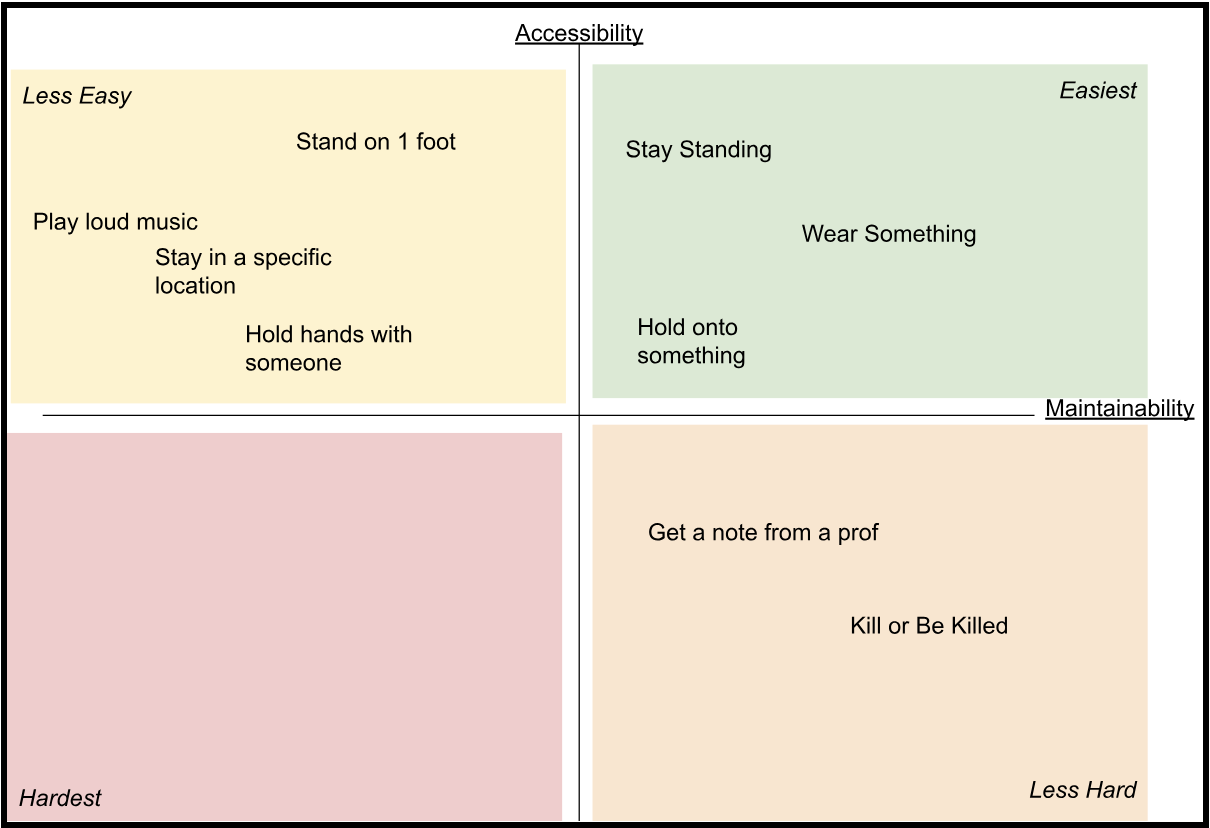
There are two axes to evaluate how a Spoon Assassins safety can be made “easy” or “hard”:

  1. Accessibility: How easy it is to quickly move from unsafe to safe.
  2. Maintainability: How easy it is to continue being safe once made safe.

I took the liberty of making an arbitrary 2×2 in order to exemplify this concept.

As time progresses, the “easiness” of the safeties should decrease accordingly. This can fluctuate of course, as creating the swings in difficulty make the game feel more intense, but the general trend should remain moving from green to red with deliberate deviation. As the game continues, however, access to information should increase. To advance the game, the most important information a player can have is how to kill their target. Evaluating how safeties provide this information can be measured across a linear scale: 

Safeties that are difficult to access or maintain are only one half of what it takes to accelerate the game. Players that know their target and are able to track them are much more lethal assassins. 

All these rules can be followed and still generate a boring game. This is where the true role of the game masters lies! It is their creative flare that fuels good stories the Olin community can share. That’s the reason why safeties are ridiculous, and it’s why they facilitate kills as opposed to letting players hide in their room all day. 

Ultimately, those unforgettable moments come down to how the player engages with the game. It’s not like the game masters can guarantee a dramatic tale, but Spoon Assassins is a great experience to be a part of because all the structures in place make this play experience like no other. I commend the game masters for their facilitation and their endless rules-clarification, and I commend you for the ways you contributed to the game, even if you weren’t playing. 

What I’m trying to say is that Spoon Assassins is a big DesNat play experience where the bio-inspiration is an Oliner that’s cooler than you.

My Adventures in Baking: Why Y’all Should Clean Up the Kitchen

I’m sure you know me as the person who keeps sending out Carpes about various things I’ve made. The west hall kitchen is my home away from home. But it isn’t just mine, it’s everyone’s in West Hall. And as such, the tragedy of the commons has befallen us.

What is the tragedy of the commons? The idea, proposed in a pamphlet in 1968, is that when people are given unfettered access to a space, they will eventually destroy it by using too much of the resources. On the other hand, the idea was used as a basis to argue that too many people will have kids and overpopulation will destroy us. Which isn’t true. 

But how can I say this hasn’t happened? When I made my first dish in West Hall, there were ants crawling over the not-so-freshly washed dishes and a spoon encrusted with… something (also ants) that I had to soak for half an hour. I went to clean up the East Hall kitchen for the scavenger hunt, and there was a bowl with a bit of dried rice and a desiccated chicken bone just sitting there. So why don’t people clean up this stuff?

I don’t agree with the idea that tragedy of the commons even applies to West Hall. The problem is that no one thinks of the kitchen as the commons. I think of the kitchen as my space, and I’m sure the cooking club does too, but what if you only go in there once in a while? Make some pasta or use the only kettle you can? You might not have the same attachment to the space. What ownership do you have over those piles of various cooking implements stacked to the ceiling? None. So you have no reason to clean up. 

But stuff piles up in the sink, and I see stuff put away with food still crusted on it. At home, I was that kind of person. It needs to look clean enough that my parents accept that I did the dishes, then I can go back to my room. But here, I’ve started to feel pride in my work. I’m not cooking for my family, I’m cooking for people that won’t lie and say my mini apple pies are great (Y’all actually will, you’re too nice. I know there wasn’t enough sugar in those pies.) I need to make sure the tools are clean enough for the next person who will stumble in with a recipe and a dream.

And now I come to the end. What’s the answer? How can we fix this? The answer is in the tragedy of the commons. At least part of the name. Commons. This is all our space. As my mother said to me when I was refusing to clean something sitting in the sink, “It may not be yours, but can you please just do it?” If you come in for a snack and a chat, wash a glass while you’re there. And if you don’t know how, well, the commons will help you out. Shoot me an email, I know how to do dishes. And I might even have cupcakes.