Exploitation, Music, & Beauty in Cinderella

Rodgers + Hammerstein’s Cinderella revels in its seemingly blunt and simple naivete. It’s so bold as to make a scene where its lead preaches about kindness and everyone clapped for it. But as I worked on this show, and found insight from other actors about how they see this world, Cinderella transformed into anything but a plain country bumpkin. R&H’s Cinderella was adapted from a much shorter animated story, well-renowned for its poignant simplicity. Plenty of other simple stories have followed this trajectory into the modern day, but as Cinderella is given space to grow, to reflect on its place in a changing world, the contribution to its own conversation has matured. We are treated to a story of love, and class, and family, and with new messages that call to be heard. 

Part 1: Beauty 

If I were to ask you what Disney’s first adaptation of Cinderella was about on a thematic level, what would you say? You might think of hard work, or inheritance, or staying true to yourself. For now, think about how Disney’s Cinderella spends its energy asking about who is beautiful. Not a beautiful spirit, but external, aesthetic beauty. The stepfamily wears beautiful clothes, but they have ugly faces. The mice are externally ugly, but are capable of creating beautiful things. Cinderella starts out disheveled, but is made the most gorgeous character in the movie with the flick of a wand by the Fairy Godmother, who in this movie is a godly embodiment of beauty. The prince, who is less of a person, is the arbiter of beauty. Not only does he exercise this authority during his ball, but his quest to fit the glass slipper on every woman in the kingdom is a reinforcement of the power to decide who is and is not beautiful. And on the condition that Cinderella is beautiful, and through no other standard, she gets to live happily ever after. 

When we look at the events of the story, we can draw a conclusion about what Disney’s Cinderella might be trying to say. Why was Cinderella the most beautiful? Well, her dress was perfectly molded against her body. People who tried the slipper could not fit it because they were trying to fit a form that was not theirs. In this way, the story suggests that everyone has their own unique form of beauty tailored to them, and happiness lies in discovering that specific and unique style. While there are many ways to read this story, you will see this may offer insight to what future iterations have to say. 

The new 2013 musical is undeniably invested in beauty as well. Cinderella once again dawns her gown as the prettiest woman at the ball. There are new songs dedicated to how beautiful the prince is. Most notably however, the show opens with a chorus about how beautiful the world is, with a closing remark, “It makes you wish the world could be as lovely as it looks”. This is our first clue suggesting how the musical expands on the ideas of its source material. Right from the beginning, there is a relationship between beauty and goodness. And as the show begins, it’s implied they do not coincide.

Part 2: Exploitation 

The largest plot change in R&H’s Cinderella can be explained through the introduction of Sebastian and Jean-Michel. Sebastian lies and misrepresents, aiming to convince everyone that what he asks of his companions is not worth the trouble of understanding. Jean-Michel, by contrast, is fervent with his transparency about the work and sacrifice that is required of serving others. Not only does he run a soup kitchen, but the source of his food is from those who donate. These two characters contrast each other because both of them know how to—or not to—exploit others for their own gain. 

Everything about the world of Cinderella warps itself around the relationship each character has toward the power to exploit others. Sebastian believes it is natural and worth rewarding to use other people as stepping stones in pursuit of opulence. Those who agree with him participate most readily in the ridicule competition. Jean-Michel believes that exploitation is a useless tool when everyone around you is willing to serve the community. It is why he scavenges, and begs, and rallies, and inspires. When we choose not to exploit, we are granted something greater—loyalty.  

When Marie, the fairy godmother, enters stage, she unifies these seemingly separate ideas around beauty and exploitation. If Ella is the most virtuous, she is now too made the most beautiful. This is what it looks like when the world is as lovely as it looks. With a flick of her wand, Marie makes the world as we wish it, so long as the pieces are already there to make it so.

Marie tells us that Ella is the first person to show generosity, charity, and kindness, and that because of this, Marie is willing to grant her gifts throughout the show. Ella becomes beautiful in this moment, but there are other canonically beautiful characters such as Prince Topher (for the details are explained throughout the song aptly named “He is Tall”). And what’s Jean-Michel, chopped liver? He’s clearly friends with Crazy Marie, so surely there is a reason she sticks around him. Surely he doesn’t not-know who Marie really is. Is he, too, not worthy of this gift of beauty? If we are left with these questions, we are forced to ask: if these characters are also beautiful, then why? What do they represent, if not generosity, charity, and kindness, that they are so closely aligned with these symbols? 

If according to Disney’s Cinderella, beauty is only achievable by those who align their style with who they are, and in this show, beauty is equivalent to virtue, then we have an answer. Everyone has their own unique way of demonstrating virtue, and in doing so, expressing their inner beauty. For Jean-Michel, his righteous anger drives him to do justice. The Prince demonstrates his best virtue by listening, and seeking out the voices that must be heard. By doing so, he finds himself. Through righteousness, we make the world beautiful. Through listening to others, we hear the music inside ourselves and others.

Part 3: Music 

In “The Prince is Giving a Ball”, Jean-Michel attempts to sing in concert with the town, but is shouted over by Lord Pinkleton. In Topher’s first number, “Me, Who Am I”, the lyrics are discordant. He sings out of sync with the knights, who contradict his words. But as the show continues, there is more harmony. There is more conversation and camaraderie. By the conclusion, everyone sings together for they achieved the unity sought from the beginning of the show. 

To truly harmonize within a chorus, you must listen diligently to the people around you. You must align with their tune, their volume, and their rhythm. It demands care for the people around you. If we can listen, show kindness, generosity, and charity, then we may move in harmony with the rest of the world.

You may wish the world could be as lovely as it looks. But the world is complicated. It’s impossible to find such beauty. So much of life seeks to tell us there is nothing worth hearing besides the rhythm by which we walk this planet, and when we believe that to be so, we become jaded, and we resort to ridicule and exploitation. But if there is ever a doubt in your mind, just remember—that impossible things happen every day.

Spoon Assassins as Game Design

Spoon Assassins is a highlight of Olin culture, and it does so by accomplishing these main experience goals for the members of Olin college: 

  1. Meet people you would not otherwise interact with. 
  2. Experience locations on and off campus with a new perspective and appreciation. 
  3. Get a damn good story out of it. 

The game serves three player archetypes. Personas, if you will:

  1. Vib’n Viney: “I’ll stick this out as long as I can”
  2. Tryhard Terry: “I’ll pursue any opportunity to make a kill”
  3. Onlooker Amy: “Not my game, but it’s funny to watch” (encompassing staff and faculty in addition to students)

Different structures are in place to cater to different player archetypes. Safety zones for class or speaking with staff and faculty appeal to Amy. Easy safeties allow Viney to feel like they get to participate in Olin culture, and the escalation of difficult safeties allows Terry to put all his energy into something enjoyable. The game also involves Amy by enabling her to collaborate with or betray active players.

Games tell stories, and these story arcs are measured by how many resources a player is given at the beginning, and then changing that resource in a specific direction. Games like checkers start a player off with the most pieces they will have at any point in the game, and slowly whittle away until the players are fighting for scraps. Scrabble starts players off with no letters on the field, and the rate of scoring points escalates as more and bigger words can be assembled. 

The arc of Spoon Assassins is oriented around two resources:

  1. Safety: A game begins with “easy” safety, and slowly that safety is less accessible.
  2. Knowledge: As you play, you gain a greater understanding of how to find/assassinate your target.

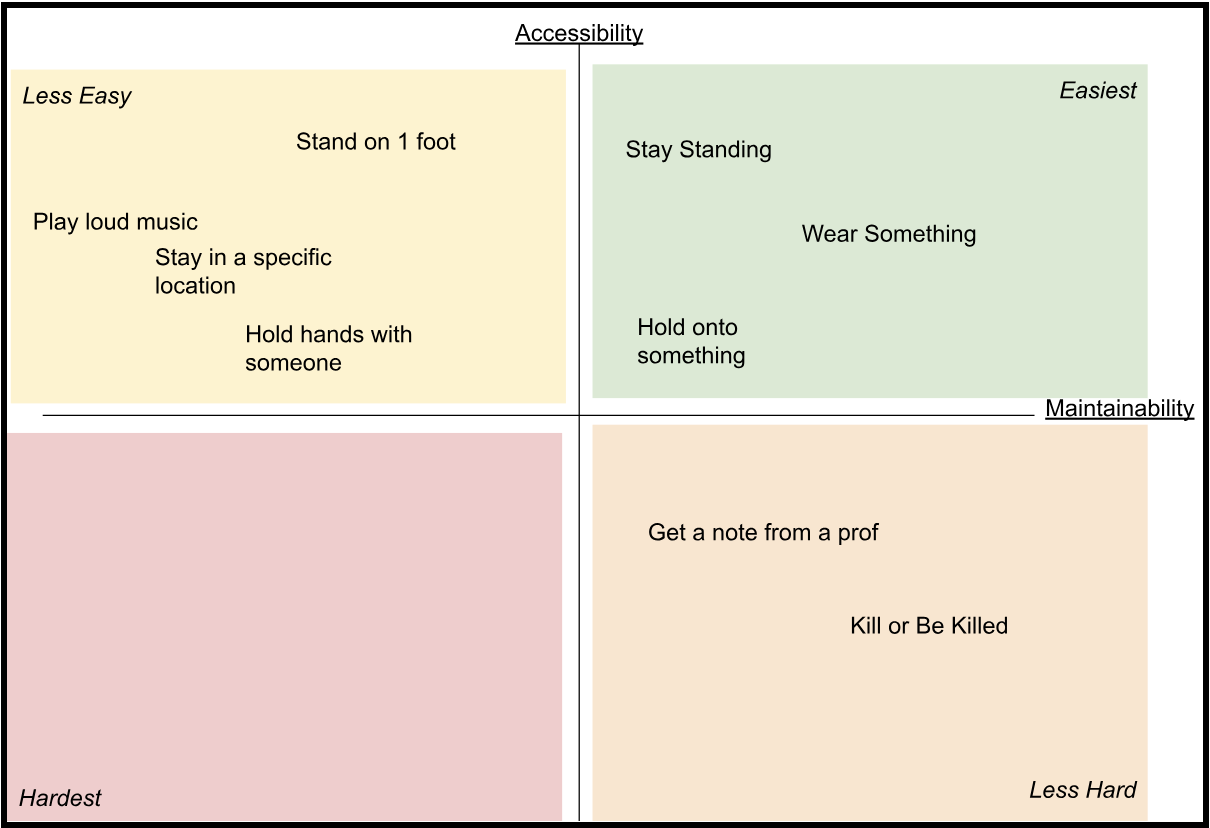
There are two axes to evaluate how a Spoon Assassins safety can be made “easy” or “hard”:

  1. Accessibility: How easy it is to quickly move from unsafe to safe.
  2. Maintainability: How easy it is to continue being safe once made safe.

I took the liberty of making an arbitrary 2×2 in order to exemplify this concept.

As time progresses, the “easiness” of the safeties should decrease accordingly. This can fluctuate of course, as creating the swings in difficulty make the game feel more intense, but the general trend should remain moving from green to red with deliberate deviation. As the game continues, however, access to information should increase. To advance the game, the most important information a player can have is how to kill their target. Evaluating how safeties provide this information can be measured across a linear scale: 

Safeties that are difficult to access or maintain are only one half of what it takes to accelerate the game. Players that know their target and are able to track them are much more lethal assassins. 

All these rules can be followed and still generate a boring game. This is where the true role of the game masters lies! It is their creative flare that fuels good stories the Olin community can share. That’s the reason why safeties are ridiculous, and it’s why they facilitate kills as opposed to letting players hide in their room all day. 

Ultimately, those unforgettable moments come down to how the player engages with the game. It’s not like the game masters can guarantee a dramatic tale, but Spoon Assassins is a great experience to be a part of because all the structures in place make this play experience like no other. I commend the game masters for their facilitation and their endless rules-clarification, and I commend you for the ways you contributed to the game, even if you weren’t playing. 

What I’m trying to say is that Spoon Assassins is a big DesNat play experience where the bio-inspiration is an Oliner that’s cooler than you.

Olin is Not a Jewish Space

Nearly 10% of Olin’s campus is Jewish. Consistently I can find between eight and ten Jewish students in every class. Compare that to the national population of two percent, and I expected a very different campus culture when I came to Olin. I would imagine people talking about the holidays in casual conversation, or find dining hall meals dedicated to the larger festivals. This does not happen at Olin—not in the years I’ve been here, and I don’t foresee this changing any time soon. 

From a top-down perspective, Olin is too small to appeal to observant Jewish students. There’s too much work for resting on the Sabbath. The dining hall doesn’t serve kosher meals. We don’t have a Hillel chapter. In case you don’t know, that’s an affiliation with the largest international organization dedicated to providing Jewish students resources on campus, and our school is too small to receive their services. 

Because of these top down limitations, students are restrained from creating their own bottom-up solutions. The school’s structure discourages observant Jews from attending Olin. The students here who try to run events operate on severe deficits in Jewish knowledge, and there’s no time at Olin to study up on how to properly run a celebration. Student initiatives barely get off the ground and seldom reach the broader Jewish community. Thus, Jewish life remains vacant. 

When I came to Olin, I wanted to explore more what it meant to be Jewish at college. I visited Jewish organizations at other schools, each with their pros and cons. Brandeis was too far away, Wellesley felt strange being a man, and the prayers at Babson were sexist sometimes. Then I went abroad for a semester and the one service I attended there made me so upset I wrote a FS article about it (It’s one of my proudest. You should read it if you haven’t). I gave up looking after that. 

Judaism at Olin is a journey traveled alone, and the institution will not help you through it. Heed my warning: The dining hall will NOT give you the food you need for Passover. 

That’s where JOO fits in. The Jewish Organization at Olin is left in a terrible position. The resources are sparse, the leadership lacks expertise, and our most active member is a baptised Catholic (we love you Azzy). Historically, JOO buys food from local Jewish vendors a few holidays a year and hosts small celebrations. However, these events could serve a greater purpose. These food events could gather Jewish students before the holidays, and we can popularize all the inter-school activities that happen in the near future. JOO doesn’t need to be a hub of Jewish culture at Olin. It can be a vehicle to transport Olin Jews to the communities they find solace with.

Serving as a guide instead of the host enables JOO to stay lean and serve the community with greater precision. It can focus its small events toward building something greater, and it can stay true to a mission instead of what I saw as failing to live up to its name. 

Seeing so many freshmen stop by on Rosh Hashanah for apples and honey filled me with hope. This FS would have been far more pessimistic otherwise. I hope to see more people going to Babson Chabad, and I recently became friends with a few members of the Wellesley Hillel e-board, so I’ve been going to their services every Friday. Let me know if you’d like to join.

Learning To Grow On A Farm

I stopped following politics after Trump got elected again. In 2020, I thought I was a part of a movement where everyone was growing in conscious. With every day a new headline, a new crime, a new impeachable offense, the country could clearly see the damage he dealt domestic and abroad. After 2021 there was quiet, and I thought we liked it that way. I thought I was part of a growing movement, but I wasn’t. I was terminally online, and I was out of touch. 

I stopped reading the news because the one way I thought real change could happen would not come. I thought great change must come from laws, government departments, political advocacy, and more radicals in government. But that got us the same old fascist, DOGE, and insert any other upheaval I’m not reading about. I couldn’t stay online.

This summer I touched grass, and I mean really touched grass, in a way I never had before. I did so by working on a farm.

I did research at Olin under Alessandra, and she asked a simple, yet challenging question for me to explore: what economic and ecological incentives align for farmers? After a bit of googling, one of the answers to this question is the concept of “regenerative agriculture”, a series of strategies that prioritize revitalizing the land and capturing carbon through farming practices. Broader research points to a variety of successful, well tested strategies for farms to implement, alongside being far more profitable in the long run. Now, the follow up question becomes: How can I contribute to enabling farmers to implement regenerative agriculture?

The answers to this new question are diverse, fascinating, and complicated, but one discovery was clear to me. The government could never “legally mandate regenerative agriculture”. Farms are too diverse for blanket standards, and guidelines are frequently unable to encompass the farmers they supervise. My aforementioned theory of change could not succeed under these conditions. This developed my first new understanding: Systemic change must be designed to empower its users at a granular level, and these systems do not need to be government supported.

The farming community in Massachusetts is beautiful and diverse, and every farmer is supported by relying on one another to teach and grow together. I saw farmers that depended on networks of mutual aid, and I could see how successful this strategy was. Farms hosted events to share how they found success, and how that impacted their perspectives about the industry. Systemic change must be enforced through a community’s dependence on their peers, not their dependence on authority figures. Farmers change their behavior through close community mentorship, and it is difficult for politicians, academics, or engineers to meaningfully contribute to a farmer’s operations.

My final project became a guidebook for farmers to compare success stories related to regenerative farming. It took the summer of engrossing myself in a new ecosystem, questioning my biases as an engineer, and exploring how I can support a community that already relies on an established system of aid. 

I want to farm more. Not just because the community is so welcoming, not just because the work is tangible and rewarding, but because farming makes me believe that change is still possible. What I learned might not resonate with you. But there are other ways to change the world that you may not be thinking about. I implore you to seek out these means of change and discover the greatest contributions you can provide. Your current theory of change does not encompass every impact one can make in this world. And if you’re like me, then you know your capacity to give is greater than support for movements that don’t feel successful. You deserve to discover how.

The Lifelong Quest of Becoming the Greatest Side Character

I used to think I needed a lead role. I got my role as Scarecrow in my middle school’s Wizard of Oz, but when I was in my freshman year of high school, all the leads went to the upperclassmen. Of course, I cared about doing a good job. But I had no named parts, and I was surrounded by actors who I considered vastly more talented than I. Even so, I was stopped by a stranger after one of the performances. They grabbed my shoulder and said, “I don’t know who you are, but you were my favorite character. Don’t stop doing what you did up there tonight,” before disappearing into the after-show crowd. I will never forget this compliment.

When I was a kid, I would watch superhero movies and imagine myself in their place. I would imagine having the power, the attention, and the story. That was the person I wanted to be: The Hero. When I was a late teenager, I watched an anime called Mob Psycho 100, a show about a main character who is not very expressive. He is supported by ‘the body improvement club’, which only appears sporadically. They would exercise with the scrawny protagonist and be proud when he runs just a bit longer than the day before. After I saw the body improvement club, it became clear that I was wrong. I did not want to be a hero. I knew my calling: I wanted to become a side character.

Side characters serve two roles in a story. They interact with the main character(s) to progress the plot, and they expand the world that gets to be seen. I want to convince you of how fun it is to serve both purposes in other people’s stories. 

You’ve probably heard the slogan “there are no small roles, only small actors”. I stand by this claim not only because it makes the story more engaging, it also reminds actors that side characters are equally deserving of depth, understanding, characterization, and analysis. As a side character, you can embody a wider range of experiences. You can be a rival, a lover, a mentor, and more—all in the same show. Legally Blonde is full of one-off, high-impact characters: the Harvard administration from “What You Want”, the gawking guys in “Bend and Snap”, the department store workers in “Take it Like a Man”, the Judge in the various court scenes, and of course, Carlos, from “Gay or European”. They are the characters that make this play so fun to me. 

Out in the world, I try to embody this ideal. I question the role I get to play when I meet a new stranger. I see people walk by and wonder what worldbuilding I am facilitating by being in their space. To take the place of a side character is to take on the responsibility of enhancing the moment in support of someone else’s chance in the spotlight.

To me, being a side character is the freedom and confidence to know you have changed a person’s life simply by being a part of it. I don’t need to always be a main character to make an impact. It empowers me to accept the way other people enter and leave my life. All I need to do is appear, give a little exposition, provide a little inspiration, and I have changed the path of another protagonist’s story. And now and then, I get to appear, make a big splash, and disappear into the crowd knowing that I’ve made a difference and earned a powerful round of applause.

My Olin Mad Libs Adventure: A Normal Day in the Life as a Formula Member

By Hugh Keenan, Ava Possidente, and  ___(first name)___   ___(last name)___!

I stayed up all night working on my _(component of a car)_ and I’m so _(emotion)_ to show my formula lead and best pal, _(name of Oliner)_, what I spent _(number)_ hours on, for it was my time to present on my design review! When I was done presenting, I showed them a simulation of my _(body part)_ exploding. _(Oliner from before)_ was so proud of how I did that they jumped in the air with joy. “_(exclamation)_!” They proclaimed. “This _(noun)_ just might be what we need for the _(part of a car)_, and it might even solve world hunger!” Clearly this had to become a business model, so I ran to the LPB to figure out how to _(verb)_ its manufacturing process. I started by looking forlornly at the tools. I began touching the things. They were _(material)_. Probably. Except for the parts that weren’t. _(name of different Oliner)_ told me to attach the beams together. I did not know how to that _(adverb)_. Duck tape or _(plural noun)_ seems good. I think wheels are for the weak. We don’t need them. I’ll just throw them into the bottomless pit we built two _(plural unit of time)_ ago. I’ll throw my sorrows in there too for good measure. In exchange I have unlimited access to a plethora of _(plural noun)_. That aside, I _(past tense verb)_ the beams together. I accidentally lit some _(plural noun)_ on fire in the process though. But as _(Oliner from before)_ always says, “you can’t _(verb)_ on the _(noun)_ or else the _(noun)_ will get you down.” And I’ll bet my _(body part)_ they’re right! And this is why I don’t need a life outside of formula, because as you can see, I have all the _(plural noun)_ I could ever need.

My Olin Mad Libs Adventure: Getting Dressed for a Day at Olin

By Hugh Keenan, Ava Possidente, and  ___(first name)___   ___(last name)___!

I wake up on a day like any other. I’m feelin’ snazzy, sassy, and ___(adjective)___. ___(exclamation)___! I yell as I awaken from my ___(noun)___! The room is ___(adjective)___, the shower is ___(adjective)___, and with ___(noun)___ in my sink, I know today is going to be as ___(adjective)___ as the days before it. I ___(verb)___ my wardrobe and take a look to see what ___(noun)___ I could wear today. Sequins are a must. I ___(verb)___ the weather ___(noun)___, and it forecast a ___(noun)___ storm and a temperature of __(number)__degrees ___(unit of temperature)___, so I know I need to ___(verb)___ up and wear __(number)__ pairs of pants. First I find pants. My favorite. Then I pick out my sparkliest ___(article of clothing)___ and wiggle it onto my ___(body part)___. I am going to ___(activity of Oliner)___ later so I should probably also wear my ___(article of clothing)___. First ___(noun)___ I see goes right on my ___(body part)___. And for the last touches, I put on a(n) ___(article of clothing)___ just to look nice for the ___(mythical animal)___ tribe in Parcel B. Putting on makeup is a ___(noun)___. It makes me look so ___(adjective)___ that I have to do it at least once per ___(unit of time)___. I’m sure I’ll get so many compliments. My friends will probably say things like “I love the glitter on your  ___(bodypart)___.” or “your  ___(animal)___print  ___(noun)___really pulls the look together.” or “your  ___(noun)___ glows with the radiance of  ___(periodic element)___ going through fission.”  I look in the mirror and strike a little pose. I look flipping ___(adjective)___.  And with that, I am ready to ___(verb)___ the day with my ___(adjective)___ outfit. Now out the ___(noun)___ I go!

The Autistic Battle Against Apotheosis

I read The Curious Incident of the Dog in the Nighttime by Mark Haddon for a Babson class this semester, and I swear it’s relevant to The Guy Who Didn’t Like Musicals. The book’s main character, Christopher, opens his story saying: 

“…when I first met Siobhan, she showed me this picture:

and I knew that it meant ‘happy’… she drew some other pictures

but I was unable to say what these meant.”

I love theater for many reasons. The first is because I get to make heightened expressions to convey characters’ feelings to the audience. A simple smile goes unrecognized because of how far the audience sits. Instead, a performer must convey a more pronounced emotion—elation:

Without context, these expressions look exaggerated, uncanny, or even grotesque – but in order to effectively communicate the story, it is necessary. 

It’s often said about musicals, “when your character cannot express their feelings with words, they sing.” It’s a sweet sentiment, but if you don’t relate to emotions the same way, the experience can feel uncanny. The aliens from The Guy Who Didn’t Like Musicals weaponize songs, lighting, and most interestingly, their facial expressions, to sell their otherworldliness. The aliens, like actors, are unnervingly over-expressive. Professor Hidgens questions how the aliens could wordlessly choreograph their song and dance. Christopher, similarly, asks how we could relate to each other so seamlessly just by using the shape of our face. The people in Christopher’s story operate under an unspoken assumption that their mode of expression is not only normal, but correct, excluding those who do not understand. The aliens in TGWDLM make that assumption explicit.

The most interesting line in TGWDLM to me is from the song, “Let It Out”, when Paul sings solo, “I’ve never been happy. Wouldn’t that be nice?” When he makes that proclamation, I don’t see a man who isn’t happy. I see someone who has been given a definition of happiness he cannot attain. Paul has never “been happy” because the world around him invented a concept of happiness that doesn’t apply to him. In the real world, it enforces conformity, and the contagion in TGWDLM repurposes the aesthetic of happiness to convince everyone to join the hive. 

The Guy Who Didn’t Like Musicals speaks to the social understanding of health and wellness. This perspective suggests that wellness is oriented around being a productive worker. Imagine ADHD not as a unique inability to focus, but instead a natural state of being that has only been given a diagnosis because the world forces adults and children to primarily work at computers.

When the hive entices the world to consume its ‘blue shit’, it reminds me of the mood-stabilizing drugs I took when I was 10. The pills came in shades of green and blue. My friends from back then have said it made me look like this:

The Guy Who Didn’t Like Musicals argues that separation from the neurodivergent self is inherently violating. We are genetically reconstructed from the inside out, given new personas that others will find palatable. Some people are forced to take medicine or receive surgery so they can conform to the standard of “normal”. For many of us like Professor Hidgens, the resulting identity is worth that pain. It is a worthy second chance. For others, like Paul and Emma, with this conformity we see the death of unique, interesting, authentic, and happy experiences.

My Olin Mad Libs Adventure: My Greatest Spoon Assassin Kill

It was a ___(adjective)___and stormy night, and the safety was to stand on our ___(body part)___. I had everything I needed, including my great grandfather’s ___(noun)___. I knew my target: _(spoon assassin target’s last name)_, ___(target’s first name)___, ___(target’s last name)___. Now all I had to do was ___(verb)___ them. I planned to ___(verb)___in the classroom all night, ready to strike before their ___(time)___am class began. ___(exclamation)___! What’s this? Just as I pull out my ___(noun)___from my bag, ___(target)___ enters the room, no doubt intending on some late night (verb)ing. I tried to look ___(adjective)___ as I ___(past tense verb)___ under the table, but it was too late. They tried to get on their ___(aforementioned  part)___. Realizing it was too  ___(adjective)___ to sustain, they ___(past tense verb)___ away, and I ___(past tense verb)___ after them. “___(exclamation)___!” My target yelled. “They’re going to ___(verb)___ me!”. ___(name of Professor)___ looked at us with ___(emotion)___ on their face, as we ___(past tense verb)___ around campus for  ___(number)___ ___(plural unit)___. I finally ___(past tense verb)___ them in ___(location at Olin)___. The air was thick with ___(noun)___ & ___(noun)___. They begged me for ___(noun)___, with ___(emotion)___ in their eyes. I raised my ___(noun)___ in the air and took one ___(verb)___ forward. ___(sound effect)___! ___(target)___’s phone went off. ___(Name of Oliner)___ messaged in the chat: Another Oliner has been ___(past tense verb)___ from the game.

Olin Mad Libs

My Olin Mad Libs Adventure: Swimming in the LPB

It was finally happening! After __(number)__ months of planning, we were ready to throw our beach day palooza in the LPB! We had all the best decorations prepared. A  ___(noun)___ to set the mood, ___(noun)___s to bring the hype, and 7 ___(noun)___s to top it off. Everyone came in their ___(adjective)___est  ___(noun)___, and stood waiting by the poolside. Dave Barret says to never  ___(verb)___ in the LPB pool because it’s for his robot  ___(noun)___, but  ___(name an Oliner)___says it’s fine, and they’re basically as ___(adjective)___ as Dave. So we took off our  ___(noun)___, and took a dive. “ __(exclamation)__!” each Oliner would yell as they hit the pool floor. Everyone was having a  ___(noun)___, but then we realized the floaties on the water were  ___(verb)___ing. We realized it’s because of all the  ___(noun)___ in the water, which would lead to horrible  __(medical condition)__, but that was the risk we were willing to  ___(verb)___ after we passed the LPB training. After  __(number)__minutes of  ___(verb)___ing around, we all left the pool. Every last one of us had turned into  ___(noun)___, and we were all covered in  ___(noun)___es.  ___(Name an Oliner)___was in a particularly  ___(adjective)___situation, because now they were growing a new  ___(body part)___. We were about to  ___(verb)___ it off with a  ___(noun)___, but just then, speak of the  ___(noun)___, Dave Barret, the  ___(noun)___ himself,  ___(verb)___ed open the door. We all ___(verb)___ed, and hid in the  ___(noun)___ until he left. Dave, suspicious, looked around, admired the decorations, and once he was confident no one was there, grabbed a  ___(noun)___, and hopped in the pool. We escaped by the skin of our  ___(noun)___, and we vowed never to  ___(verb)___ in the LPB pool ever again!