‘Do Something’ in Practice

We’re all familiar with the ‘Do Something’ mantra at Olin. Ask the person down the hall, the studier in the lounge, or the person sitting next to you to name the values of the Honor Code, and you can be sure that they will at least name Do Something. We see it in the title of emails and the closing sentiments in recruitment propaganda. We hear it in praise of starting awesome activities, sarcastically called out when no one volunteers to take on improvements, and as advice to the first year frustrated with a class or club at Olin. The Honor Board is just as guilty of throwing around Do Something as other organizations and individuals.

These are the actual words to the Do Something value in the Honor Code: “I will strive to better myself and my community and take responsibility for my own behavior. When I become aware of a violation of the Honor Code or an issue within the community, I will take action towards resolution of the situation. I expect others to do the same.”

If we were to summarize, this is basically a call to arms – it’s certainly about addressing personal behavior and actions that have broader impacts, but it is also a call to engage in actively promoting the Honor Code. Furthermore, it is open to interpretation – what does it mean to ‘strive to better my community’ or to ‘expect others to do the same’? If we aren’t actively striving to do these things, perhaps we are all in violation of the Honor Code.

Historically, there have been very few Honor Board cases that have been seen purely as a violation of Do Something. Some of this has to do with the ambiguity and broadness of the clause, and some has to do with the pain of determining whether or not someone was ‘striving’ enough. However, Do Something is called out almost daily. As a congratulations of good deeds, as a broad solution to any problem, as a guilt tactic to recruit the few volunteers we need to run all of the various organizations and events on campus…

Why? As a community, do we really need to be reminded to Do Something (anything) so often? Is there perhaps a reason why we aren’t doing anything?

We’re stretched thin right now. There are, oft claimed fondly, “more clubs than students.” We’re a community that prides itself on the independence and ability of the students to be involved in every aspect of life here: academic, service, social. We take it upon ourselves to load our plates with activities because we think we need to, because they’re ‘good for us’, because they’re ‘good for others’, or because no one else would do them.

We need to stop. As is so treasured at Olin, maybe its time for us to reflect as a community on what it is we ACTUALLY value. The Honor Code is supposed to be a tool to reflect the position of the Olin student body at this moment. The way in which we use Do Something doesn’t necessarily gel with the verbiage right now. Should it?

We all ‘pledge’ to Do Something when we sign the honor code, as written. We’re not signing to have Do Something held over our heads every time an email is sent out. We’re not signing to have to participate in every aspect of Olin culture. However, we are signing to ‘do the right thing’ as the community deems fit. Whatever that might be – participating in student government, meeting with professors to improve a class, helping out peers who have fallen on hard times.

Next time we are asked to Do Something, perhaps we should start asking “Why do we have to?” Is there a good reason that this is being asked? Is this going to better us as a whole? Are we as individuals currently ‘Doing Something’ at the moment?
And next time we tell or ask someone to Do Something, perhaps we should start asking “Why can’t I and why should they?”

SERV: More Than Words

This is the first installment of a monthly spotlight on volunteering opportunities in the Boston area. We’ll share the stories of organizations as well as how you can get involved! Feel free to email david.zhu@students.olin.edu for your thoughts and feedback to help me continually improve this segment.

About

If you want to empower disadvantaged youth through real-world skills such as business and interview training, More Than Words (MTW) is the perfect place to help. The organization helps youth “who are in foster care, court involved, homeless or out of school to take charge of their lives by taking charge of a business.” More Than Words does this by creating a chain of bookstores that sell donated books. More importantly, the bookstore is completely run by the at-risk teens enrolled in the program. Organizers, staff, and other volunteers help and train these young adults with the entrepreneurial and people skills that they need to succeed once they graduate from the program.

Impact

More Than Words accepts at-risk adolescents who are 16-21 years-old who have “compounding risk factors and are in need of an empowering life experience” to help them rise above their current situation.

84% have recent or current involvement with the foster care system.

54% have recent or current court involvement.

~80% do not have their GED and are either not pursuing or struggling in school.

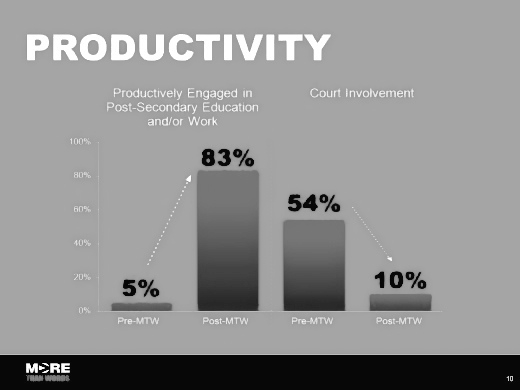
More Than Words proactively collects data to track its program’s effectiveness. 83% of MTW graduates have received or plan to receive their GED/diploma, compared to the 18% who had a GED/diploma before participating in the program. Also, 34% of graduates have enrolled in postsecondary education compared to 5% prior (illustrated in the graph below). Similarly, work-school engagement rises to 83% from 5% before the program (see the graph on the facing page). “While approximately 50% of youth come to MTW with court-involvement, this number drops to 28% when they leave the program and continues to drop to 10% within 24 months after the core program.”

Francis, a veteran of MTW, writes: “Before I came to MTW, I was getting in a lot of trouble, became court involved, and wasn’t going to school. While I was at MTW, I really enjoyed getting work experience. I learned how to give excellent customer service and how to be professional, and got my GED. I really appreciated all of the love at More Than Words. They helped me get the things I needed in life and helped me stay on track. When I transitioned, I got an internship at a hotel and now I just got a job at Bentley College. I’m working hard on my education. Education is very important to me now because I know that having an education can take you far in life.”

fs-apr_serv2

fs-apr_serv1

History

Jodi Rosenbaum started More Than Words “after a friend saw a pile of books on the side of the road.” Jodi states: “We realized those books were worth money and a hands-on way to empower youth with real-world skills… I am particularly passionate about adolescents who are system-involved and typically seen as liabilities rather than assets. For over 15 years I have worked in the public schools, juvenile courts, and nonprofit sector and have seen so many kids fall through the cracks despite good intentions. I think too often our efforts to help focus too much on trying to fix problems or remediate. That’s what has ignited my passion. I see youths with skills and untapped potential. It is exciting to be part of a model that focuses on how to empower a spark, a hope, and that gives an opportunity for youth to do it for themselves” [1].

Do Something

All in all, More Than Words is a great social venture where you can directly help up-and-coming adults with relevant skills so that they can also become contributors to society. There are various options to participate. For a one-time thing, you can assist as a mock interviewer and give feedback to the program members to improve their interview skills. You can also run a small workshop! (Think about some really helpful things you’ve learned while at Olin.) Finally, you can get involved on a weekly or monthly basis, working with the youth managing the store or being an educational coach.

If you are interested in volunteering at MTW, let’s come together and help out as a team. SERV will connect you with other Oliners who also want to participate. Find out more about More Than Words at www.mtwyouth.org, check out the upcoming carpe, and/or talk about it during our daily tabling sessions!

Citations
[1] http://www.jewishboston.com/Molly-Parr/blogs/3857-four-questions-with-jodi-rosenbaum-executive-director-of-more-than-words
[2] https://www.mtwyouth.org/

Horoscopes by Drunk Editors

Aries (March 21 – April 19): Marco?

Taurus (April 20 – May 20):.Many hands.

Gemini (May 21 – June 20): You, are foudroyant.

Cancer (June 21 – July 22): April showers bring rainbows. Go find some.

Leo (July 23 – Aug. 22): Nyctalopic octothrope.

Virgo (Aug. 23 – Sept. 22): There’s gum on your shoes. Both of them.

Libra (Sept. 23 – Oct. 22): Politeal Popinjays Play Ping Pong.

Scorpio (Oct. 23 – Nov. 21): Boo.

Sagittarius (Nov. 22 – Dec. 21): Name a country.

Capricorn (Dec. 22 – Jan. 19): Hitherto.

Aquarius (Jan. 20 – Feb. 18): [create your own]

Pisces (Feb. 19 – March 20): POLO!

Portable Gaming: Game Boy to iPhone

videogametriviaGaming on the go is a concept almost as old as video games themselves. One of the first – if not the first – portable video games was called Auto Race, and was made by Mattel in 1976 [1,2]. It was a simple device, based off of a calculator chip, but it started a large market. Many other toy companies – Tomy, Bandai, and Milton Bradley, to name a few – joined in. One of these was a relatively small Japanese toy company by the name of Nintendo. In 1980, Nintendo released a small portable video game called Game and Watch: Ball [3]. This was soon followed up by many other Game and Watch titles, at a rate of one a month. A total of 59 different games were released. Nintendo’s foray into the market did well, selling 12 million copies in Japan and 30 million overseas [4]. These numbers may, in fact, be lower than the true number sold, as Nintendo had problems with counterfeiters selling knock-offs [5].

But just one game will get boring after a time, and it’s hard to justify the cost of an entire device for a single game. That’s why Milton Bradley created the Microvision, a portable device that could utilize interchangeable cartridges. It was released in 1979, only three years after the first home console that accepted cartridges (the Fairchild Channel F, see February’s column) [6]. While the Microvision did moderately well, it didn’t set the world on fire. There wasn’t another cartridge-based handheld until Nintendo’s Game Boy, released in 1989 [7]. However, unlike its predecessor, the Game Boy did incredibly well. This in part was due the fact that it was marketed to adults as well as children.8 Seeing the opportunity, other companies released handheld systems. Atari released the Lynx in 1989 [9], and Sega released the Game Gear in 1990. Though both these competitors had superior graphics, their battery life was less than impressive, and their bulk reduced portability. As a result, neither was a success, and Nintendo gained a near-monopoly on the handheld gaming market.

Game Boy’s sales slowed in the mid 90’s, and some thought that it was nearing the end of its life [10]. Instead, its sales surged again due to two factors. The first was a hardware refresh, the Game Boy Color. It was smaller and had a somewhat more powerful processor, but the real advantage was its color screen. The other factor was a pair of games called Pokémon Red and Blue (or Green, if you were in Japan). With the new interest from a generation of kids who loved Pokémon, the Game Boy line continued until 2004.

It was then that Nintendo faced perhaps its most formidable opponent in the handheld industry: the Sony PlayStation Portable. Like the previous Lynx and Game Gear, it was technologically superior to Nintendo’s offering, but unlike them, it had a decent battery life. It also had the strength of Sony’s software ecosystem, coming off of their successes with the PlayStation and PlayStation 2. It did well, selling 80 million units total [11]. Nintendo, however, wasn’t going to roll over and let Sony win again. Despite its original success with adults, the Game Boy line had become more child-oriented over the years. Nintendo decided to shake things up by adding a new way of interacting with the games, in the hope of attracting new customers. The result was the Nintendo DS, a two-screened device that had a touch screen on the bottom. Initially, it was presented as a “third pillar” – an experiment alongside the Game Boy line, not designed to replace it. But the DS took off, selling 5 million units in its first year (2004), and the Game Boy brand was quietly retired [12].

The release of the iPhone in 2007 was not seen as a video game event, but within a few years it became clear that it and the other smartphones that followed in its wake were going to have a big impact on the handheld gaming sector. Games on smartphones, such as Angry Birds, have done remarkably well. The successors to the PlayStation Portable and the Nintendo DS – the PlayStation Vita and the Nintendo 3DS, respectively – have both sold substantially less than their predecessors, which has been attributed to people filling their portable entertainment needs with their phones.

What is the future of portable gaming? Smartphone gaming is not going anywhere – a fact that has been underlined by Nintendo’s recent announcement they would make games for smartphones. But many games built for more traditional platforms do poorly when moved to phones, whether because of the small screen or a reliance on traditional buttons. Ultimately, I’m far too biased to give an accurate prediction. What is clear is that portable gaming has become mainstream, and that is unlikely to change.

Citations
[1] Before the Crash, page 86
[2] In action: https://www.youtube.com/watch?v=isejBX1Tyjk
[3] http://iwataasks.nintendo.com/interviews/#/clubn/game-and-watch-ball-reward/0/1
[4] http://iwataasks.nintendo.com/interviews/#/clubn/game-and-watch-ball-reward/0/3
[5] Game Over, page 127
[6] http://www.officialnintendomagazine.co.uk/13153/features/history-of-nintendo-game-boy/
[7] The Ultimate History of Video Games, page 415
[8] Game Over, page 295
[9] The Ultimate History of Video Games, page 419
[10] http://www.nintendo.co.jp/ir/en/library/events/150217qa/02.html
[11] http://metro.co.uk/2013/11/27/xbox-one-v-playstation-4-who-will-win-the-next-gen-console-race-4201485/
[12] http://www.nintendo.co.jp/ir/library/historical_data/pdf/consolidated_sales_e1412.pdf

A Letter to Teenage Shane

Dear teenage me,

You probably thought that by now I’d be brimming with advice and important life wisdom that I needed you to know. I thought I’d think of plenty of anecdotes to tell you.

Now, I realize I am not sure what to say, which I guess is a good thing. There is no amazing advice I need to give you. No secret message to fix everything. Could you do college differently? Of course. Could you have a better relationship with your parents? Obviously. Will depression come back, self-esteem continue its roller-coaster ride, and your room remain messy? You betcha. But, that’s ok. That’s life.

What I guess I do want to tell you, though, is that you haven’t gotten that good at all things you want to be better at. Well, I mean that I’m not yet what you consider to be good. You want to command a room like your friend Mark, be able to make friends with anyone like Isaac, and crack jokes like Roi. You have a whole list of ways you could be a better person and another whole list of people you want to be like. Well, like I said, you can’t speak like Mark, you’re still a bumbling mess around strangers, and your jokes are still equally hilarious, but mostly only to you.

I can say that you’ve slowly realized you don’t need to be like Mark or Isaac or any of them, because no one can tell a Shane story or plan a spontaneous adventure like you do. You can make people feel comfortable around you, your sarcasm is so good that most people don’t even get it, and you’re still really funny. Yeah, of course I am going to keep practicing and trying to get better at all that other stuff, but just remember to look around and see all the things you’re good at too. I count at least 3 talents, but counting might not be one of them.

– Shane

Meatless Mondays at Olin

I encourage the student body to revisit the proposal for our dining hall to take part in Meatless Mondays. This program not only encourages people to start off their week with healthy food, but also presents a way for us to reduce our carbon footprint and conserve natural resources. Animal agriculture is an environmentally destructive industry, contributing to air pollution, water pollution, land degradation, and negative effects on biodiversity. The livestock sector generates 18 percent of greenhouse gas emissions, more than all the cars and trucks in the world combined [1].

I have no doubts that a shift towards a sustainable lifestyle is a challenge Olin students will want to face head on. The dining hall already provides us a selection of vegan foods on a daily basis, along with vegetarian proteins at the salad bar. They offer ‘faux meats’ at the burger station, along with all the toppings that you can get on a regular burger. We know the dining hall is capable of providing vegetarian options, and Meatless Monday would allow us to expand on the number of choices offered.

In implementing this program, Olin College would not be alone in its efforts. Brandeis University, Vassar College, The International Culinary Center, and dozens of other universities have launched initiatives encouraging students to participate in Meatless Mondays. If you believe in social justice or being good for the planet, I encourage you to Do Something [2].

Citations
[1] http://www.fao.org/ag/magazine/0612sp1.htm
[2] https://franklyspeakingnews.com/2013/12/dumb-ass-social-justice/

Something Needs to Give

This has been the most turbulent start to a semester in my two years at Olin. I started with 18 credits of classes and OCO, for a total of 19 credits. I was taking UOCD, PDEs, MechSolids, and the special topics course Paradigms, Predictions and Joules. Within a couple weeks, it became clear to me that PDEs required a different level of understanding of math than I had, or at least a different way of thinking that would require more time to grasp than I had to give. After a late night discussion with a close friend, I decided, on the last day of Add/Drop, to drop PDEs and pick up Thermo. This decision was a lifesaver for me, and is one I wholeheartedly stand behind. Thermo is more closely and concretely connected to my interests of energy, sustainability, and systems thinking than PDEs.

This brings me forward to the first Candidate’s Weekend. On Wednesday of that week (an Olin Monday), the narrative running through my head, of feeling like I’m drowning in work and commitments and feeling like I wasn’t cut out for Olin but didn’t want to leave, caused me to step out of class. It was the closest to a mental breakdown that I’ve come in my life, and it was scary. I was trying to hide my turbulent emotions, to maintain the façade that everything was okay, that I could handle everything. But I knew that something had to give. I wasn’t able to put the time or effort into any of my classes, meaning that I was struggling to varying degrees in all of them, feeling like a poor teammate in UOCD and PPJ, and that I was putting in the minimum effort but the maximum that my time allowed on problem sets in Thermo and MechSolids. I kept thinking, something has to give.

My realization now is that the thing that needs to give is bigger than my personal decision to drop MechSolids in favor of the other three classes that more closely correlate to and support my interests, because I know I’m not the only one who has felt inadequate and experienced this level of stress. The thing that needs to give is the feeling among students at Olin, propagated and fueled by students at Olin, that everyone needs to do everything, and needs to do everything well. These are two things that do not always go together. Some people are able to take 20 credits and be the leader of a project team and hold down an on-campus job. I have no idea how they do it, but they can, and more power to them. But what is important, if not necessary, to realize is that not everyone can do that, and that’s OK. As a community, we need to take a step back and consider why we are doing what we’re doing, both on an individual level and a community level, and what effects it might be having on the health of the Olin system and the students that compose it.

By stepping back, I realized that I am not a Mech:E. When I think of Mech:Es, I think of someone spending a lot of time using SolidWorks and devoting themselves to vehicle teams and working in the machine shop. I can think of many people who embody what a Mech:E is (and I’m guessing you’re thinking of some right now). But that’s not me. What really excites me, however, is sustainability, renewable energy, and green building. That is why I am in love with PPJ and Thermo. For me, being a Mech:E doesn’t help me accomplish my learning goals. I was learning in MechSolids, true, but at the cost of not learning as much as I want to in PPJ and Thermo and UOCD.

My point in sharing this story is that as a community, we need to be more cognizant of how other people learn, what they want to learn, and why they make their decisions, and then let them do that. I have a feeling that some people reading this article will think that I am quitting, that I could have continued with all four courses and passed, maybe even gotten A’s. And maybe that’s true, but what you’re not considering is that, at least for me, doing so would have come at the expense of my happiness, my duties as an R2 and a friend, and my learning. And those three things are not worth living up to the Olin status quo.

Let’s change the status quo to be doing what YOU are capable of and what YOU want to do, instead of what it SEEMS you should be capable of and what it SEEMS you should want to do. Because then we can all get back to what we came here for: learning, growth, and enjoying our time at Olin.

A Survey on Service at Olin

This month we asked the student body a few questions to understand how service is currently being pursued at Olin. (All good design comes from good research!) We would like to share with you some of our findings and also how we can proceed as a community doing service.
Some quantitative questions we asked were:
Do you have an individual service project you are currently doing? If yes, what is the service activity called? If not, what are some areas of opportunities you may be interested in volunteering in? If you have a specific service activity in mind, what is the name?

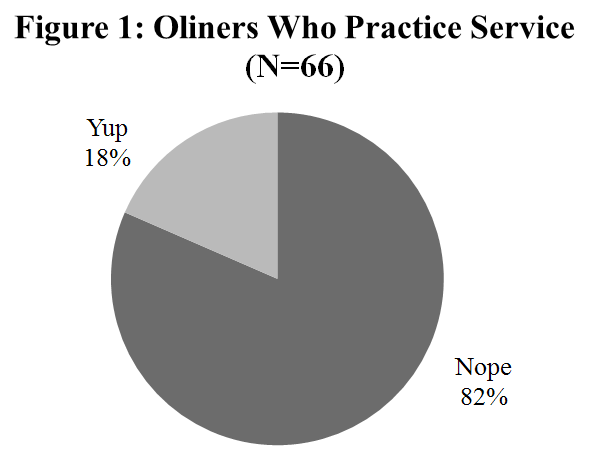
We were happy to receive 66 responses to the survey. The distribution of people who currently identify themselves as service participators is shown Figure 1 to the right.

fs-mar_service1According to the Corporation for National and Community Service, the college student volunteering rate across the country lies at 30.5% and is 30.7% in Massachusetts. Nationally, the median annual volunteering hours per college student is 40 hours, and “44.1% of college student volunteers engage in ‘regular’ volunteering (volunteering 12 or more weeks a year with their main organization)” [1]. This demonstrates that we, as a college, have a lot of room for improvement!

The results from our survey show that 82% of people who are interested in doing service are not actually engaging in it, suggesting that service opportunities are not easily accessible for students at Olin. We want to improve to follow the fifth founding precept from the Franklin W. Olin foundation: “The college, itself, the product of philanthropy, should find ways to contribute to its community and beyond… Policies must be maintained that support these outcomes.”

For those of us who are currently participating in service, the activities that we currently do include (but are not limited to): Edisco, HonorBoard, JFK Elementary School, Food Recovery Network, Math League, therapeutic riding, Brigham and Women’s hospital, regularly donating blood, and being a peer advocate. (Email us at SERV@olin.edu to let us know of a service you do that we missed!)

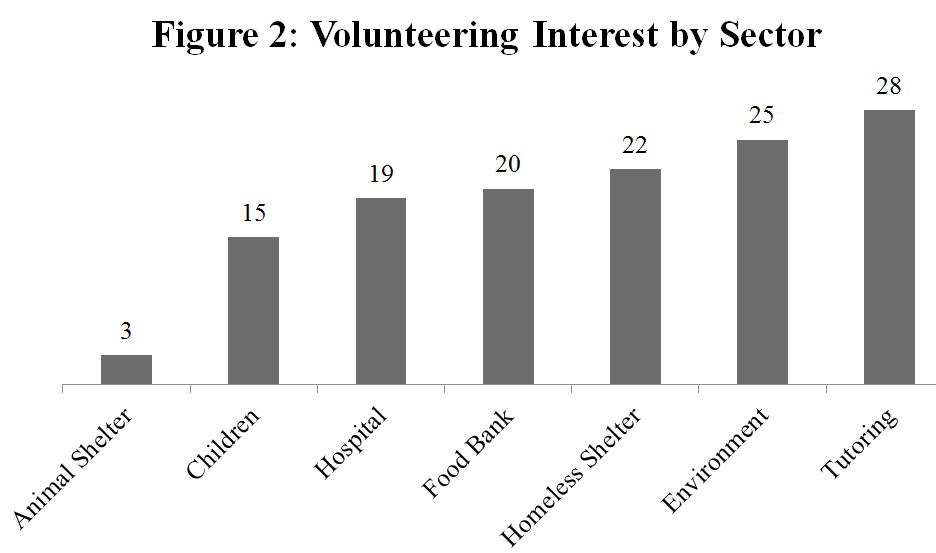
For Oliners who are currently not sure how to volunteer, the graph in Figure 2 demonstrates interest in the following sectors. fs-mar_service2Among these results, there were also other interests, including: professional applications of my engineering abilities, retirement homes/hospice, robotics, social justice, sporting events, youth art centers, and any other under-served group.

So now knowing what we can improve on and also what we are interested in, how should we move forward? Last month, Service Pursuits were introduced to help students get assistance and funding to participate in any service activity they are interested in. As we brought this new opportunity to the student body, we realized that many people loved the freedom and support that they now have. However, many of us don’t know where to start.
It takes time for us to find the right service we want to pursue, and with our busy lifestyles, finding service may quickly become marginalized. So to make this process even simpler, here are some strategies.

SERV members will be tabling every week from Monday to Thursday – come talk to us if you have any interest in trying a service pursuit! Not only do we process your requests, we are also here to help you form them.
Talk with friends and see what kind of service they are participating / want to participate in! We can help each other find opportunities that really engages us.

Expect to see some more informative documents/emails in the next few weeks. We are currently in the process of taking our research and creating a simple experience for everyone to find the service that matches their interests.
Give us feedback! Honesty is the most important aspect of this whole process, and without your thoughts and opinions, we can’t become the best service community that we aspire to be. Come talk with us in the dining hall or anytime, or email us at SERV@olin.edu.

I’m excited to see the next chapter of our service story at Olin, and I hope you are too!

Citations
[1] http://www.nationalservice.gov/pdf/06_1016_RPD_college_full.pdf
[2] http://www.volunteeringinamerica.gov/rankings/States/College-Student-Volunteer-Rates/2013

Becoming More Honorable

“I’m not honorable.” “I’m always late for meetings.” “I lie all the time.” This is just a sampling of the excuses given last year by people who did not want to run for the Honor Board. I realize that many of these were said in a joking manner, but there is a troubling thought lurking behind this. The Honor Code is something every student signed, promising to live by it for their four years at Olin College. Is the Honor Code a document we sign once and then forget about, or are we supposed to live by its values every day? The following is an examination of individual clauses of the Honor Code in action.

The Integrity clause of the Honor Code reads, “I will represent myself accurately and completely in my work, my words, and my actions in academic and non-academic affairs.” Lying is clearly a direct violation of this clause. I see this clause broken most frequently when people probably do not mean to tell a non-truth. For instance, committing to do a certain task for a project or club and then not follow through on it is an inaccurate representation of one’s self. If someone is not going to do an assigned task, I would rather that they tell me before I count on them to finish it or as soon as they realized they could no longer complete the task.

The Respect for Others clause in our Honor Code reads, in part, “I will be patient and understanding of fellow community members, and considerate of their inherent dignity and personal property.” This starts with respecting, rather than ignoring, choices people make that differ from your own. I wish we had a culture where people felt comfortable talking about ‘taboo’ topics. In her article from the November 2014 Frankly Speaking, “Religion and the Broom Closet,” Claire Barnes said, “We as a community need to be able to have open, productive conversations about all aspects of life, including religion.” I agree. However, we have yet to achieve that level of respect at Olin. In my classes lately, I keep hearing things such as “because we’re all engineers we think…” Yet not everyone in the room is thinking the same thing. As soon as comments are made dismissing any other opinion that could be made, the environment can become hostile for anyone who thinks differently. When we leave the Olin Bubble, the diversity of opinions we encounter and need to work with is likely to grow. If we cannot respect each other here at Olin, how are we going to fair upon entering ‘the real world’?

Creating a culture of respect in all aspects of life is a long-term challenge. I invite you to start with the simple action of respecting others’ time. I have been on exactly one project team at Olin where every single person on the team committed to showing up on time. And it worked! I have been told it could never happen at Olin, yet it did. As a community, we have implicitly decided that habitual tardiness of 10, 15, 20 minutes is acceptable, but when my team decided that we should respect each other’s time, the difference to our team dynamics was amazing. In addition to having the full, scheduled time to meet, meetings no longer started with annoyance at teammates for being late, so the meetings began in more collaborative manner.

Openness to Change we frequently think of as being willing to try new things. This clause in the Honor Code reads, “I will be receptive to change, supportive of innovation, and willing to take risks for the benefit of the community.” To fully live this, we need to be receptive to new classes, new professors, trying new things in established classes. We also need to think about how we talk about such experiences. “Linearity sucks” “Don’t take [class] with [non-Olin prof]” Supporting innovation requires actively engaging in the process. Instead of stopping at “linearity sucks,” continue the process of improvement by figuring out why linearity sucks and also what is going well. Engage in a respectful conversation with the professor. Will it always work? No, but trying is important. Taking risks is not a passive activity.

I end with a request. Please look at the small places where you personally are not living up to the Honor Code and try and change. Choose a couple of clauses of the Honor Code to focus on, then try to live out the spirit of these clauses in full. As the Do Something clause says, “I will strive to better myself and my community and take responsibility for my own behavior…” To me, this surpasses the guilt trip ‘Do Something’ is frequently used as. The Do Something clause sounds to me like a way of life. I hope you see it as the same.

Horoscopes by Drunk Editors

Pisces (Feb. 19 – March 20): Sandals and snow don’t mix. Boots were invented for a reason. Although boots and tall snow don’t mix well either, so you’re probably just screwed.

Aries (March 21 – April 19): This month we will lose an hour. You’ll need to work very hard to make up for this missed hour or work time or sleep time. Use your negative hour very wisely – you paid for it with a hangover in November.

Taurus (April 20 – May 20): See if any of the doors to the roof of your heart are open. Stargaze. Don’t get caught.

Gemini (May 21 – June 20): If there was ever a time to embrace Pass/No Record, now is not it. Good news, though – spring break is right around the corner. You’ll have an extra week to work hard.

Cancer (June 21 – July 22): If there was ever a time to embrace Pass/No Record, now is not it. Good news, though – spring break is right around the corner. You’ll have an extra week to work hard.

Leo (July 23 – Aug. 22): You will have to walk to school, barefoot uphill both ways in the snow. And this winter is about to be Boston’s snowiest winter ever.

Virgo (Aug. 23 – Sept. 22): When you see the bananas in the dining hall I bet all you can think of is the telephone. Use this as a reminder to call your family or reconnect with old friends. I bet they would love to hear from you.

Libra (Sept. 23 – Oct. 22): Stop. Stop procrastinating. Stop saying ‘no.’ Stop trying so hard. Stop not trying hard enough. Stop feeling guilty.

Scorpio (Oct. 23 – Nov. 21): Tennis balls are so perfectly round and fuzzy. They are fun to bounce. You can’t not smile when you’re holding a tennis ball. Next time you see one of these magical objects, make sure you give it its due respect.

Sagittarius (Nov. 22 – Dec. 21): You can convince them of anything. Remember, people used to think the Earth was flat.

Capricorn (Dec. 22 – Jan. 19): You look like you need some ice cream. Guess what flavors the Dining Hall has? Peach.

Aquarius (Jan. 20 – Feb. 18): BACK UP YOUR DATA! EVERYTHING WILL CRASH AT MIDNIGHT!