Farewell Senior Editors

In two short weeks, the Class of 2015 will be graduating, leaving Olin to join the real world. This means that we will be saying goodbye to basically our entire editorial staff. So before they head off into the world, I would like to take a moment to thank them for their work, and to wish them well in their endeavors.

Thank you to Julianne Jorgensen, Morgan Bassford, and Allie Duncan for looking over the paper before it was published and catching our little mistakes.

Thank you to all of our contributors; your articles and insights will be missed. Special thanks to Elizabeth Mahon for the Video Game Trivia column.

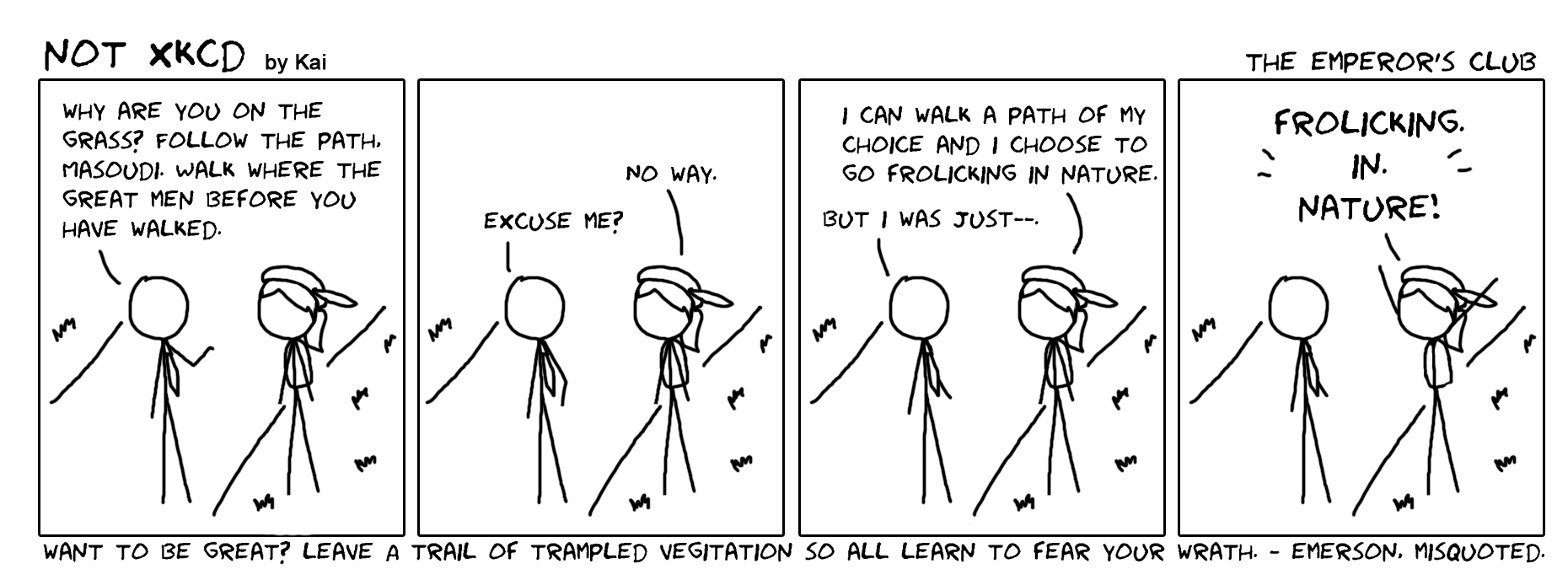
Thank you to Kai Austin for editing, layout, Not XKCD, and maintaining the website.

Finally, thank you so very much to our wonderful Editor in Chief, Lyra Silverwolf, for seeing the paper through its fourth and fifth years and for joyously announcing the first weekday of every month.

I’m good at writing neither goodbye’s nor conclusions, so good luck, we will miss you, and thank you for Frankly Speaking.

Editor in Chief Announced

Frankly Speaking has been an integral part of my Olin experience, and I cannot begin to express how much I will miss it when I leave. However, as I will be graduating in less than a month, I am pleased to announce that Gigi Chow ‘18 will be taking over my role as the sole editor-in-chief next year. The paper has not only seen a fifth year of existence, but it will also fearlessly enter its sixth year in the fall under Gigi’s careful guidance and leadership.

Gigi joined Frankly Speaking with a wealth of knowledge and experience from her high school newspaper, and she has been heavily involved in all aspects of our paper since she arrived here. During her four years of high school she held the positions of photo editor and website manager, before transitioning to be a co-editor-in-chief during her senior year. I am glad to leave the paper in her capable hands.

However, Frankly Speaking can’t survive on the editor-in-chief’s passion alone. The paper isn’t possible each month without the help of our editors, writers, and contributors. Gigi needs your help to keep Frankly Speaking running!

We have several seniors who work on the paper graduating this month, including myself (EIC, 2 years), Kai Austin (editor and website manager, 3 years), and our esteemed Video Game Trivia columnist, Elizabeth Mahon (columnist, 2 years). Many thanks to them for all of their hard work!

Here’s who we need:

Editor – reads, edits articles, helps with layout. Must be able to spell and edit.

Layout editor – uses InDesign to lay out paper. Must be willing to learn InDesign.

Website manager – keeps FS’s website up to date. Kai Austin revamped the website two years ago, but he needs a successor to upload new content each month.

Copy Editor – check the first print copy of Frankly Speaking for grammatical errors, typos, and layout faux pas.

Staff Illustrator – sometimes we have these awkward spaces and they have to be filled with drawings. Can you draw things at the drop of a hat? Be staff illustrator!

Contributor – the bread-and-butter of the paper. Everyone is a contributor! Submit articles to:
submit@franklyspeakingnews.com

Building Bridges at Olin

As a recent alum and staff member on campus, I’ve had the opportunity to- and in fact have been asked to- spend some time thinking about how to build bridges between different parts of the community (Students, Faculty, Staff, Alumni, Parents), as well as within those groups. We’re such a small community that any distance between these groups almost feels magnified – we are our each other’s support network. Working on bringing the community closer together was my favourite thing to do back when I was a student, so it’s really a joy for me now that they’re paying me to do it! Well, these past few months have been a little busy for me, but now I’m back. And I’m very interested in hearing your feedback on (and/or support for) my thoughts.

First of all, let’s look at bridges that are currently in place. Advising families are structured to give students and faculty a point of contact over the course of the semester on a professional and personal level. SAC invites staff and faculty to major events like Dare to Diva and Spirit Week, and organizes kickouts to really encourage this bonding. Also in that vein, the seniors have a Faculty/Staff party at the end of the year. More recently, Banter was set up to connect older alumni with students on a professional level. At last month’s SLACfest, students and alumni worked out a number of new initiatives to improve alumni-campus connections, including an alumni-written newsletter filled with interviews of on-campus Oliners. The Student-Staff Bridges program is a low-intensity conduit for conversation between these different communities. And, thanks to a push from parents, LinkedIn is now a viable way to reach out to parents in different parts of the country for all kinds of assistance.

Building bridges is intended to be a gratifying experience – it feels good to learn about people who do cool things and are part of the same ‘tribe.’ But efforts often flounder or feel ineffective. The reason is simple: if one half of the interaction doesn’t find sufficient personal benefit, they won’t prioritize the connection. At some level, we all ask: “What’s in it for me?” They might go out and participate just for the sake of the other party… but they have lots of other things that maybe feel more important. So is there space for these efforts in a community as busy as Olin’s?

Definitely! Having solid connections with members of our small community in different spheres actually makes our lives easier: When we know and understand one another better, we can be more effective in all of our other efforts. We just need to understand how to build those connections in a manageable way. So looking ahead, what do we have and what do we need?

I’ll generalize: Students have skills, enthusiasm, and time (if properly compensated by credits, cash, or chow). The key to connecting with students is to a) do what they’re already doing, with no added effort on their part; b) make their work more effective or efficient, c) pay them, or d) create a compelling interaction for them that is, itself, worthwhile. Faculty and certain staff are connection powerhouses. They have big ideas and the resources to deploy them, as well as the incentive. What they generally don’t have is time. To successfully connect with this group, be prepared to have much of the engagement proceed independently, with the contact points being intense, brief bursts. Other staff, alumni, and parents simply want access to, and connection with, the community. Actually, some don’t, but I’m ignoring them for the purposes of this article. Those who do will spend time, as well as the resources available to them, to give back if they feel that their efforts are a) having the desired impact and b) appreciated. Unfortunately, this group also lacks the ability to deploy effectively on campus.

And what about the subset of Olin community members who are both staff and alum, are on the StudentEvents mailing list, and are a contact for the Parent Advisory Board? What does that subset have? Well, it has a single member: just me! And I have a wish: For more successful bridgings to take place. What do I need? People I can help! I can be a ‘connector’ all on my own for you – if you have plans but you don’t know who, in another group, you should talk to, please feel free to ask me. And I’m willing to put the time in to work on executing larger-scale projects in this space. I have ideas; you have ideas. Let’s chat!

Perspective on Vegetarianism

I’ve been asked countless times, “why are you vegetarian?” yet every time, the question stumps me. I usually just say, “meat doesn’t seem like a food to me,” and then struggle to explain what that means. I have been vegetarian since I was three, but I could never attribute the reason to any environmental, ethical, religious, or health causes. Recently, I think I’ve finally found a cohesive answer to this question in some articles by Paul Rozin, an influential author on the subject of disgust.

There is a type of disgust that makes us withdraw from things that remind us that we are fundamentally biological creatures. This disgust involves things such as death, corpses, and violations of the external boundaries of the body. It is called animal-nature disgust, and it differs from core disgust, the fear of incorporating offending substances with one’s body and interpersonal disgust, direct and indirect contact with strangers or undesirables. The latter two types of disgust are meant to prevent contamination of our bodies and keep us from getting sick. However, animal-nature disgust is different in that it has a strong connection to fear of death. Just like animal bodies, human bodies die. I do not eat meat because it reminds me that we, like animals, are vulnerable and mortal.

‘Do Something’ in Practice

We’re all familiar with the ‘Do Something’ mantra at Olin. Ask the person down the hall, the studier in the lounge, or the person sitting next to you to name the values of the Honor Code, and you can be sure that they will at least name Do Something. We see it in the title of emails and the closing sentiments in recruitment propaganda. We hear it in praise of starting awesome activities, sarcastically called out when no one volunteers to take on improvements, and as advice to the first year frustrated with a class or club at Olin. The Honor Board is just as guilty of throwing around Do Something as other organizations and individuals.

These are the actual words to the Do Something value in the Honor Code: “I will strive to better myself and my community and take responsibility for my own behavior. When I become aware of a violation of the Honor Code or an issue within the community, I will take action towards resolution of the situation. I expect others to do the same.”

If we were to summarize, this is basically a call to arms – it’s certainly about addressing personal behavior and actions that have broader impacts, but it is also a call to engage in actively promoting the Honor Code. Furthermore, it is open to interpretation – what does it mean to ‘strive to better my community’ or to ‘expect others to do the same’? If we aren’t actively striving to do these things, perhaps we are all in violation of the Honor Code.

Historically, there have been very few Honor Board cases that have been seen purely as a violation of Do Something. Some of this has to do with the ambiguity and broadness of the clause, and some has to do with the pain of determining whether or not someone was ‘striving’ enough. However, Do Something is called out almost daily. As a congratulations of good deeds, as a broad solution to any problem, as a guilt tactic to recruit the few volunteers we need to run all of the various organizations and events on campus…

Why? As a community, do we really need to be reminded to Do Something (anything) so often? Is there perhaps a reason why we aren’t doing anything?

We’re stretched thin right now. There are, oft claimed fondly, “more clubs than students.” We’re a community that prides itself on the independence and ability of the students to be involved in every aspect of life here: academic, service, social. We take it upon ourselves to load our plates with activities because we think we need to, because they’re ‘good for us’, because they’re ‘good for others’, or because no one else would do them.

We need to stop. As is so treasured at Olin, maybe its time for us to reflect as a community on what it is we ACTUALLY value. The Honor Code is supposed to be a tool to reflect the position of the Olin student body at this moment. The way in which we use Do Something doesn’t necessarily gel with the verbiage right now. Should it?

We all ‘pledge’ to Do Something when we sign the honor code, as written. We’re not signing to have Do Something held over our heads every time an email is sent out. We’re not signing to have to participate in every aspect of Olin culture. However, we are signing to ‘do the right thing’ as the community deems fit. Whatever that might be – participating in student government, meeting with professors to improve a class, helping out peers who have fallen on hard times.

Next time we are asked to Do Something, perhaps we should start asking “Why do we have to?” Is there a good reason that this is being asked? Is this going to better us as a whole? Are we as individuals currently ‘Doing Something’ at the moment?
And next time we tell or ask someone to Do Something, perhaps we should start asking “Why can’t I and why should they?”

SERV: More Than Words

This is the first installment of a monthly spotlight on volunteering opportunities in the Boston area. We’ll share the stories of organizations as well as how you can get involved! Feel free to email david.zhu@students.olin.edu for your thoughts and feedback to help me continually improve this segment.

About

If you want to empower disadvantaged youth through real-world skills such as business and interview training, More Than Words (MTW) is the perfect place to help. The organization helps youth “who are in foster care, court involved, homeless or out of school to take charge of their lives by taking charge of a business.” More Than Words does this by creating a chain of bookstores that sell donated books. More importantly, the bookstore is completely run by the at-risk teens enrolled in the program. Organizers, staff, and other volunteers help and train these young adults with the entrepreneurial and people skills that they need to succeed once they graduate from the program.

Impact

More Than Words accepts at-risk adolescents who are 16-21 years-old who have “compounding risk factors and are in need of an empowering life experience” to help them rise above their current situation.

84% have recent or current involvement with the foster care system.

54% have recent or current court involvement.

~80% do not have their GED and are either not pursuing or struggling in school.

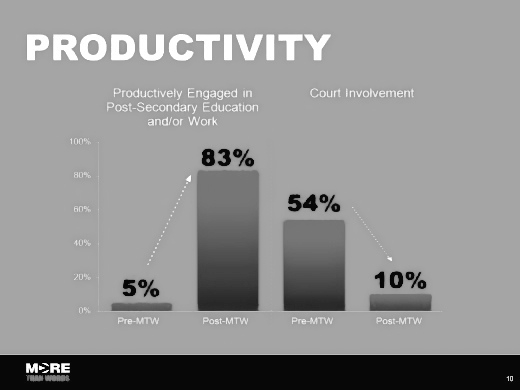
More Than Words proactively collects data to track its program’s effectiveness. 83% of MTW graduates have received or plan to receive their GED/diploma, compared to the 18% who had a GED/diploma before participating in the program. Also, 34% of graduates have enrolled in postsecondary education compared to 5% prior (illustrated in the graph below). Similarly, work-school engagement rises to 83% from 5% before the program (see the graph on the facing page). “While approximately 50% of youth come to MTW with court-involvement, this number drops to 28% when they leave the program and continues to drop to 10% within 24 months after the core program.”

Francis, a veteran of MTW, writes: “Before I came to MTW, I was getting in a lot of trouble, became court involved, and wasn’t going to school. While I was at MTW, I really enjoyed getting work experience. I learned how to give excellent customer service and how to be professional, and got my GED. I really appreciated all of the love at More Than Words. They helped me get the things I needed in life and helped me stay on track. When I transitioned, I got an internship at a hotel and now I just got a job at Bentley College. I’m working hard on my education. Education is very important to me now because I know that having an education can take you far in life.”

fs-apr_serv2

fs-apr_serv1

History

Jodi Rosenbaum started More Than Words “after a friend saw a pile of books on the side of the road.” Jodi states: “We realized those books were worth money and a hands-on way to empower youth with real-world skills… I am particularly passionate about adolescents who are system-involved and typically seen as liabilities rather than assets. For over 15 years I have worked in the public schools, juvenile courts, and nonprofit sector and have seen so many kids fall through the cracks despite good intentions. I think too often our efforts to help focus too much on trying to fix problems or remediate. That’s what has ignited my passion. I see youths with skills and untapped potential. It is exciting to be part of a model that focuses on how to empower a spark, a hope, and that gives an opportunity for youth to do it for themselves” [1].

Do Something

All in all, More Than Words is a great social venture where you can directly help up-and-coming adults with relevant skills so that they can also become contributors to society. There are various options to participate. For a one-time thing, you can assist as a mock interviewer and give feedback to the program members to improve their interview skills. You can also run a small workshop! (Think about some really helpful things you’ve learned while at Olin.) Finally, you can get involved on a weekly or monthly basis, working with the youth managing the store or being an educational coach.

If you are interested in volunteering at MTW, let’s come together and help out as a team. SERV will connect you with other Oliners who also want to participate. Find out more about More Than Words at www.mtwyouth.org, check out the upcoming carpe, and/or talk about it during our daily tabling sessions!

Citations
[1] http://www.jewishboston.com/Molly-Parr/blogs/3857-four-questions-with-jodi-rosenbaum-executive-director-of-more-than-words
[2] https://www.mtwyouth.org/

Horoscopes by Drunk Editors

Aries (March 21 – April 19): Marco?

Taurus (April 20 – May 20):.Many hands.

Gemini (May 21 – June 20): You, are foudroyant.

Cancer (June 21 – July 22): April showers bring rainbows. Go find some.

Leo (July 23 – Aug. 22): Nyctalopic octothrope.

Virgo (Aug. 23 – Sept. 22): There’s gum on your shoes. Both of them.

Libra (Sept. 23 – Oct. 22): Politeal Popinjays Play Ping Pong.

Scorpio (Oct. 23 – Nov. 21): Boo.

Sagittarius (Nov. 22 – Dec. 21): Name a country.

Capricorn (Dec. 22 – Jan. 19): Hitherto.

Aquarius (Jan. 20 – Feb. 18): [create your own]

Pisces (Feb. 19 – March 20): POLO!

Portable Gaming: Game Boy to iPhone

videogametriviaGaming on the go is a concept almost as old as video games themselves. One of the first – if not the first – portable video games was called Auto Race, and was made by Mattel in 1976 [1,2]. It was a simple device, based off of a calculator chip, but it started a large market. Many other toy companies – Tomy, Bandai, and Milton Bradley, to name a few – joined in. One of these was a relatively small Japanese toy company by the name of Nintendo. In 1980, Nintendo released a small portable video game called Game and Watch: Ball [3]. This was soon followed up by many other Game and Watch titles, at a rate of one a month. A total of 59 different games were released. Nintendo’s foray into the market did well, selling 12 million copies in Japan and 30 million overseas [4]. These numbers may, in fact, be lower than the true number sold, as Nintendo had problems with counterfeiters selling knock-offs [5].

But just one game will get boring after a time, and it’s hard to justify the cost of an entire device for a single game. That’s why Milton Bradley created the Microvision, a portable device that could utilize interchangeable cartridges. It was released in 1979, only three years after the first home console that accepted cartridges (the Fairchild Channel F, see February’s column) [6]. While the Microvision did moderately well, it didn’t set the world on fire. There wasn’t another cartridge-based handheld until Nintendo’s Game Boy, released in 1989 [7]. However, unlike its predecessor, the Game Boy did incredibly well. This in part was due the fact that it was marketed to adults as well as children.8 Seeing the opportunity, other companies released handheld systems. Atari released the Lynx in 1989 [9], and Sega released the Game Gear in 1990. Though both these competitors had superior graphics, their battery life was less than impressive, and their bulk reduced portability. As a result, neither was a success, and Nintendo gained a near-monopoly on the handheld gaming market.

Game Boy’s sales slowed in the mid 90’s, and some thought that it was nearing the end of its life [10]. Instead, its sales surged again due to two factors. The first was a hardware refresh, the Game Boy Color. It was smaller and had a somewhat more powerful processor, but the real advantage was its color screen. The other factor was a pair of games called Pokémon Red and Blue (or Green, if you were in Japan). With the new interest from a generation of kids who loved Pokémon, the Game Boy line continued until 2004.

It was then that Nintendo faced perhaps its most formidable opponent in the handheld industry: the Sony PlayStation Portable. Like the previous Lynx and Game Gear, it was technologically superior to Nintendo’s offering, but unlike them, it had a decent battery life. It also had the strength of Sony’s software ecosystem, coming off of their successes with the PlayStation and PlayStation 2. It did well, selling 80 million units total [11]. Nintendo, however, wasn’t going to roll over and let Sony win again. Despite its original success with adults, the Game Boy line had become more child-oriented over the years. Nintendo decided to shake things up by adding a new way of interacting with the games, in the hope of attracting new customers. The result was the Nintendo DS, a two-screened device that had a touch screen on the bottom. Initially, it was presented as a “third pillar” – an experiment alongside the Game Boy line, not designed to replace it. But the DS took off, selling 5 million units in its first year (2004), and the Game Boy brand was quietly retired [12].

The release of the iPhone in 2007 was not seen as a video game event, but within a few years it became clear that it and the other smartphones that followed in its wake were going to have a big impact on the handheld gaming sector. Games on smartphones, such as Angry Birds, have done remarkably well. The successors to the PlayStation Portable and the Nintendo DS – the PlayStation Vita and the Nintendo 3DS, respectively – have both sold substantially less than their predecessors, which has been attributed to people filling their portable entertainment needs with their phones.

What is the future of portable gaming? Smartphone gaming is not going anywhere – a fact that has been underlined by Nintendo’s recent announcement they would make games for smartphones. But many games built for more traditional platforms do poorly when moved to phones, whether because of the small screen or a reliance on traditional buttons. Ultimately, I’m far too biased to give an accurate prediction. What is clear is that portable gaming has become mainstream, and that is unlikely to change.

Citations
[1] Before the Crash, page 86
[2] In action: https://www.youtube.com/watch?v=isejBX1Tyjk
[3] http://iwataasks.nintendo.com/interviews/#/clubn/game-and-watch-ball-reward/0/1
[4] http://iwataasks.nintendo.com/interviews/#/clubn/game-and-watch-ball-reward/0/3
[5] Game Over, page 127
[6] http://www.officialnintendomagazine.co.uk/13153/features/history-of-nintendo-game-boy/
[7] The Ultimate History of Video Games, page 415
[8] Game Over, page 295
[9] The Ultimate History of Video Games, page 419
[10] http://www.nintendo.co.jp/ir/en/library/events/150217qa/02.html
[11] http://metro.co.uk/2013/11/27/xbox-one-v-playstation-4-who-will-win-the-next-gen-console-race-4201485/
[12] http://www.nintendo.co.jp/ir/library/historical_data/pdf/consolidated_sales_e1412.pdf
A Letter to Teenage Shane

Dear teenage me,

You probably thought that by now I’d be brimming with advice and important life wisdom that I needed you to know. I thought I’d think of plenty of anecdotes to tell you.

Now, I realize I am not sure what to say, which I guess is a good thing. There is no amazing advice I need to give you. No secret message to fix everything. Could you do college differently? Of course. Could you have a better relationship with your parents? Obviously. Will depression come back, self-esteem continue its roller-coaster ride, and your room remain messy? You betcha. But, that’s ok. That’s life.

What I guess I do want to tell you, though, is that you haven’t gotten that good at all things you want to be better at. Well, I mean that I’m not yet what you consider to be good. You want to command a room like your friend Mark, be able to make friends with anyone like Isaac, and crack jokes like Roi. You have a whole list of ways you could be a better person and another whole list of people you want to be like. Well, like I said, you can’t speak like Mark, you’re still a bumbling mess around strangers, and your jokes are still equally hilarious, but mostly only to you.

I can say that you’ve slowly realized you don’t need to be like Mark or Isaac or any of them, because no one can tell a Shane story or plan a spontaneous adventure like you do. You can make people feel comfortable around you, your sarcasm is so good that most people don’t even get it, and you’re still really funny. Yeah, of course I am going to keep practicing and trying to get better at all that other stuff, but just remember to look around and see all the things you’re good at too. I count at least 3 talents, but counting might not be one of them.

– Shane