Pandemic Art: Dada and Creativity Practicum

Last fall, I took the Olin class Creativity Practicum, a studio class about understanding and finding your own voice in art and design. One of the first assignments has you watch a video titled “I Could Do That” by the YouTube channel The Art Assignment. The video talks about why people who look at art, such as a Pollock painting, and say something along the lines of “that’s not art, I could do that” should really think before they speak, but that’s not relevant to this Frankly Speaking piece–no, I mention the video because for approximately two seconds, a piece of art was splashed across the screen, and it completely changed the way I approach art.

But before we get to that, a little bit about me: I’ve been drawing since I could pick up a crayon. Art-making has been a part of how I express myself, reflect, and tell stories for my entire life. In high school, I made art like this:
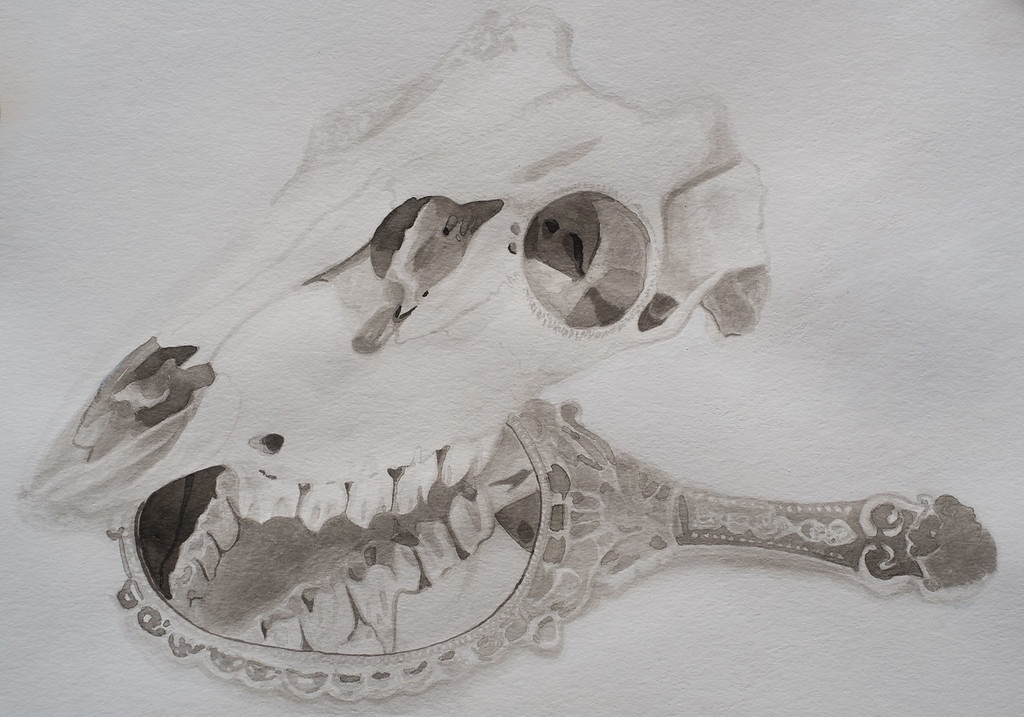
Skull & Mirror

Extremely detailed, highly accurate observational work. And I loved it! The process of observational drawing was (and still is) extremely meditative for me, and I’d sometimes become so absorbed in the process that I’d stand for four or five hours straight. However, I didn’t work quickly. A single piece would take me weeks or even months to finish.

Creativity Practicum, on the other hand, pushes you to work fast. There isn’t any emphasis on the quality of work you put out, or even on the idea that you’re “making art” at all. Each week you explore a different idea–sometimes a specific artist’s work, sometimes a more abstract concept–and then on one page of a spread you’d put images you associated with the week’s assignment, and on the other, you’d create a summarizing image and write a half-page reflection. I went about completing the first assignment in the way I usually do, and inevitably didn’t finish, but didn’t think much of it because I didn’t need to have a finished piece. And then I watched the aforementioned YouTube video, which features this collage by Hannah Hoch:

Hannah Höch, Cut with the Kitchen Knife Dada Through the Last Weimar Beer  Belly Cultural Epoch of Germany – Smarthistory

The title is Cut with the Kitchen Knife Dada Through the Last Weimar Beer Belly Cultural Epoch of Germany. Concise… but I was captivated by it. I love how the crowded composition makes your eye dart around the picture, and how carefully cut out and placed each individual part is (such as the man juggling his own head near the center of the image, which, upon closer inspection, seems not to be his own head). I love that it’s disturbing and funny in the same breath. And, ironically, I love that whenever I look at it I think, “Wait a minute–I could do that!”

I was already thinking about the different images that came to mind for each assignment and taking note of them. What if instead of putting all this time and energy into a piece I crafted by hand, I simply took those images and arranged them in concert (or in chaos) with each other? I tried it out:
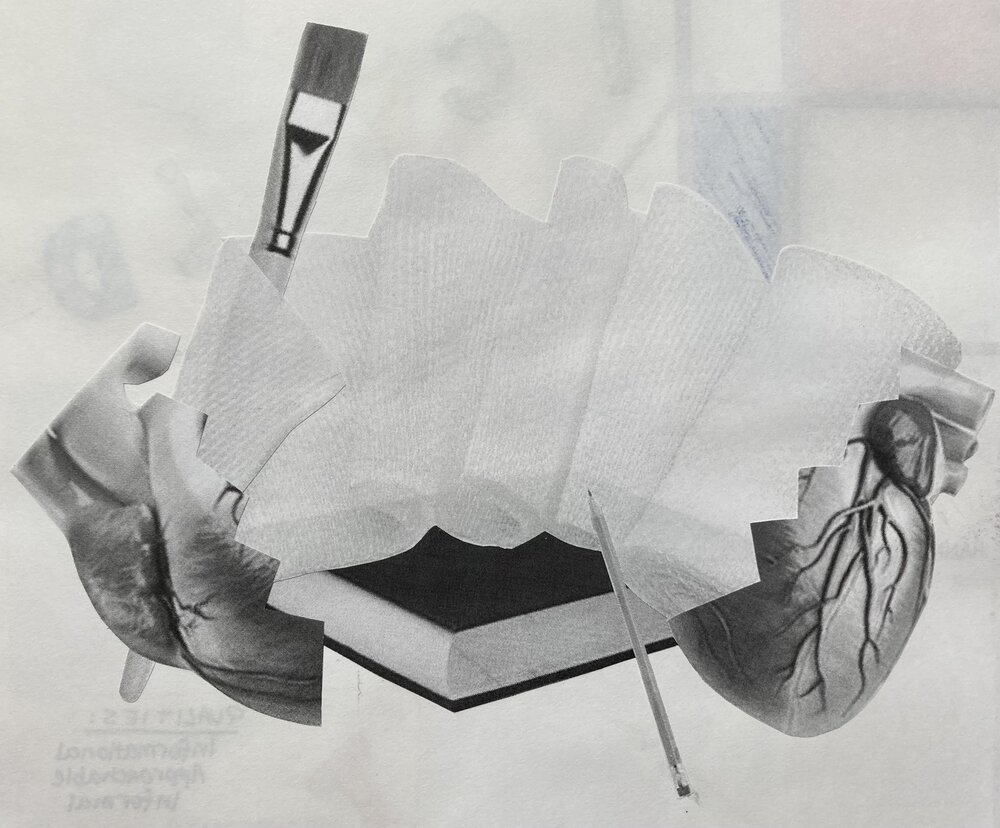
Untitled Sketchbook Page

Okay, this was cool. Only one problem: the pages of my sketchbook were curling from all the glue. Then I remembered a girl in one of my high school art classes showing off some of the pages she’d made in Keri Smith’s Wreck This Journal, an interactive workbook that asks you to–well–I’ll let you figure it out. Her pages were wrinkled and torn and the notebook didn’t even close, but the pages inside were incredible. So I made the conscious decision to actively destroy every single page I worked on.

Throughout the semester, my art improved tenfold. Not only that, but instead of making one piece in four months, I made thirty. Less than half of them are things I’m proud of, and almost none of them are portfolio-worthy, but for the first time, I felt like I was conveying complex ideas and showing my personality through my work.

At home in the pandemic, I was constantly in the company of my childhood pet, Hobbes. His relentless affection was mostly reciprocated, but I sometimes felt he was a bit… needy. One day for fun, I made this:
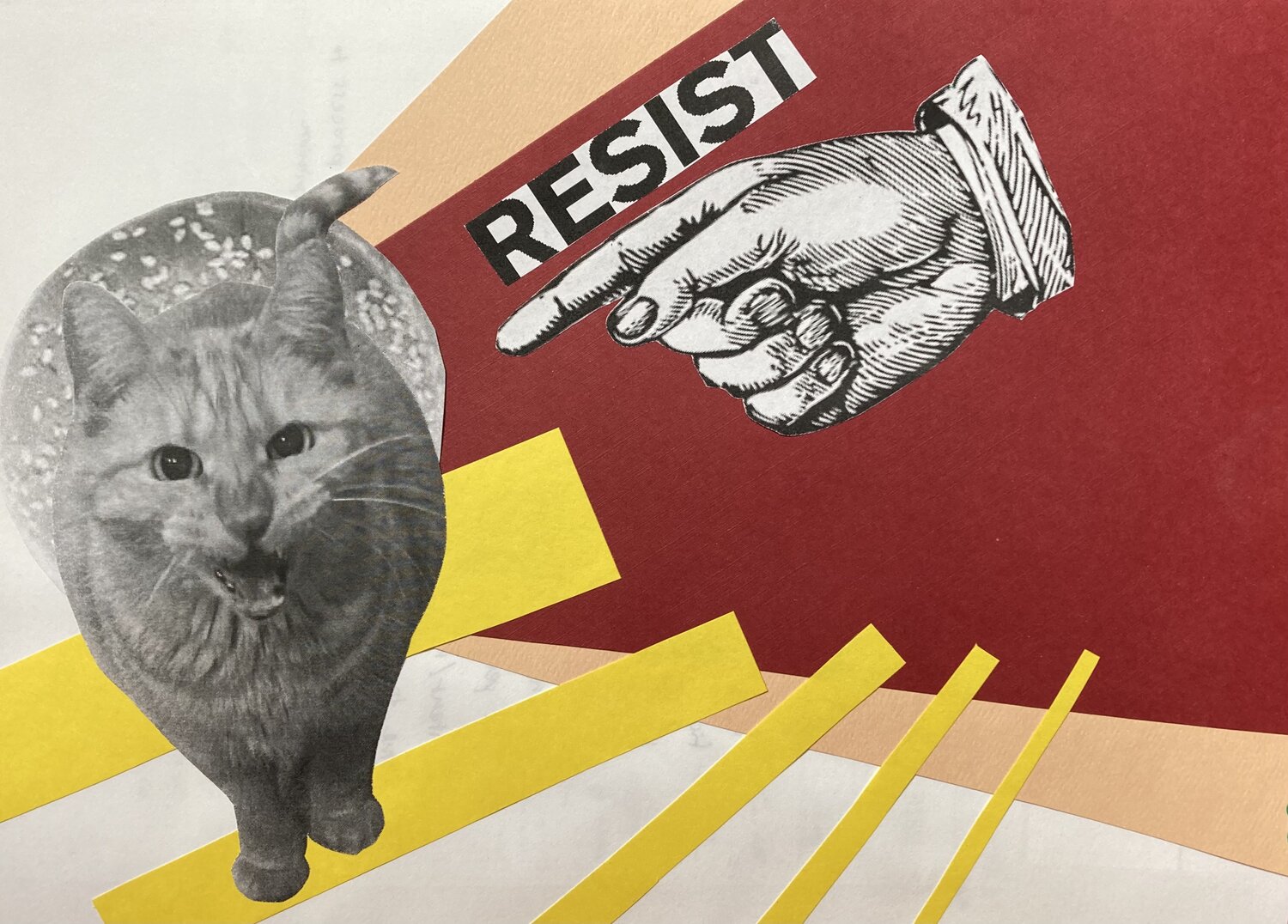
Resist! (Sketchbook)

Hobbes began to feature prominently in my work. Everyone in the class became familiar with him, and not just because whenever I unmuted they could hear distant meowing. For the class’s final project, a collection of postcards, I decided that each one would feature Hobbes among images from photographs I’d taken. And throughout the whole process, my mind kept returning to the collages of Hannah Hoch.

Hoch was part of the Dada art movement, which developed in Europe and New York in direct response to World War I. Hoch’s work specifically centered around identity construction–what does it mean to be a “modern woman” in the aftermath of such a devastating event? During the pandemic–which hasn’t ended!–I felt comfort in the way that Dada embraced nonsense. Nothing else in the world made sense, after all–why should our art?

Although we’re back at Olin, things still don’t feel “normal,” and there’s no promise they ever will be. But I can continue to grow, as an artist and a person, in spite of that. And I’m glad to have found my “mews.”

RESIST!

OCLOACA Catalog

OCLOACA (Olin College “Look Out! Anomalous Creatures!” Association) has been hard at work over the past month since our return to campus. We seek out those creatures whose existence seems to reject reality, and warn the community of any dangers or delights associated with them. We are pleased to finally present a partial catalog of anomalous entities observed, or thought to have been observed, directly or indirectly, at Olin College of Engineering.

The Weeping Capacitors

These electronic components, found primarily in the iSIM lab but occasionally spotted elsewhere, are notably emotionally sensitive. If you curse at them in the heat of circuit-related confusion, they will cease to properly function until you cradle them in your arms and apologize profusely. Just don’t make them cry. We still don’t know what their tears contain. Also, we kinda want to protect them now.

That Perfectly Shaped Circle Of Moss We Saw On The Dining Hall Balcony That One Time, And I Just Had To Take A Picture Of It, Because Come On, It Was Such A Perfect Circle

I miss it every day.

The Anti-Mimics

These irritating pieces of text consist of a single symbol, or a single collection of symbols, that can be associated with many completely separate concepts. Most Anti-Mimics actually live in harmony with us, helping us communicate more concisely. However, many specimens can be particularly nefarious. One such specimen was recently sighted within the covers of a Discrete Math textbook: P(x) referring to the power set, and then only 2 pages later the same P(x), this time referring to a propositional function? We consulted one expert, Dr. Hexter, who specializes in malicious symbolic anomalies, and they had this to say: “[series of incoherent noises]”. After some guttural-noise-frequency analysis, our current hypothesis is that they were trying to evade the harms of the Anti-Mimics by creating a single-use, disposable word for every concept, but we’re not sure.

The Mist of Guilt

These microscopic organisms often build up in places like team rooms, classrooms, and poorly ventilated areas, but their multiplication is greatly accelerated by occasions where sleep-deprived yet passionate people have been talking in one room for too long. The Mist has a characteristic smell that doesn’t register as a smell to humans; rather, it registers as a strong feeling that you must solve all of the world’s problems now, or else — and not only that, but that you must do so alone. After being accidentally released from the site of a failed superhero creation experiment ██ years ago, many institutions have had to deal with periodic infestations of the Mist. If you begin to feel the effects of the Mist at any time, you must stop your current activity, evacuate the contaminated area, and do something else for a while, to allow the contaminated room to air out.

The Unknown Unknowns

The class of anomalous entities that we don’t know that we don’t know about. The only thing we know about these creatures as a class is that the number of entities belonging to it is probably extremely large, as well as incredibly huge. Maybe.

The Impostor

This monstrous creature skulks around every Olin location at once. Though it has been observed by many, its true appearance cannot be described. If one is exposed to it too often, it may follow them around anywhere they go. Contrary to popular belief, the Impostor’s most dangerous property is not being “sussy”. If you observe it, you will be strongly induced to believe that the Impostor is you — that you are watching yourself skulk about from a distance. There are many ways to prevent this. One involves recognizing your own goodness. I guarantee that if you’re reading this, you are not this creature, as the only thing that this creature ever does is try to make others believe in it. Have you been skulking around all places at once, at all hours of the day, making everyone think that they’re you? I thought not.

Join OCLOACA now, to help us better understand the reality-breaking entities that affect our lives every day. And remember — only you can prevent ████ █████████ ████████.

What Your Dorm Says About You

The Floor Is Laundry

What’s the point of making your bed when you’ll sleep in it the next day anyway? You have open containers of food and clothes strewn all over the floor. You haven’t taken out the trash in three weeks. You don’t get many visitors and you don’t know why.

The AmazonBasics Dorm

You forgot that dorms are supposed to have decorations, so you purchased everything off of Amazon when you got here. You have a Great Wave poster and a map of the world because those were the first things that showed up when you looked up “posters”. You used the rubber tubing and dowel as your hopper trigger.

The Dorm With All The Plants

You have given names to your plants and talk to them daily. You bought your water bottle from REI and decorated it with national parks stickers. Your favorite shoes are Birkenstocks or Tevas and you own at least one article of clothing from Patagonia.

The Food Pantry

Your fridge is overflowing because you make frequent trips to Trader Joe’s and hoard food from the dining hall. Your parents never let you eat snacks when you wanted, so you’re overcompensating now.

The “Live Laugh Love” Dorm

Everything you own is color-coordinated. You own scented candles and have used them more than once since first getting them on Etsy. Your favorite thing from home is your Fujifilm Instax and you hang your polaroids on your wall with string lights.

Your Floor Is So Spotless You Could Eat Off the Ground

You clean your dishes right after eating. You always put colored pencil sets into rainbow order when you’re done with them. You tell people “my dorm is so messy!” when the only thing on the ground is your shoes. Your hopper worked on your first try.

You Have Apple “Think Different” Posters On Your Wall

You check Hacker News every day. You’ve read Zero to One and The Hard Thing About Hard Things. You frequently quote Paul Graham, wear Allbirds, and use words like “scale” and “pivot” more than necessary. You are taking classes at Babson.

Why You Should do NOTHING, Like Me

Picture this: you’re alone in your room, which is a mess, with a semester-long to-do list in which nothing has been checked off. Your finals are next week. You have one night to finish a semester’s worth of homework for one class. It sounds impossible, but that’s what my life was like for my first two years at Olin.

“How did the professors even let that happen?! That’s not even possible!” you say.  Which—fair. You have a point. But the reason it got to that point is that I was depressed and anxious. And people at Olin are understanding. They give you the space you need to do the growing you need to do.

As many of you know, the people at Olin are just incredible. Each person you meet seems smarter and more talented than the last. They are talented, skilled and knowledgeable. They’ve done the coolest internship, the most complex projects, and have the best job lined up after graduation. It’s easy to feel like an imposter. It’s a lot, and it hit me hard. I felt completely out of place. I was just some not-American girl, who didn’t know how to code, who hadn’t done big engineering projects in high school. I pushed myself so hard after getting here thinking that I had to catch up. Two project teams, Robolab, and 20 credited on top of it. I thought if I became some kind of machine who was working all the time I could a) catch up with everybody else and finally get that internship, and b) not lose sleep agonizing over “what did I do to make everybody hate me today”.

Obviously, that crashed and burned real fast. I was barely able to keep up with that schedule for a week before I started falling behind, and I’d avoid people in shame, and then agonize over being ignored, and consequently not get anything done in the process of agonizing. I was burned out within the semester. I spent two years subjecting myself to this cycle, just so I could be good enough.

And then, COVID-19. We got sent home in March 2020. I was actually doing a little better that semester, adequately busy (but not too much), with some healthy social dynamics. I learned very quickly that online learning wasn’t for me. I decided to take the year off. At first, I was pushing myself hard to find an internship or some way of being productive. The internship didn’t work out, but I thought, “If I learn some theoretical content now, I won’t struggle when I’m at school, and I won’t be depressed!”

This turned out to be completely false. I was at home, learning at my own pace. No homework, no deadlines, no stress, but I was still lost. I felt hopeless all the time. I was living because of some invisible, inevitable, and incessant force pushing me forward, not because I had a dream of my own. And then one day, exactly five months ago, I put my foot down. I told myself, “For the rest of my break, I am going to do nothing.”

And that’s what I did. I would wake up whenever I felt like it and spend all day in bed binge-watching Modern Family and a random assortment of equally good, but equally trashy, K-Dramas and C-Dramas. I learned languages, sang terribly, ate the worst food, and did whatever I wanted to do, solely because I wanted to and it was good. So good that I don’t have any more eloquent words to describe it. I felt myself growing dreams and aspirations that I had given up on ever having again. I finally developed a passion for engineering beyond the point of it merely being a fleeting interest. For the first time ever, I want to be where I am, doing what I’m doing, with the people I’m with. And that’s all that really matters.

It’s really easy at Olin to fall victim to imposter syndrome and FOMO. For some, it’s worse than others. I only hope that you don’t get it as bad as I did. Because, honestly, it’s not worth it. Finding joy in what you’re doing, and being the best you that you can be, will bring a lot more value to your life than some stupid internship.

Editor’s Note: Please, please, please reach out to an ARC before it gets as bad as it did for me.

21

21 years of natural disaster after natural disaster

21 years of climate change denial

21 years of widespread poverty, food insecurity, and lack of access to basic needs

21 years of billionaires in the richest country in the world

21 years of mass shootings

21 years of “now is not the time”

21 years of endless death and torture caused by our country in the middle east

21 years of “protecting national security”

21 years of being told terrorists are coming to bomb us

21 years of bombing other countries

21 years of gay and trans people being seen as less

21 years of “you’re being too dramatic”

21 years of pervasive racism in every part of our society

21 years of already having the Civil Rights Act, what more do you want?

21 years of pervasive sexism in every part of our society

21 years of not needing the Equal Rights Amendment because women are already equal

21 years of controlling women’s bodies

21 years of “protecting lives” in a country with almost no safety net

21 years of not having the right to healthcare

21 years of “uninsured people are lazy”

21 years of being asked why I’m so jaded

21 years of America.

Our Hopes: Returning From Online Classes

This semester we are returning to Olin in-person, after two and a half semesters of classes online or a hybrid of online and in-person. Olin classes typically involve building things, using tools, and lots of teamwork.While many classes had extremely creative solutions for moving their content online, things were undoubtedly different. At the end of the summer, I interviewed several current juniors and seniors about their experience with online classes, and what their hopes are as we go into an in-person fall semester.

While students had widely varying experiences with different parts of their online classes, everyone I talked to said that the experience was overwhelmingly lonely. “It did feel lonely and isolating at times… you’d run into those moments where you’re like, ‘Oh, I am sitting alone in my room, scribbling on a piece of paper, hunched over my bed.’” one student said. Multiple students said it was “harder to check up on people,” and that they felt less connected with their teammates than they had during in-person semesters.

While everyone experienced loneliness, students had different experiences with other aspects of online learning. While for one student professors seemed inaccessible and writing an email felt overwhelming, another said it was easy to find time to talk to professors because they only had to write an email and set up a Zoom call. The Zoom chat was especially polarizing: some people found it overwhelming and distracting, some felt more engaged using it, others really enjoyed having a “backchannel” to share links, and others only liked it as a place to type a brief check-in. A few students said that assignments and due dates were more well-documented and easier to keep track of than they’d been in-person, while others felt like the wide variety of online tools being used–Canvas, Slack, Discord, and custom class websites, to name a few–made things more confusing.

At the end of each conversation, I asked students what their hopes were for this semester. Here are some of their responses:

  • “I am super excited to be back on campus! I just really want to be around people again, I’m very excited to work in teams and in groups, and in the AC–or the MAC is what it’s now called”
  • “I hope I can maintain relationships without being in the same space as a person”
  • “I want to share my stupid ideas with people more”
  • “I hope that I can still find assignments online if I miss them”
  • “I’m really excited to have more space, like, not be confined to a single bedroom”
  • “I don’t think my priorities have changed that much, but I have a better idea of how to attack them now”
  • “I want to talk to professors more”
  • “I… do not know, right now, because I’m just expecting things to be difficult, and… I just hope to be able to stay afloat, in whatever way I can”
  • “I want to focus more on activism, and ethics in engineering and everything you do”
  • “I’m really hoping for a dynaming of rebuilding community that is patient. I hope that people share with one another and that we maintain this compassion that we built in zoom land, understanding that just because we’re back in person now doesn’t mean people’s lives are dramatically easier”
  • “I want ‘normal plus plus’”

Although we’re already two weeks into the semester, much still feels uncertain. What are your own hopes for this semester? I hope that as we continue to settle into a kind of routine, we can support each other and ourselves in achieving these hopes as best we can.

Professors Aren’t Your High School Teachers

You’ve already noticed that most professors at Olin go by their first names, while your teachers in high school went by their last. You might not know that you shouldn’t call them “Mr. or Mrs. Lastname”. Professor is always a safe option if you need to address someone with a title, but most Olin professors prefer you refer to them by just their first name in class and in emails.

Just like these are different ways you treat your professors with respect, they have different ways to show you respect than what you might be used to. You don’t have to ask to use the bathroom, or to leave the room at all. As a principle, you’re an adult and they treat you as such; you’re allowed to go where you want when you want, and you’re responsible for your education. If you’re doing independent work and don’t want to be in your seat, go sit somewhere else, like the hallway. Just know when to be back or make sure someone knows how to find you.

You suddenly have a lot of autonomy. Sometimes it feels like too much. I don’t always know what I’m supposed to be doing. You don’t have to go through a class completely on your own though. The professors and CAs are there to support you, and are happy to help when you need it. Asking for help at Olin feels different than asking for help in high school did. I felt like if I didn’t justify my confusion to my high school teachers, they would think I wasn’t trying, or that I was stupid. It feels different at Olin. Asking for help is proof enough that you’re trying. Professors expect you to try on your own, but will give support when you ask. Almost all the wondering if you belong at Olin comes from inside your own brain.

The professors I’ve talked to are careful not to force their point of view onto students. If you disagree with one, it’s probably safer than you think to speak up. They’ll explain their reasoning if you ask and leave room for other opinions. Feel free to ask why you’re doing a specific activity or why they said something.

Similarly, if they give you feedback, you don’t have to accept it without question. Feedback is not always a correction that needs fixing, sometimes it’s just a recommendation. In my English classes in high school, every red mark on the paper needed to be fixed or I would lose points in my next draft. When I got feedback on my writing in college at first, I was frustrated making changes that I disagreed with. Sometimes, I’d even  get conflicting feedback on my next draft. Eventually, I learned I didn’t have to make every change . I can interpret the intent behind feedback and decide how to use it on my own.

In all of these situations, I felt like my high school teachers were trying to catch me doing wrong. I had to fight against them for help, for extensions, or even to use the bathrooms. My professors treat me more like I want to be treated as a student: with respect, and like a capable adult who is sometimes in need of guidance.

It took me a while to realize this and treat them with respect in kind: as a resource, a more experienced adult, an expert, and never an opponent.

Everything You Need To Know About Lint

Everything You Need To Know About Lint

Many people have been talking about lint recently. You may have heard about lint on the news or from your friends. But you may have questions about lint. Well, today we’re here to tell you everything you need to know about lint.

What is lint?

Lint is a collection of soft fibers you can find in human crevices. You may be aware of lint from your bellybutton, but it’s actually a myth that bellybuttons are the only place where lint occurs. Recent studies show that lint appears all over the body, in all known crevices and orifices. Some Dentists have even found lint in patients’ cavities!

Where does lint come from?

Lint was previously thought to come from our clothes. However, this “lint” is not the same lint as we know today. The definition of lint has evolved over time. Did you know that in the 19th century, “lint” referred to shaved linen? That lint was used to patch wounds during the American Civil War. Many ladies at home would join Lint Societies to collect lint. Read more about the history of lint here!

Why does lint matter?

Lint is an important part of the human body’s natural functioning. It’s proof that you’re alive. It’s perfectly normal to have a little lint here and there. You may want to clean yourself of lint before getting in the shower, to collect it for other things. You can easily do so with just your fingers. If you’re worried you have too much lint you should see an Ethical Lint Committee licensed doctor for assistance.

Lint has many health benefits! You can keep an eye on your health by taking a close look at your lint with your eyes, a magnifying glass, or a microscope. You might be surprised by what you find! Most lint is gray, which tells you you’re in good health. Reddish lint can indicate issues in circulation. A greenish lint is often a precursor to the development of neurological conditions: the brightness of the lint will help you know how severe you can expect it to be. Crumbly black lint indicates an excess of black bile. Check out our list of the 16 most common types of lint and what they mean for you!

BE CAREFUL! Do not attempt to remove all your lint! Recently scam artists posing as doctors have offered patients a “Full Lint Cleanse”. This is not possible and it would be a bad thing if it were anyways. If anyone offers to “Remove all the bad lint from your body” or anything like that, please report them to be added to the Ethical Lint Committee’s Practitioner Blacklist. In addition, there is no such thing as bad lint, though sometimes you can have too much lint. Do not trust anyone who tells you to remove your lint for no reason.

What can you use lint for?

If you choose to collect your lint, you can make use of it in a great number of ways. Lint is a wonderful material that is sure to become a staple in your home and body.

Composting

Did you know you can use lint for composting? Lint is full of hungry microbes that help break down compost into fertilizer for your plants. You can also really feel like a part of you is in your garden. Take a look at our complete guide to composting with lint!

Lint Dolls

Everyone loves dolls, and lint dolls are no exception. You can start by collecting your lint in a jar and waiting until you have enough for your doll. Just by rolling it between your fingers, you should be able to make it into a nice ball. Then you can squeeze it gently to shape it. The lint should feel good in your hands; Soft and supple. You can touch it for as long as you like. Once you’ve got the shape of the doll, you can accessorize with more lint, or dress it up with rhinestones, yarn, or other doll-appropriate fashion. See how local artist Pamela Knic makes amazing life-size dolls with just lint!

Lint-stening

Lint can help you improve your concentration and mental acuity. All you have to do is put some lint in your ears. It’s important to get it as close to your eardrum as possible, so you’ll want to use a pointed tool, like a cotton swab or tweezers. Pack the lint into your ear until it reaches the outside.

Once your ears are filled with lint, you’ll have a much easier time focusing. For one thing, you won’t be distracted by pesky sounds around you. Lint filters out bad sounds like people talking and brings forward good sounds like the buzzing of fluorescent lights. An added benefit to lint-stening is that you will be able to identify patterns much better than before. This phenomenon is known as pareidolia. The ability for lint to enhance pareidolia was first discovered in patients with naturally excessive lint. Since then, people have voluntarily used lint earplugs to be better in tune with the Hidden Universe Of Forms. Check out our shop for ear-ready packs of lint!

Lint Divination

Drawing from various traditions, experts in the psychic arts have identified a system of divination using lint. This complex means of future-telling is fully discussed in Schwarz Cemtyl’s Looking To The Lint: A Complete Guide To Lintic Arts, but the basics are available in our Intro To Lint Divination article.

Many professionals indicate that Inner Lint provides the best readings. Our fans have often asked us if there are any ways to get Inner Lint readings for cheap. While we recommend supporting the professional business of lint divination, we are proud to offer Lynt’s At-Home Endoscopy Kit at our online shop for wholesale prices.

Lint In The Bedroom

Are you ready to get lintimate? Lint in the bedroom isn’t something to be ashamed of any more! Bring lint into your sexytimes for a host of surprising and exciting new opportunities. Read our exclusive interview with avid sex fan-turned-entrepreneur Samantha Mayfair about her business culturing lint for couples!

Investment

You’re likely not surprised to know there’s a growing market for lint. Internationally, lint’s value has been increasing exponentially. You could be sitting on rare lint without even knowing it. Consider getting your lint appraised by a nearby lint expert, or checking the LintMarket forums for tips and community to get you started on lint speculation. We also have a complete guide to basic lint investment for 2021!

That’s all!

We hope you enjoyed this peek into the wonderful world of lint. Everyone deserves to know more about lint. Please take a moment to check out some of our other articles and consider donating if you enjoy our cause. Happy linting!

Messays

Dear Messays,

I’m a first-year and I’m super excited to be at Olin, but honestly, I’m feeling a little overwhelmed. There are so many clubs and other things to be involved in, and they all sound fun! I know it’s pass/no-record this first semester, but I’m still worried about overcommitting or stretching myself too thin. How do I say “no”, or even know what activities I should say “no” to? Everything seems so great, I don’t want to miss out on something amazing.

-Fear Of Missing Out

Dear FOMO,

When I was a first-year in college, we weren’t returning to a semblance of normalcy amidst a global pandemic that totally messed up our social lives and ability to interact with… well, anyone other than our nuclear families. But even still, I remember how exhilarating it felt to be away from home for one of the first times in my life, how both scary and enthralling it was to know that I had moved onto another stage in adulthood. It was tough for me not to overcommit myself, but it must be even harder for you after a year and a half of so much solitude and sheltering in place. I fully get why you’re worried about overextending yourself, and a few suggestions pop into mind:

  1. Remember, this is not only your first year, but your first semester at Olin, you sweet summer child, you. You have four more years to try different things. The right club/activity for you won’t be upset that you started halfway through sophomore year vs. the second you showed up to campus.
  2. Were there one or two clubs that really jumped out at you as the club you wanted to join? Club Fair is coming up soon, so even if you don’t know the answer to this yet, think about how you might try to focus on only one or two clubs/activities that have a special appeal to you. Remember, you’re not writing off all of the other ones; you’re just giving yourself a smaller pool of choices vs. trying to weigh the pros and cons and interesting-ness of every single club at Olin. Reduce that mental bandwidth, baby!
  3. Think about what you need, FOMO – not what your roommate needs or what your friends in class need. Are you an introvert to the degree that you need space away from social activities in order to recharge? That’s okay! Just realize that about yourself and try to work your “recharge time” into your schedule.
  4. Remember that all of us are in a period of exercising many of our social abilities for the first time in a year and a half. You might find that the transition to college itself, with or without the added stresses of COVID, is more than enough to wear you out at the end of the day – and that’s OK, FOMO. If you need to take a step back even as you’re raring to get more involved, that too is OK. Refer back to tip #1 – you’ve got so much more time to try out different things, and you can always stop doing an activity you try that just doesn’t feel like the right fit.
  5. Ask for help when you need it, whether that’s with your coursework or with activities you’re working on as a part of a club. It’s not a sign of weakness; it’s a sign that you have the courage to be vulnerable and honest about what you’re having trouble with. Olin is a very close-knit, supportive network; we bet we know someone who can help you with whatever you’re getting stuck on.

The long story short, FOMO, is you have nothing to be afraid of when it comes to missing out. You have so much more time at Olin to fill up with whatever strikes your fancy (or drives your car, or flies your rocket). Take care of yourself and spend time getting to understand your limits. You’re just getting started!

Hugs,

Messays

———-

Dear Messays,

I feel like I’ve lost my ability to be a person in the last 18 months. How can I re-adjust to life on campus after being away for so long? I mean, there are so many people I haven’t met! How do I remember everyone’s name? Especially when half of their faces are covered? There’s one person who always says “Hi [Still Adjusting]!” every time they walk past me, and I have no idea what their name is! What should I do?

-Still Adjusting

Dear Still Adjusting,

What was it like to have the ability to be a person before the last 18 months? I have been masquerading as a human being for many decades now, so I get curious about these things. But I digress; back to you. My first thought here is that you are sooooo not alone. There’s many people in the world who had trouble putting names to faces before half of our faces were covered (and then sporadically uncovered when we’re outside and on Zoom!). I mean, many moons ago I worked with a lady who called me “Sarah” for three months in a job where my nametag was very much on every day, and my name is very much not “Sarah.” I also don’t know about you, S.A., but my brain, unbidden, always tries to fill in the masked part of a person’s face before I know what it looks like and it’s consistently wayyyyy off and then things get even more confusing. 

The one advantage I’d say you have in this current situation is that everyone should really be extra understanding and tolerant of people not recognizing each other, or people forgetting each other’s names right now. We have a very valid excuse for being confused and extra forgetful; we’re all being mentally taxed by the fear and uncertainty of continuing to live through a devastating pandemic, and we’re also shaking off those 18 months of lacking social interaction–we’re rusty. Given the circumstances, I think you have a once-in-a-lifetime opportunity to get away with a boldfaced “who are you?” to the unknown person who keeps saying “hi.” Or, if you don’t want to go that route, can you find someone nearby that might be able to identify the mystery person? If you want to be a little more surreptitious, one of my go-to strategies is to ask the person what their Olin email address is. My dayjob lends itself well to this trick, but you’re clever, S.A.; I bet you could find a way to work it into conversation.

Remembering names and faces of people you’re meeting for the first time is tough for anybody. I just fiddled around on the web for a bit looking for strategies to help you remember people’s names, and so many of them are useless in these mask-filled times. Without the visual cues of facial features and expressions, you might need to spend a higher amount of brainpower than usual on remembering names and faces. Make sure you’re focusing on and intentionally storing their name away in the ol’ filing cabinet of the mind when you’re meeting someone new, and try to repeat their name at least once.

I guarantee you’re going to be OK. We’re all screwing everything up right now, so let’s screw up together!

Squishes,

Messays