The Black Experience at Olin: Stop Saying the N-Word

Hi everyone! Olin’s Resident Angry Black Lady is back again! Let’s talk about the N-word. (First years, pay close attention). While the N-word is a highly discussed issue of public speech with a rich history of hateful degradation and civic reclamation, even today, many people don’t know how to feel about the N-word—and most importantly, who can say it and who can’t. Well, luckily, it’s very simple:

  1. If you’re black, you can say it.
  2. If you’re not black, you CANNOT say it. 

(A lot of my explanation here will refer to the wisdom of Ta-Nehisi Coates, so feel free to research his own work for a more thorough response.)

If you were ever bullied in elementary school for being a “nerd” and now proudly own that title, you can slightly understand the impact of redefining a negative word as a positive trait. When you reclaim that word, it weakens the power of the people who use it make you feel small. The same logic can be applied to the N-word.

The N-word was created to degrade and dehumanize black people in America, at a time in American history where black people weren’t even considered people—just property. It was created with the intent to hurt others, to remind black communities that they were less than white communities. They were referred to as niggers to avoid being referred to as people, to uphold the societal label that having dark skin made no longer human. That makes it an ugly, hurtful word, and today it is used by white supremacists to enforce their deluded belief that lighter pigmentation equals better worth. So when future engineers at Olin use that word, they assert that they are worth more than me and everyone else at this school who looks like me.

During the civil rights movement, black communities took that word back. We realized if we call each other niggers, then we aren’t seeing each other as property, but as survivors of past discrimination and abuse who made it through with strength to keep fighting. We use the N-word to describe each other at our best, highlighting a core of black history in America. We are resilient, we are strong, and we know our own worth despite others trying to define it for us. When we use that word, it is meant to make us laugh and smile about how far we have come. 

What’s ridiculous is that this is common knowledge, but people get stuck thinking about edge cases and work around ignoring the big picture. At Olin, biracial students are often asked if they can say the N-word if they are only “part black”. Just because someone is mixed doesn’t mean you can throw the N-word around with them either. And whether they can or cannot is none of your business! Biracial people have their own ties and identity to black culture that is complex and personal, they don’t need to explain this identity to anyone else just because a few people want to feel cool and use a racial slur. So stop asking—you know who you are! In conclusion, STOP USING THE N-WORD IF YOU’RE NOT BLACK! There is no gray area here: you don’t have a reason to use that word except to be a racist asshole. And if you want to be a racist asshole, then fuck you.

Editors Note: If you would like to contact the author of this piece, please let Frankly Speaking staff know and we will put you in touch.

Spoon Assassins as Game Design

Spoon Assassins is a highlight of Olin culture, and it does so by accomplishing these main experience goals for the members of Olin college: 

  1. Meet people you would not otherwise interact with. 
  2. Experience locations on and off campus with a new perspective and appreciation. 
  3. Get a damn good story out of it. 

The game serves three player archetypes. Personas, if you will:

  1. Vib’n Viney: “I’ll stick this out as long as I can”
  2. Tryhard Terry: “I’ll pursue any opportunity to make a kill”
  3. Onlooker Amy: “Not my game, but it’s funny to watch” (encompassing staff and faculty in addition to students)

Different structures are in place to cater to different player archetypes. Safety zones for class or speaking with staff and faculty appeal to Amy. Easy safeties allow Viney to feel like they get to participate in Olin culture, and the escalation of difficult safeties allows Terry to put all his energy into something enjoyable. The game also involves Amy by enabling her to collaborate with or betray active players.

Games tell stories, and these story arcs are measured by how many resources a player is given at the beginning, and then changing that resource in a specific direction. Games like checkers start a player off with the most pieces they will have at any point in the game, and slowly whittle away until the players are fighting for scraps. Scrabble starts players off with no letters on the field, and the rate of scoring points escalates as more and bigger words can be assembled. 

The arc of Spoon Assassins is oriented around two resources:

  1. Safety: A game begins with “easy” safety, and slowly that safety is less accessible.
  2. Knowledge: As you play, you gain a greater understanding of how to find/assassinate your target.

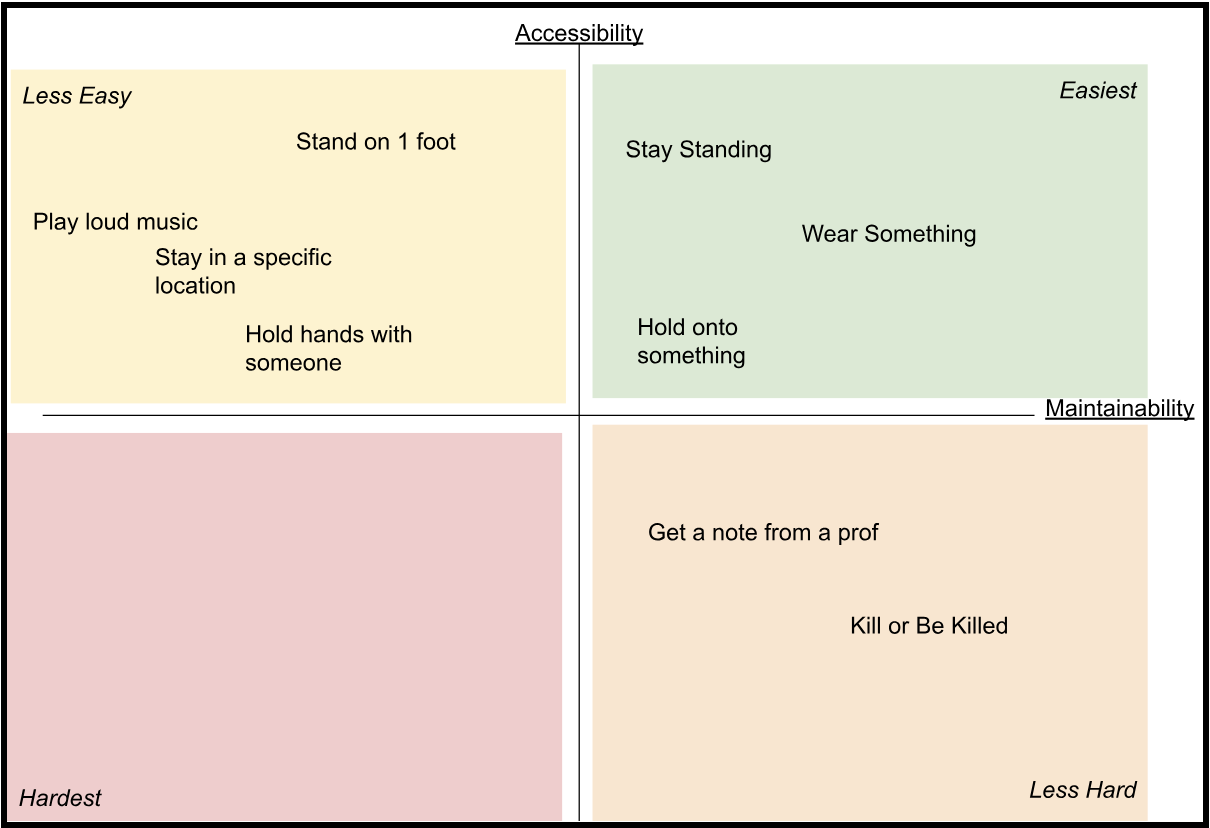
There are two axes to evaluate how a Spoon Assassins safety can be made “easy” or “hard”:

  1. Accessibility: How easy it is to quickly move from unsafe to safe.
  2. Maintainability: How easy it is to continue being safe once made safe.

I took the liberty of making an arbitrary 2×2 in order to exemplify this concept.

As time progresses, the “easiness” of the safeties should decrease accordingly. This can fluctuate of course, as creating the swings in difficulty make the game feel more intense, but the general trend should remain moving from green to red with deliberate deviation. As the game continues, however, access to information should increase. To advance the game, the most important information a player can have is how to kill their target. Evaluating how safeties provide this information can be measured across a linear scale: 

Safeties that are difficult to access or maintain are only one half of what it takes to accelerate the game. Players that know their target and are able to track them are much more lethal assassins. 

All these rules can be followed and still generate a boring game. This is where the true role of the game masters lies! It is their creative flare that fuels good stories the Olin community can share. That’s the reason why safeties are ridiculous, and it’s why they facilitate kills as opposed to letting players hide in their room all day. 

Ultimately, those unforgettable moments come down to how the player engages with the game. It’s not like the game masters can guarantee a dramatic tale, but Spoon Assassins is a great experience to be a part of because all the structures in place make this play experience like no other. I commend the game masters for their facilitation and their endless rules-clarification, and I commend you for the ways you contributed to the game, even if you weren’t playing. 

What I’m trying to say is that Spoon Assassins is a big DesNat play experience where the bio-inspiration is an Oliner that’s cooler than you.

My Adventures in Baking: Why Y’all Should Clean Up the Kitchen

I’m sure you know me as the person who keeps sending out Carpes about various things I’ve made. The west hall kitchen is my home away from home. But it isn’t just mine, it’s everyone’s in West Hall. And as such, the tragedy of the commons has befallen us.

What is the tragedy of the commons? The idea, proposed in a pamphlet in 1968, is that when people are given unfettered access to a space, they will eventually destroy it by using too much of the resources. On the other hand, the idea was used as a basis to argue that too many people will have kids and overpopulation will destroy us. Which isn’t true. 

But how can I say this hasn’t happened? When I made my first dish in West Hall, there were ants crawling over the not-so-freshly washed dishes and a spoon encrusted with… something (also ants) that I had to soak for half an hour. I went to clean up the East Hall kitchen for the scavenger hunt, and there was a bowl with a bit of dried rice and a desiccated chicken bone just sitting there. So why don’t people clean up this stuff?

I don’t agree with the idea that tragedy of the commons even applies to West Hall. The problem is that no one thinks of the kitchen as the commons. I think of the kitchen as my space, and I’m sure the cooking club does too, but what if you only go in there once in a while? Make some pasta or use the only kettle you can? You might not have the same attachment to the space. What ownership do you have over those piles of various cooking implements stacked to the ceiling? None. So you have no reason to clean up. 

But stuff piles up in the sink, and I see stuff put away with food still crusted on it. At home, I was that kind of person. It needs to look clean enough that my parents accept that I did the dishes, then I can go back to my room. But here, I’ve started to feel pride in my work. I’m not cooking for my family, I’m cooking for people that won’t lie and say my mini apple pies are great (Y’all actually will, you’re too nice. I know there wasn’t enough sugar in those pies.) I need to make sure the tools are clean enough for the next person who will stumble in with a recipe and a dream.

And now I come to the end. What’s the answer? How can we fix this? The answer is in the tragedy of the commons. At least part of the name. Commons. This is all our space. As my mother said to me when I was refusing to clean something sitting in the sink, “It may not be yours, but can you please just do it?” If you come in for a snack and a chat, wash a glass while you’re there. And if you don’t know how, well, the commons will help you out. Shoot me an email, I know how to do dishes. And I might even have cupcakes.

Follow-up: Why Olin Is Racist

Hi again, here is another article from Olin’s resident angry black lady (a title I’ve heard around campus used to describe me). For freshmen I would suggest reading my previous two Frankly Speaking articles, “Olin Is Racist” and “Follow Up On Olin Is Racist”, before this one to best understand my points and perspective. For those of you who don’t want to go read old articles, I’ll give a quick summary here:

I’m a black female student at Olin and last year I sent an article to Frankly Speaking describing all the ways I have been mistreated, discriminated against, and insulted at Olin for my race. highlighting an instance where another Oliner told me to my face that, “people like you don’t belong here,” insinuating it was about my race. It is an undeniable fact that Olin is racist and needs to be improved, but recently I was asked about my article and I started thinking about why Olin is racist. It’s a good question, and while there is no one decisive answer, I have a few reasons that contribute to racism on campus. 

  1. There are not enough black students: The other day a friend and I were wandering through the Campus Center and ended up in the 3rd floor hallway across from PGP. Shiny class portraits of past and current Olin classes hang on the wall with pride. Jokingly, we decided to look through each class picture and count up the number of black students we see. The game started out fun, like an Olin version of Where’s Waldo, but quickly got depressing when we realized how few black people there have been. Our final count was 52 students. In almost 20 years of graduating classes, only 52 black people have graduated from Olin. You might be thinking: “Olin is a small school, these numbers make sense,” but I did some research: Olin has had approximately 2000 students, so in the entire history of Olin, only 2.6% of students have been black. This is low even compared to other engineering schools. The percentage of black students in the history of MIT is 5%, and at CalTech, 7%. Around 14% of the American population is black, so a diverse school should have approximately 14% black students. Never in Olin’s history has there been a time where the percentage of black students in the student population was 14%. The percentage of black students currently at Olin is 4.5%, that is already an accomplishment for us. Many non-black Oliners will never meaningfully interact with a black Oliner, so how can they fix their internal racism without working with black engineers long-term?
  1. There are not enough black faculty: There are currently 2 black professors and 3 black associate professors at Olin. Out of 39 full time professors, only 12.8% are black. Even still, only in the past 5 years has the number of black professors at Olin dramatically increased, as originally this school was founded with no black professors involved. Non-black Oliners have less chances to interact with black engineers. Without exposure or a guiding hand, Oliners will never learn to let go of biases or hateful stereotypes. Furthermore, prospective black students don’t get to see themselves reflected or represented in the faculty, making this school unappealing to them, and contributing to reason 1. 
  1. Olin is designed to exclude black students: Olin college recruiters go to high schools that are majority white and Asian, and have historically avoided advertising at schools with majority black and brown students. Olin made a decision to not promote at those kinds of schools knowing that many prospective black engineers looking for a great college will not know about us and never apply. On top of this fact, to be admitted into Olin, prospective students are required to have taken calculus. Many schools in low-income neighborhoods that primarily serve black students don’t offer Calculus because of underfunding. When a black person goes to a mostly white high school like I did, it’s a battle for us to get into advanced math and science classes. In my senior year of high school I wanted to take AP Calculus, and requested it, but was placed in Statistics because my vice principal thought I wouldn’t be able to handle “the academic rigor of AP Calculus,” despite the fact I had a straight-A report card. I had to petition my school to put me into AP Calculus, and I ended up thriving in the class (I even got a perfect score on the AP exam, no joke). However, other black students at my school weren’t as lucky. They were also automatically placed in the lowest level classes, but most of them failed in their petition and never got to take advanced classes that could have helped their college applications. It is not a secret in the educational world that black students are systemically excluded from taking this class.  Last year, Olin ran a beta program that partnered with a math camp to sponsor incoming first-years to learn calculus before attending—but this option was not advertised anywhere online, and to access it, students had to personally reach out to admissions after acceptance and organize the lessons themselves. The fact that Olin was designed with a calculus requirement that directly disadvantages students of color demonstrates an internal attempt to keep black students from attending Olin.
  1. Black people at Olin are not respected: Every black student at Olin has been called by the wrong name repeatedly, even by the same people after correction. How would you feel if people don’t work hard enough to remember who you are? How would you feel if your own professors grouped you into a character in their head with all of the other students who share your pigmentation rather than taking the time to get to know you and differentiate you from other students who look like you? This is blatant disrespect and humiliation that black Oliners are forced to live with. People ignoring this issue spreads the internal belief that we are all the same and negligibly different from one another. But it’s more than just names. It’s hard to verbalise microaggressions and small acts of disrespect, but I have a story that I think conveys these effects. At the start of this semester my friend, another black Oliner, and I went on a grocery run together. When we were driving back to campus and turning into Lot B, a white woman stood in front of the car and asked “Are you guys lost? This is Olin College.” We told her we weren’t lost and her reply was “Well, this is student parking.” Once we corrected her and explained we were both students, she walked away with a confused look on her face. For those who can’t understand the racism in this situation, my friend and I were assumed to not be Olin students, which is an odd assumption to make about 2 college-aged students on Olin’s campus. And what’s worse was that we were at first assumed to not even have a reason to be at Olin. This woman’s first thought was that 2 black students shouldn’t be here and tried to shoo us away. We should not be harassed like this on our own campus. 

These are the simple reasons I can name without going into the larger history of deep rooted prejudice in education and eternal biases Americans are raised on. The main point is that Olin is a toxic environment towards black people, and in 25 years of operation has failed to make proper actions to address these issues. Olin needs to change, and until it does, expect more articles from Olin’s Resident Angry Black Lady. 

Olin is Not a Jewish Space

Nearly 10% of Olin’s campus is Jewish. Consistently I can find between eight and ten Jewish students in every class. Compare that to the national population of two percent, and I expected a very different campus culture when I came to Olin. I would imagine people talking about the holidays in casual conversation, or find dining hall meals dedicated to the larger festivals. This does not happen at Olin—not in the years I’ve been here, and I don’t foresee this changing any time soon. 

From a top-down perspective, Olin is too small to appeal to observant Jewish students. There’s too much work for resting on the Sabbath. The dining hall doesn’t serve kosher meals. We don’t have a Hillel chapter. In case you don’t know, that’s an affiliation with the largest international organization dedicated to providing Jewish students resources on campus, and our school is too small to receive their services. 

Because of these top down limitations, students are restrained from creating their own bottom-up solutions. The school’s structure discourages observant Jews from attending Olin. The students here who try to run events operate on severe deficits in Jewish knowledge, and there’s no time at Olin to study up on how to properly run a celebration. Student initiatives barely get off the ground and seldom reach the broader Jewish community. Thus, Jewish life remains vacant. 

When I came to Olin, I wanted to explore more what it meant to be Jewish at college. I visited Jewish organizations at other schools, each with their pros and cons. Brandeis was too far away, Wellesley felt strange being a man, and the prayers at Babson were sexist sometimes. Then I went abroad for a semester and the one service I attended there made me so upset I wrote a FS article about it (It’s one of my proudest. You should read it if you haven’t). I gave up looking after that. 

Judaism at Olin is a journey traveled alone, and the institution will not help you through it. Heed my warning: The dining hall will NOT give you the food you need for Passover. 

That’s where JOO fits in. The Jewish Organization at Olin is left in a terrible position. The resources are sparse, the leadership lacks expertise, and our most active member is a baptised Catholic (we love you Azzy). Historically, JOO buys food from local Jewish vendors a few holidays a year and hosts small celebrations. However, these events could serve a greater purpose. These food events could gather Jewish students before the holidays, and we can popularize all the inter-school activities that happen in the near future. JOO doesn’t need to be a hub of Jewish culture at Olin. It can be a vehicle to transport Olin Jews to the communities they find solace with.

Serving as a guide instead of the host enables JOO to stay lean and serve the community with greater precision. It can focus its small events toward building something greater, and it can stay true to a mission instead of what I saw as failing to live up to its name. 

Seeing so many freshmen stop by on Rosh Hashanah for apples and honey filled me with hope. This FS would have been far more pessimistic otherwise. I hope to see more people going to Babson Chabad, and I recently became friends with a few members of the Wellesley Hillel e-board, so I’ve been going to their services every Friday. Let me know if you’d like to join.