October Updates from the SERV Board

Happy October from the SERV board! First and foremost, we are thrilled to welcome our two newest SERV members: Michael Costello and Brenna Manning! Just as a reminder, though, service is for everyone. The role of the SERV board is to give you the funds and resources necessary to make service easy. If you ever have an idea for a service activity or want to volunteer, let us know!

We had an exciting month in September. This semester’s kickball tournament was one of our most successful yet, and we raised over $160 for Kick-it, an organization dedicated to children’s cancer research. The weather was great, and we had a lot of fun and friendly competition! Congratulations to the winning team, Baller Not Ready.

In September, we also cleaned up Parcel B and made blankets for Project Linus during Alumni Weekend, had Olin students and faculty walking in the Jimmy Fund Walk and running in the Charles River Center 5K. To cap it all off, we held a Thankathon with the Office of DFAR to call parents and alumni who donated to Olin in the past fiscal year. Thanks to everyone who participated and made this month’s SERV events a success!

Here are the events coming up in October that you should look out for:

10/3 – Blood Drive

Contact Michael Resnick for more information.

10/11 – International Day of the Girl Child

In order to participate in this annual event to promote gender equality, SERV had combined forces with SWE and eDisco to invite middle school girls from the community to come to Olin from 9am-12pm on Saturday October 11th to hear from women role models and learn more about engineering. We’re still looking for volunteers, so let us know if you want to help out!

We will also be making more blankets for Project Linus at Family Weekend. You should all keep an eye on your inbox mid-October for the SERV Auction kick-off. This is SERV’s biggest event of the year, and we’re really excited to get started. If you’re interested in helping out this year, email serv@olin.edu – we can use all the help we can get!

Remember, SERV is here for you, and we are always open to your exciting new ideas! E-mail us at serv@olin.edu, follow us on Twitter @olinserv, and Like us on Facebook! Have a great month and eat lots of apple cider donuts!

A Brief History of Super Smash Bros.

videogametriviaSuper Smash Brothers for Nintendo 3DS comes out this Friday (Oct 3), so what better time is there to look back at the history of the series?

For those of you unfamiliar with it, Super Smash Brothers is a series of fighting games for Nintendo systems. Unlike most traditional fighting games, which rely on a health bar, Super Smash Bros. uses only ring outs; as characters gain more damage, they fly further, until you can launch them right off the screen. Its other major distinguishing feature is that it is a crossover of Nintendo’s best known characters. Ever wondered whether Mario would win in a fight against Link? Wonder no more.

Sales-wise, Smash Bros. is a pretty big deal. The first one, for Nintendo 64, sold so well in Japan that Nintendo decided to sell it worldwide. More than 5 million copies were sold worldwide, a respectable number given that the console sold 32 million units worldwide. The sequel, Super Smash Bros. Melee for the Gamecube, improved on that number, selling 7 million units and becoming the best-selling title on the Gamecube. The Gamecube only sold 21 million units worldwide, so one in three Gamecube owners owned the game. The next game in the series, Super Smash Bros. Brawl, was on the Wii. The Wii console sold more than 100 million units overall. The larger install base would imply larger software sales, and that turned out to be true, with 12 million units sold as of March 2014.

For such a large and important series, Super Smash Bros. had a humble start. In 1999, Masahiro Sakurai, creator of Kirby, and Satoru Iwata, who is now the president of Nintendo, were working on a fighting game for the Nintendo 64. Iwata handled all the programming, while Sakurai handled everything else – planning, design, movement, etc. It was called “Dragon King: The Fighting Game.” This limited team came about because the project was not assigned by their employer. Instead, it was an idea that Sakurai had come up with and showed to Iwata, who offered to help. Iwata enjoyed it so much that he “seemed to come to life” when working on it, which he did even on weekends. The goal of the project was to create a “4-player battle royale” that would be different from the standard 2D fighters that were popular at the time. As the game developed, they realized that the faceless stand-in characters they had been using failed to set up an atmosphere, and no one would want to buy it. So they put in a request to use Nintendo’s all-stars. At the time, Nintendo was very skeptical of the idea of creating a crossover like that, so Iwata and Sakurai had to write up extensive documents supporting their proposition. Their persistence paid off, though, and the first game contained 12 characters from 10 of Nintendo’s biggest series. They had to be inventive for some of the moves characters used, though – Captain Falcon of F-Zero fame had never been seen outside of his car, for instance. Rumor has it that the famous “Falcon Punch” that resulted is actually a remnant of “Dragon King.”

The success of the first game led to more support being thrown behind its sequel. As a result of the high expectations, Sakurai worked for 13 months straight, with no holidays and few weekends. To show off the new abilities of the Gamecube, HAL, the company behind the game, worked with three different graphics companies to create the well-known opening sequence. Not long after Melee, Sakurai became disillusioned working at HAL, when he realized that people expected a sequel every time he worked on a game. As a result, he left and started his own company, Sora Ltd.

When the Wii was revealed in 2005 with the code name “Revolution,” Nintendo announced that it would have support for online play. Iwata said at a press conference that he hoped that in the future, one of the games they would release with online play would be a new Super Smash Bros. Unfortunately for him, many observers took this as an announcement that Nintendo was working on a new installment in the series. So Iwata asked Sakurai, who was looking for a project to work on next, to meet with him. While Iwata understood that Sakurai may decide not to work on the project, he felt that without Sakurai’s involvement, it would be impossible to add new elements – it would almost be a re-release of Melee. With that implicit threat and with the knowledge that a new Super Smash game would make lots of people happy, Sakurai agreed to work with Nintendo again to create Brawl. Since Nintendo had not been planning to work on the game, their internal development teams, including the one that had worked on Melee, were all busy.

As a result, they contacted another company – Game Arts – to help get the project started while they hired more staff. Partially due to this, Brawl was developed outside of Nintendo’s traditional Kyoto area, in Tokyo. Sakurai even moved, because in his words, “if you want to make a new Smash Bros., you have to be ready to put everything else on hold if you want to make it work.” While this is an unusual way to make a game, particularly for Nintendo, it worked out impressively well. Averaging professional reviews, Brawl holds an aggregate score of 93 out of 100, one of the highest on the Wii. Iwata and Sakurai attribute this to two factors: the love all the staff had of the series and Sakurai’s ability to envision what a completed game will look like from the start.

Now Sakurai once again reaches the end of a development cycle for a Super Smash Brothers game with the impending international release of Super Smash Bros. for 3DS and the release later this year of its Wii U counterpart. Until it is over and he has time to do interviews rather than work on the game, we cannot get a complete look at their development. I can tell you, however, that I’m certain that just as with earlier games in the series, the entire team worked their hardest with a commitment to delivering a fun game to us fans.

(Citations coming soon)

A Puzzle By Midnight Math

Kevin buys a bus ticket from Singapore to Malaysia, but he is unaware that his ticket has an assigned seat. Upon boarding the bus, he sits in a random empty seat. Passengers continue to board and sit in their assigned seats until a passenger sees Kevin in their seat. The passenger, not wanting to be rude and displace Kevin, assumes they have made a mistake and sits in a random empty seat. The next passenger whose seat was taken also sits in a random seat, and so on until the last passenger sits in the last seat left. Given that the order of passengers entering (including Kevin) is random, and that each passenger (who isn’t Kevin) will sit in their assigned seat unless it’s taken, and that Kevin is not the last passenger, what is the probability that the last passenger in line will sit in their assigned seat?

Send in your solutions (with proofs) to midnight.math@outlook.com. If you are correct, you will be given the highest of accolades: your name mentioned here, next issue.

Awesome Honor Board MadLibs

Cases before the Honor Board are wide and varied. Topics range from personal differences and academic dishonesty to misuse of public materials. Above all, the Honor Board is a means for Olin Community members to work out their differences safely and confidentially.

Find a friend and fill out the MadLibs in the paragraphs below to learn about a past case.

______ (name 1) submitted an Honor Board report regarding three of his/her roommates’ messiness in the suite lounge. Problems included old ______ (noun) left in the refrigerator and ______ (object 1) left out in the suite lounge for several ______ (duration of time). At one point, a ______ (noun) was left out for several ______ (duration of time). The ______ (same noun) melted and started running onto the ______ (location) and ______ (common Oliner possession) in the lounge. Another incident happened before break when ______ (name 1) found perishable ______ (plural noun) that were not his, such as ______ (noun) and ______ (different noun), left in the refrigerator. Everyone else left for break, and the mess was left for ______ (name 1) to ______ (transitive verb).

______ (name 1) decided to submit a report after his/her roommates repeatedly ignored his/her ______ (plural noun, exclamation or sound) to clean up the lounge. The case came to the Honor Board after ______ (name 1) ______ (past verb) rooms. The roommates’ actions were cited as ______ (present verb) of the Respect for Others clause of the Honor Code. In a hearing, the roommates agreed with the facts ______ (name 1) presented including the ______ (object 1) and refrigerator incident. They never fully realized how much it made ______ (name 1) feel ______ (emotion). They also admitted that their actions did not respect ______ (name 1) and have since tried to remain neater.

______ (name 1) was not seeking a sanction so much as a ______ (noun) for future situations, and the accused also ______ (past verb) that ways of handling similar situations should be devised. In particular, ______ (name 1) was interested in building a list of associated ______ (plural noun) for room damages, which he felt would be ______ (adjective) for him and other students. The accused agreed that this would be ______ (same adjective) and worked with ______ (name 1) and facilities to develop a reimbursement sheet for students.

This MadLib was loosely based on an Honor Board case from Spring 2008 about suite cleanliness. You can read the entire abstract in the Honor Drive (\\fsvs01\StudentGroups\HonorBoard\Abstracts).

Sexual Assault at Olin

At the end of last academic year, I surveyed all Olin students and alumni about their experiences with sexual assault. After two different students shared their experiences in Frankly Speaking [1], I wanted to learn more about how Olin students experience and relate to sexual assault and begin taking proactive steps to address the problem.

The Olin community perceives the “bubble” as a safe place, where students can leave laptops in the lounge or a $20 bill on someone’s whiteboard, because we look out for one another. For the most part, I’ve found this to be true. The numbers also support this notion; Olin’s published crime statistics consistently show that we have no campus crime, including sexual assault [2].

My three years at Olin have revealed to me that these numbers don’t tell the whole story. Sexual assault is a problem on every college campus, and unfortunately Olin is no exception. Like on many other campuses, many survivors of assault at Olin never report their experience, and those who do often choose quieter routes such as the Honor Board or OSL (which can provide no-contact orders). Because the student body as a whole doesn’t hear about cases of assault, there isn’t an overwhelming sense that’s it’s an important issue on our campus.

I want to change that.

The response rate for the survey was incredible: 233 current students (out of ~350) and 249 alumni (out of 585) completed the survey, for a total of 482 responses. Some responses are grouped by gender: cisgender women, cisgender men, non-cisgender people, and people who did not specify a gender. (Cisgender refers to people whose identity matches with the gender assigned to them based on their biological sex.) Non-cisgender peoples’ responses are shown together because of the range of gender identities provided and my desire to protect the privacy of the small number of non-cisgender people who responded to the survey.
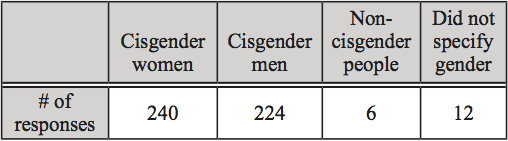
survey participants

The responses to the survey mostly echoed published sexual assault statistics from other colleges and universities [3]. The main discrepancy is that non-cisgender people elsewhere generally experience higher rates of sexual assault than cisgender people, which was not reflected in the small number of responses from non-cisgender people to this survey.

In the survey, people were asked a series of questions about their experiences with sexual assault. You can revisit the survey at http://goo.gl/6l69ik. As a reminder, I provided a definition of sexual assault in the survey: “Sexual assault is defined as sexual activity without explicit consent. This can include, but is not limited to, penetration, kissing, and groping (including through clothing). Assault can occur with or without the use of physical force on the part of the assailant. It can also involve emotional coercion. It sometimes, but does not always, involve alcohol or other drugs. Fight, flight, and freezing are all common responses to sexual assault, and none of these responses invalidate a person’s experience or change the definition of assault. Many sexual assaults are perpetrated by someone the survivor knows, including friends, acquaintances, relatives, and current/former partners. Sexual assault can begin with consensual sexual activity – prior consent does not imply current consent. People of any gender identity, race, sexual orientation, age, etc. can be assaulted.”

Quantitative results are summarized below.

Survey question: Do you feel that you have ever been sexually assaulted?
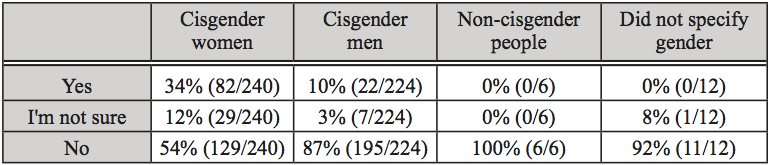
Do you feel that you have ever been sexually assaulted?

Survey question: Do you feel that you have been/were sexually assaulted during your time at Olin?
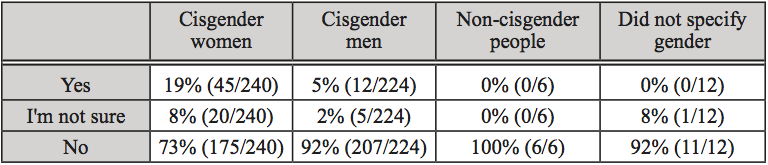
Do you feel that you have been/were sexually assaulted during your time at Olin?

Survey question: If you feel that you have been/were sexually assaulted during your time at Olin, how would you identify the perpetrator(s)?
Of the 83 people who responded “yes” or “I’m not sure” to having been assaulted at Olin, 81 categorized their perpetrator(s). Most perpetrators were other Olin students (often partners or friends), although a large number were people external to the community (often coworkers and non-Olin students at parties).

How would you identify the perpetrator(s)?

As with all collection of data and information, there are some factors that are potentially skewing these survey results: the response rate was < 100%; and current students from all years responded, so some students who answered “no” to having been assaulted at Olin may still experience sexual assault before graduation.

From these responses, however, it is clear that sexual assault is a problem at Olin. So what can we do about it?

To start, I would like to introduce a new campus group, Empower, which will promote healthy, consensual, and positive relationships, whether romantic, purely sexual, or anything in between. Our first event will be an open discussion about addressing sexual assault at Olin. All students are invited to join at 6 p.m. on Sunday, Sept. 14th in the crescent room (upstairs in the DH – feel free to bring your dinner.) My highest priority for this meeting is that it be an open, constructive, and safe discussion. We do have a strong, tight-knit community here at Olin, and I would like to use that to our advantage to address this issue that exists here, like it does everywhere. Alumni and faculty/staff members can send me their thoughts and I will bring them up during the discussion. If you would like to be further involved in the group, shoot me an email. (We are in the process of implementing an anonymous mailing list for students, empower@lists.olin.edu.)

I am also doing my AHS Capstone project on addressing these issues at Olin. If you have experienced assault (at Olin or otherwise) and are willing to be interviewed later in fall semester when I have a clearer plan, please let me know. I anticipate discussing topics such as the decision to report, support you did/did not receive, your healing process, and anything else you find relevant. You can email me at kate@students.olin.edu to set up an interview or ask any questions you have. The interviews will not be formal “research,” just a way of getting additional perspectives to inform my work on behalf of the Olin community.

Sexual assault has no place at Olin. I look forward to working with the entire community to reduce assault, support survivors, and create an open dialogue around these difficult issues on our campus.

[1] It Happens Here, and It (Still) Happens Here. https://franklyspeakingnews.com/
[2] 2012 Security & Fire Report. Rep. Olin College of Engineering, n.d. Web. <http://www.olin.edu/sites/default/files/olin_college_campus_safety_security_brochure_2012.pdf>.
[3] Sexual Violence Statistics. Rep. BARCC, n.d. Web. <http://barcc.org/assets/img/Statistics_Download_-_All.pdf>.

Kicking Off the New Year with SERV!

Welcome back to Olin! We hope your summers were wonderful, and we’re really excited as a board to share with you all the new, exciting service-oriented activities we’re planning for the new semester. We have elections, we have events, and we have resources for all your volunteering needs! Read on to find out more.

Here’s what’s on the horizon for our first month of school:

9/19 – Kickball Tournament! Our semi-annual kickball tournament for Kick-It, an organization working towards a cure for children’s cancer, will be happening on Friday, September 19. Grab your friends and form a team! Registration is $20 per team, and there should be 8-10 people per team. We are also looking for referees, so let us know if you want to volunteer.

9/20 – Alumni Weekend SERV. On Saturday of the reunion weekend, we will be hosting a Parcel B clean up from 11:30am- 1:00pm and making blankets for Project Linus, an organization that donates blankets to children in need, during the picnic from 1:00pm-4:00pm. Stop by for a while and hang out with alumni while you walk through Parcel B or make a fuzzy blanket!

9/21 – Jimmy Fund Walk. Every year, Team Olin walks in memory of our former VP of Academic Affairs Mike Moody. Join the team or donate to help our team reach their goal of $10,000!

9/28 – Charles River Center 5K! This year, SERV is sponsoring the Charles River Center Road Race, a 5K to raise money for an organization that has been providing aid for adults and children with disabilities and autism for 58 years. Join the Olin College team and run with us in Needham/ Wellesley on Sunday at 11am! SERV will reimburse each student $5 for the registration fee. They are also looking for non-runners to volunteer at the race, so let us know if you are interested.

This year, the SERV board will be holding weekly lunch meetings from 12:30-1:30 in the Crescent Room on Fridays, so feel free to stop by and say hello and find out what we are planning. We are also going to be tabling during lunch again, so stop by on your way through the dining hall to say hi and see what we’re up to!

As always, SERV is here for you, and we are always open to your exciting new ideas! E-mail us at serv@olin.edu, join the CarpeSERV mailing list for updates about spontaneous community service opportunities, and follow us on Twitter @olinserv to get the latest update on upcoming events. Oh, and we have a Facebook page now, so Like us there, too! Have a great month, and welcome to all of our first years!

Election News!

Every fall, we elect two more general members to join our SERV board. Of the two positions available, at least one has to be filled by a first year student, but everyone is welcome to run. Applications are due on Friday, 9/12 and we will be hosting a school meeting and inviting people to vote on Monday, September 15 and Tuesday, September 16 respectively. If you would like more information on how to get involved, please don’t hesitate to reach out to Ari at ari@students.olin.edu or Julianne at julianne. jorgensen@students.olin. edu. We’d love to chat with you and answer any questions you may have, and we’ll be sending more details about the election process soon as well. We can’t wait to finish filling our SERV board for the year! :)

Rethink Education @ Olin College

Oliners do big things. We drive startups, make humanoid robots, question everything. If you were around last semester, you may have heard whispers of a multi-school hackathon being hosted at Olin – a pretty big event.

True and false.

The Foundry, Olin’s entrepreneurship group, is hosting Rethink Education, a weekend workshop that will give local undergraduates the opportunity to think critically about revamping the K-12 education space through user-oriented design. On March 28-29, mentors, educators, K-12 students, and undergrads will populate Olin for the weekend.

It is our hope that the design thinking we introduce to attendees will become another tool they can utilize to tackle challenges in a meaningful, productive manner. Collaboration with like-minded students hailing from various schools and backgrounds will only fuel the fire. The odds are against attendees coming up with a revolutionary idea within two days, but we hope they will leave Rethink inspired to continue addressing the problems that they see.

What exactly is going to happen? Unlike a hackathon, Rethink will not be a sleepless event; exhaustion, which can work wonders for code, is detrimental to good design. But there are similarities. In teams of 4, attendees will mingle with stakeholders, identify a pain point, and develop an idea to address said challenge. The entire event will take shape over the course of twenty hours. The core ideas behind user-oriented design will be delivered in three phases (Empathize, Conceptualize, Develop) that will give the event structure.

In the true spirit of Olin, we’re approaching Rethink in the same fashion that we do our projects: iteratively. On Saturday September 13 from 10-5, we will be hosting a 10-15-person, small-scale, Oliner-only version of Rethink. This is your chance to take a step back to contextualize our education and work with people from other years on a topic that affects everyone (backgrounds play a huge role on how you learn and your approach to Olin) – which will in turn give us valuable feedback. As stated in a Carpe, sign up here http://goo.gl/2OEhPn by Tuesday night!

Some Questions You May Have:

Q: Why is the Foundry hosting a design-focused weekend?
A: To the casual observer, the link between design and entrepreneurship is tenuous at best. But design, as nebulous and indefinable a word as it may be, is important to identifying change that needs to be made. Yet design cannot exist in a vacuum. Entrepreneurship makes such change possible. Great design and great entrepreneurship make change longlasting.

Q: Why the focus on education?
A: Olin was founded as an experiment in breaking engineering education traditions. It only seems fitting that the theme of Olin’s first-ever design workshop be along those same lines.

Q: Stakeholders?
A: Yes! During the Empathize phase, K-12 students, parents, and educators will be present to mingle with attendees.

Q: Why should I attend?
A: In typical Olin fashion, this is an opportunity to facilitate change for a high-impact cause – age, major, etc. are never a barrier to entry. Unlike most Olin projects, there is zero-risk and zero cost associated. Think blue sky!

Nintendo’s Presidency Past and Future

videogametriviaWhether summarizing the company’s financial situation and recent releases to investors, delivering news about new games “directly” to fans, or punching his American subordinate[1], Nintendo’s president, Satoru Iwata, has become the face of many of their news releases. So who is this man, and how did he rise to the position he is in today? And is he suited to remain in his position in this time of flux in the gaming market?

As perhaps may be appropriate for a gaming company, Iwata started as a game programmer. He majored in Computer Science in college, and as soon as he graduated in 1982 he joined HAL Laboratories, which was so named because they wanted to be “one step ahead of IBM.” HAL is a subsidiary of Nintendo that is best known today for making Kirby games. There Iwata worked on a wide variety of games including Earthbound[2] and Balloon Fight[3]. A combination of his programming and people-management skills allowed Earthbound to go from entirely non-functional to complete in only one year,[4] and his advice to use floating-point numbers rather than integers helped make the underwater stages in Super Mario Brothers play smoothly. His programming skills, intuition about game design and leadership ability enabled him to move up through the ranks, and in 1993 he was promoted to president of HAL. Unfortunately, by the time he became president the company had almost gone out of business. He turned the company around, and today HAL is a respected Nintendo studio.

While he was rising through the ranks of HAL, Iwata was made a board member of Creatures, another Nintendo-affiliated game development studio. He had experience working with Creatures, since it was involved with Earthbound. Its best known project, however, is Pokémon. As a board member of Creatures, he ended up being involved with editing Pokémon Red and Blue in order to allow for the different English script, the development of Pokémon Stadium, and the development of Pokémon Gold and Silver. His assistance helped make up for the fact that Game Freak, the primary developer of Pokémon, was chronically understaffed at the time.[5] In part due to successes such as these, in 2000 he was moved from HAL Laboratories to Nintendo itself as head of the Corporate Planning Division. There he helped set up The Pokémon Company to help deal with Pokémon licensing. His projects helped increase Nintendo’s profits 41% between 2000 and 2001, and led the then-president of Nintendo, Hiroshi Yamauchi, to select Iwata as his successor.[6] In doing so, Nintendo moved away from being the Yamauchi family company, as Iwata is the first president of Nintendo to not be part of that family.

Iwata’s time at the top has been turbulent. Only a few years after his promotion, Nintendo reached new heights with the Wii and the DS. The Wii outsold even the Nintendo Entertainment System, which had far less competition. However, this peak was followed by a precipitous fall, with Nintendo posting an annual loss for the first time ever in 2012,[7] an event from which the company has still not recovered. This has led some people to believe that Iwata is no longer suitable to be Nintendo’s president. For instance, many observers, including some of Nintendo’s investors, are of the opinion that Nintendo should start making games for other platforms, such as smart phones. Nintendo has strongly resisted doing so, and rumor has it that Iwata’s personal objections, not a company-wide consensus, are the reason for the resistance. Another reason some people have called for him to resign is a perception that he may be overstretching himself. In 2013, he took on the position of CEO of Nintendo of America in addition to his duties as president of Nintendo’s main Japanese branch. This year, he missed the Electronic Entertainment Expo, the largest video game trade show, as well as Nintendo’s annual meeting of shareholders due to a “growth in [his] bile duct”[8]. Some worry that this health problem was caused in part by him working so hard for the company. Nintendo’s recent woes, his perceived conservative outlook on mobile and PC gaming, and his health problems have all led to a class of people saying it is time for Iwata to move on to another role.

On the other hand, one of the strongest arguments Iwata supporters have is his overall humility and devotion to gaming rather than profit. After a poor 3DS launch in 2011 and a drop in profits in 2014, Iwata took a 50% pay cut,[9] despite the fact that his base salary was a relatively modest $770,000, as opposed to, say, the president of Square Enix, whose base salary was closer to $1.54 million.[10] Unlike most cost-cutters, though, he focuses on quality rather than quick iteration. When the development of The Legend of Zelda: Twilight Princess was in trouble as its release date approached, he offered the team a one-year extension. This is in stark contrast to the previous console Zelda title, Wind Waker, which was developed mostly under his predecessor. The game was released in a noticeably unfinished state – data left over on the disk indicates that as many as three more dungeons were planned, which would have almost doubled the main part of the game. Even when no money is at stake, he focuses on fun rather than convenience. He ended up doing squats in front of the entire development team of WarioWare: Smooth Moves when they showed their demo to him, despite the fact that he could have moved just the Wii Remote rather than his whole body.[11] Similarly, when shown a Gameboy Advance game that could be controlled by rotating the system, he proceeded to put the game on a spinning office chair just to see what would happen.[12] He also tries to keep an eye on how game development is happening personally, through having lunch with Nintendo’s senior developers once a week.[13] Clearly, with Iwata at the helm, Nintendo will always focus on delivering a quality, fun experience, even if it comes at the cost of lowering profits.

The arguments for and against keeping Iwata as president in many ways mirror the possible paths Nintendo could follow as it moves into the future. On one hand, it could follow the rest of the gaming industry. Like its rivals Sony and Microsoft, it could make a powerful system to lure third parties to make high cost, graphically advanced titles, and it could follow the lead of Square Enix and Sega and sell titles on smart phones and the like to cushion the blows when a big game does not do well. This risks being outcompeted or being forced into spending everything on a big gamble. On the other hand, Nintendo could continue doing what it did successfully with the Wii (and not successfully so far with the Wii U) – make its own unique games, mostly ignore what other companies are doing, and keep its venerable back catalog locked to Nintendo systems to convince uncertain gamers to buy Nintendo systems. This risks Nintendo becoming completely irrelevant to the gaming industry as a whole, locked into a tiny niche of nostalgia that cannot last indefinitely.

[1] E3 2014 Nintendo Digital Event
[2] http://iwataasks.nintendo.com/interviews/#/wii/special_edition_interview/0/0
[3] http://iwataasks.nintendo.com/interviews/#/wii/nsmb/1/0
[4] http://kamedani.tumblr.com/post/45700864819/mother-2-re-release-discussion-part-1
[5] http://iwataasks.nintendo.com/interviews/#/ds/pokemon/0/2
[6] http://www.ign.com/articles/2004/07/16/profile-satoru-iwata
[7] http://www.dailytech.com/Nintendo+Revenue+Plummets+Posts+Annual+Loss+for+the+First+Time/article24556.htm
[8] http://www.nintendo.co.jp/ir/en/stock/meeting/140627/index.html
[9] http://nintendoeverything.com/satoru-iwata-will-take-a-50-pay-cut/
[10] http://gamepolitics.com/2010/06/29/satoru-iwata039s-modest-salary#.U_LPcTB1yM8
[11] http://iwataasks.nintendo.com/interviews/#/wii/warioware_smooth_moves/0/1
[12] http://iwataasks.nintendo.com/interviews/#/wii/warioware_smooth_moves/0/0
[13] http://iwataasks.nintendo.com/interviews/#/wii/zelda-skyward-sword/7/1