TW: sexual assault and sexual misconduct
The Peer Advocates for Sexual Respect (PAs) recently sent out a survey for sexual assault (SA) awareness, similar to the one first sent by the founder of the PAs in 2014. In this frankly speaking article, we aim to publish similar aggregate findings on the perceptions of SA and sexual misconduct from the Olin community.
We sent the survey through an All Students, All Staff, and All Faculty email three times, to reach as wide an audience as possible. Out of 85 total respondents, 81 identified as ‘Current Olin Students’ and 4 identified as ‘Current Staff/Faculty’.
One of our findings was that 12% respondents identified being assaulted by someone who was an Olin student at the time of their assault. Despite the bias from individuals who have experienced sexual assault being more likely to respond, in a school as small as Olin, this suggests SA impacts a non-trivial number of community members.
Another important finding is that many responders have reported that rapid role changes have caused cases to fall through and made navigating support harder, as they had to restart requests for support which was emotionally draining.
Question: How problematic is SA or sexual misconduct at Olin?
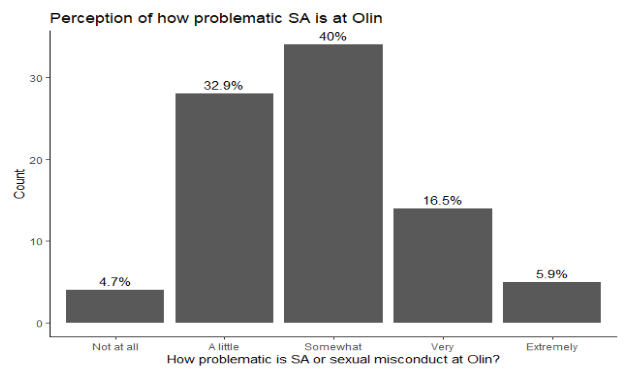
Based on this distribution, we find that a total of 95.3% of responders believe that SA is problematic on campus at some level.
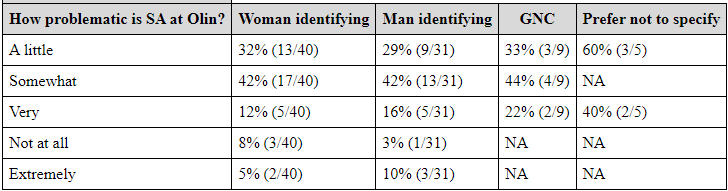
The following table shows the percentage by gender category. This is modeled after the PA founder’s original data collection.
Question: How likely do you think it is that you will experience SA or sexual misconduct on campus?
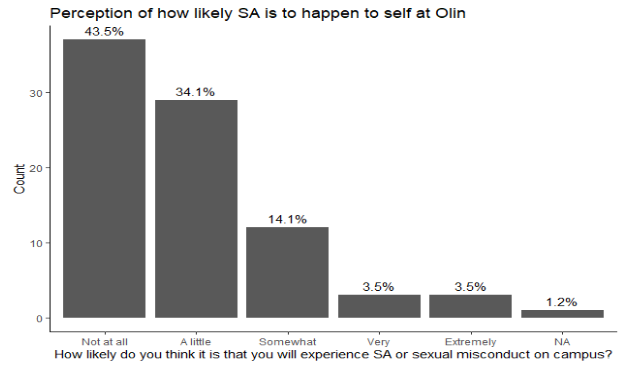
Based on this distribution, we find that a total of 55% of responders believe SA to be likely to happen to them on campus at some level.
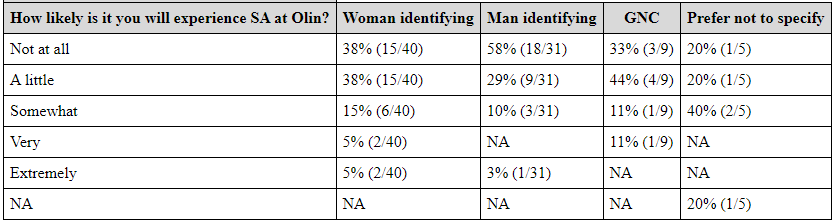
The table below shows the percentage by gender category for the previous distribution:
Question: Do you feel that you have ever been SA’ed?
The table below shows the percentage by gender category for the previous distribution:
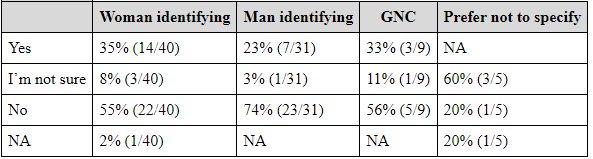
This shows that 30% (24/80) responded ‘Yes’ to having experienced SA either during or before coming to Olin campus. As with all collection of data, there are some factors that are potentially skewing these survey results, namely sampling bias.
However, it is relevant to acknowledge the fact that SA occurs on Olin’s campus and equally important to acknowledge that members of our community enter Olin’s campus with negative experiences from various backgrounds. Recognising this means being aware that we never know what someone else is dealing with and what comments may cause distress. If you have experienced anything off campus, no matter how long ago, the same resources are still available to you and if you need any support please reach out to one of the listed resources at the end.
Question: Do you feel that you have been/were SA’ed during your time at Olin?
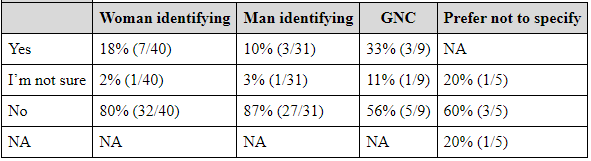
This shows that 16.25% (13/80) responded ‘Yes’ to having experienced SA during their time at Olin.
Question: If you feel that you have been/were SA’ed during your time at Olin, how would you identify the perpetrator(s)?
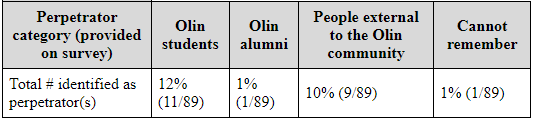
The main themes we noticed among responses was that the perpetrator identified was often a friend or someone the responder knew well and trusted. Unfortunately this is the most common form of SA. According to RAINN, the nation’s largest anti-sexual violence organization, 60% of SA’s are committed by someone known to the victim. SA committed by known acquaintances, friends, or even partners makes defining SA more confusing and difficult. This often means individuals do not name their experience as SA until much later and these experiences also go under reported as we noticed from responses in the survey.
Question: Is there anything else that you would like to share about your assault(s) that may be shared with the community?
Olin is known for being a community that watches out for one another. However, themes among responders point to the use of drugs and alcohol making consent unclear. In addition, the culture of amnesty at this institution feels at risk, which could “lead to more underground and unsafe parties” according to one responder.
Another responder notes:
“I still don’t really know if it counts as assault because I didn’t really care at the time [and I had a lot of alcohol]. I really didn’t want this person to kiss me and they knew that, they just waited until they had the opportunity.”
Consent is an ongoing conversation. It must be asked for continually even if it has been given before and it may be withdrawn at any time, even in the middle of an activity. It must be given enthusiastically and without coercion or under the influence of drugs or alcohol.
A theme identified from respondents to this question is that the small nature of Olin’s community causes frustration when people continue to hang out with those that make them uncomfortable and that there is a continued sense of pressure to do so. Another identified concern is that Title IX cases have been dismissed quickly and that there is a feeling of the perpetrator being believed over the victim.
Question: Did you ever feel there were logistical barriers that made getting support difficult?
This question brought in responses about the transfer of leadership in StAR and how difficult that has made it to know who to reach out to. Responders have reported that cases have fallen through, requiring them to restart the taxing and emotional process.
“I did the report but it fell through and I don’t have the courage to make another since it took so much out of me.”
A part of the issue is that the main Title IX coordinator is currently both interim and part-time. Because of this, students have not had reliable continued support as the resource may go away at any point and the process restarted.
Questions:
How knowledgeable are you about where to get help at Olin if you or a friend experienced sexual assault or sexual misconduct?
and
How knowledgeable are you about where to make a report of sexual assault or sexual misconduct at Olin
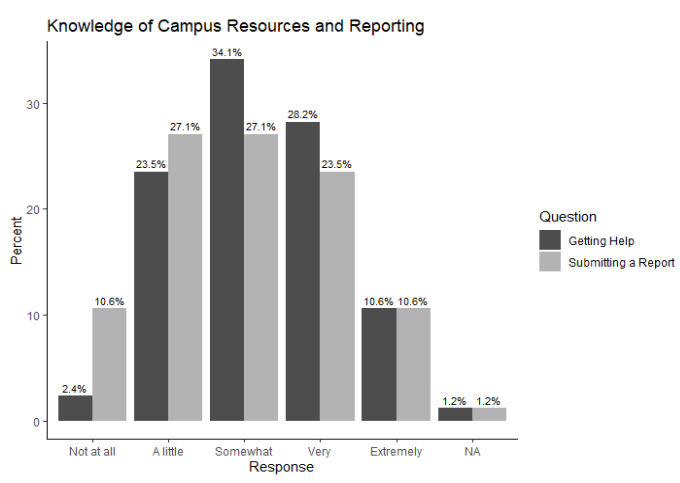
The normal distribution indicates that the general community at Olin is somewhat familiar on how to report sexual assault and misconduct at Olin. The relative scale of what someone may conceive as knowing a little versus a lot causes a lot of ambiguity in this data. To support those who wish to submit a report, and those hoping to support others, here is more information of resources on campus:
From Erin and Guilene:
“Olin’s Title IX resources are Erin Clark (she/her), Interim Title IX Coordinator and Guilene Prepetit (she/her), Deputy Title IX Coordinator. We respond to concerns of sexual harassment and other sexual misconduct by working with impacted parties to navigate resources and learn about their options, including how to file a formal complaint for investigation. Erin is available to set up a time to meet virtually during business hours, or in person as needed, and Guilene available Monday through Friday 9 to 5 and is typically on campus Tuesday, Thursday, and Friday in MH320. Someone may reach out to us to ask questions about Olin’s policies and resources, learn about how to file a formal complaint, coordinate with law enforcement, bring to our attention a concern of sexual harassment or misconduct, or seek supportive measures, such as academic flexibility, no contact orders, or educational conversations.”
From Jeanne:
“Jeanne Haley is the Director of Counseling on campus. She is here Monday through Friday from 8:30 to 5 in Room CC 332. I can be reached by email.”
Additionally, there is a new page on My.Olin being created under Student Life → Student Resources which lists out members of student facing staff and their roles on campus, which will hopefully continue to be updated as our college evolves.
If you are not wanting to reach out to someone on campus for any reason, please know that there are resources off campus:
- BARCC: The Boston Area Rape Crisis center offers free, confidential services to empower and heal all survivors of sexual violence ages 12 and older, and their loved ones, regardless of when the violence occurred. 800-841-8371
- REACH: Provides support, shelter, and education for individuals, families, and communities to overcome domestic violence. 800-899-4000
Final Thoughts
The need for this article was born out of It Happens Here, which is a community event to talk about sexual assault and misconduct at Olin. While these topics are not easy to discuss, ignoring this part of our community is not an acceptable way to treat survivors at Olin. We have tried community sit down conversations and that is frankly not enough.
Instead, there has to be a path forward and it starts with some concrete steps for Title IX and the role of the PAs by:
- Hosting more community wide trainings
- Holding community discussions about Title IX issues like the kind in It Happens Here
- Hiring a full-time Title IX coordinator, potentially with overlap at Babson or Wellesley as this survey has indicated an overlap in cases
We, the PAs, are here to try and create a safer place for students on campus. However, a part of creating a safe space is speaking up about issues and supporting those whose voices are currently not being heard.
